
Concrete RH Meter Rentals: How to Test Slab Moisture Accurately (ASTM F2170 Explained)

The flooring looked perfect on day one. Three weeks later, bubbles formed, adhesive failed, and the entire project had to be torn out. The cause wasn’t poor installation, it was hidden moisture trapped inside the concrete slab.
This scenario plays out every day on job sites around the world, which is why professionals rely on ASTM F2170 in-situ relative humidity testing before installing any flooring system. In Concrete RH Meter Rentals: How to Test Slab Moisture Accurately (ASTM F2170 Explained), you’ll learn how to test concrete moisture the right way, why RH meter rentals are often the smartest option, and how to protect your project from costly moisture-related failures no matter where you work.
Quick Answer
The most accurate way to test concrete slab moisture is by using an ASTM F2170 in-situ relative humidity (RH) meter. This method measures internal moisture at 40% slab depth, providing reliable data for flooring decisions. Renting a calibrated concrete RH meter ensures compliance, accuracy, and cost efficiency for both professionals and DIY users.
Key Takeaways:
-
ASTM F2170 in-situ RH testing is the most accurate and globally accepted method for measuring internal concrete slab moisture and preventing flooring failures.
-
Concrete RH meter rentals provide professional-grade accuracy without high upfront costs, making them ideal for contractors, inspectors, and one-time or short-term projects.
-
Surface moisture tests are unreliable because concrete dries from the top down, only RH probes measure the moisture that actually affects flooring performance.
-
Correct testing requires drilling to 40% slab depth, proper equilibration time, and calibrated sensors, all of which are essential for valid ASTM-compliant results.
-
Accurate moisture testing protects flooring warranties, reduces costly rework, and ensures long-term installation success across residential, commercial, and industrial projects.
What Is Concrete Moisture Testing and Why It Matters
Concrete holds moisture long after it looks dry on the surface. If flooring is installed before moisture levels stabilize, the result is often:
-
Flooring adhesive failure
-
Warping, bubbling, or delamination
-
Mold and indoor air quality issues
-
Warranty voids and project delays
Why Surface Tests Are No Longer Enough
Older methods like calcium chloride (ASTM F1869) only measure surface emission, not internal moisture. Concrete dries from the top down, making surface tests misleading.
ASTM F2170 measures internal slab moisture, which directly affects flooring performance.
What Is ASTM F2170? (Explained Simply)
ASTM F2170 is the official international standard for measuring concrete slab moisture using in-situ relative humidity probes.
How ASTM F2170 Works
-
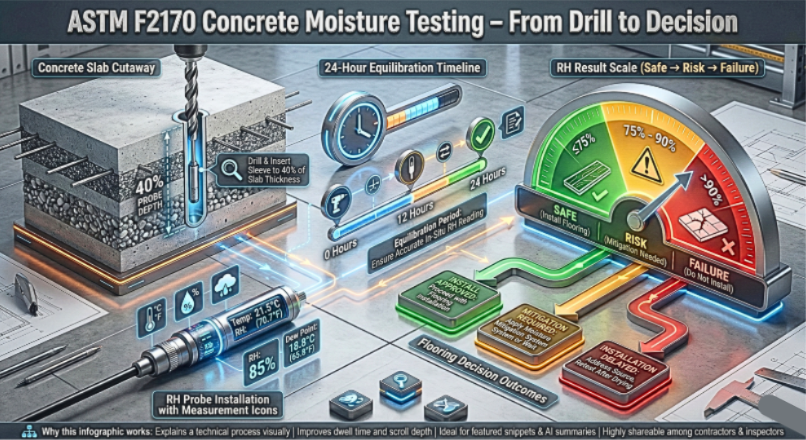
Drill holes to 40% depth of the slab (20% if drying from two sides)
-
Insert RH probes into the concrete
-
Allow equilibration (typically 24 hours)
-
Measure internal relative humidity
Why ASTM F2170 Is Trusted Globally
-
Adopted by flooring manufacturers worldwide
-
Required for warranty compliance
-
Proven to predict long-term moisture behavior
Why Rent a Concrete RH Meter Instead of Buying?
For many contractors, inspectors, and facility managers, RH meter rentals provide maximum accuracy with minimal upfront cost.
Benefits of Concrete RH Meter Rentals
-
✔ No large capital investment
-
✔ Always calibrated to ASTM standards
-
✔ Ideal for short-term or one-off projects
-
✔ Access to professional-grade equipment
Who Should Rent RH Meters?
-
Flooring installers
-
Commercial contractors
-
Home inspectors
-
Property managers
-
DIY builders needing ASTM compliance
How to Test Concrete Slab Moisture Accurately (Step-by-Step)
Step 1: Determine Slab Thickness
Use construction drawings or core sampling to identify slab depth.
Step 2: Drill Test Holes
-
Drill to 40% depth for slabs drying from one side
-
Clean holes thoroughly (vacuum + brush)
Step 3: Insert RH Probes
Install probes tightly to ensure accurate readings.
Step 4: Allow Equilibration
Wait at least 24 hours per ASTM F2170 before recording results.
Step 5: Record and Interpret Results
Most flooring systems require ≤75%–85% RH, depending on manufacturer specs.
Common Mistakes That Lead to False Readings
❌ Rushing equilibration time
❌ Using uncalibrated sensors
❌ Testing only one location
❌ Ignoring ambient temperature & humidity
Professional RH meter rentals eliminate most of these errors because sensors arrive factory-calibrated and ASTM-ready.
ASTM F2170 RH Levels by Flooring Type
| Flooring Type | Max RH Allowed |
|---|---|
| Vinyl / LVT | 75–85% RH |
| Hardwood | ≤75% RH |
| Epoxy Coatings | Up to 85–90% RH |
| Carpet Tile | 80–85% RH |
Always verify manufacturer requirements before installation
When Is the Best Time to Perform RH Testing?
-
After concrete curing is complete
-
When the building is enclosed
-
HVAC running at normal service conditions
-
Before applying moisture mitigation systems
Testing too early often leads to incorrect green lights.
Renting vs Buying: Quick Comparison
Rent an RH Meter If:
-
You test slabs occasionally
-
You want zero calibration responsibility
-
You need fast, compliant results
Buy an RH Meter If:
-
You test concrete weekly
-
You manage multiple job sites
-
You want long-term ROI
Concrete RH meter rentals give you:
-
ASTM-compliant accuracy
-
Professional-grade data
-
Peace of mind before flooring installation
If you’re serious about doing it right the first time, ASTM F2170 testing isn’t optional, it’s essential.
Find Concrete RH Meters for rent — visit Tendsupplies.com
Frequently Asked Questions (FAQs)
1. What is the most accurate way to test concrete slab moisture?
The most accurate method is ASTM F2170 in-situ relative humidity (RH) testing, which measures internal moisture at 40% slab depth. This method reliably predicts long-term moisture conditions that affect flooring performance and is required by most flooring manufacturers worldwide.
2. Why is ASTM F2170 better than calcium chloride or surface tests?
ASTM F2170 is superior because it measures moisture inside the concrete, not just surface evaporation. Surface tests like calcium chloride (ASTM F1869) can produce misleading results since concrete dries from the top down, masking internal moisture that causes flooring failures.
3. How long does ASTM F2170 concrete moisture testing take?
The drilling and probe installation take only minutes, but ASTM F2170 requires a minimum 24-hour equilibration period before readings are valid. This ensures accurate and repeatable moisture measurements.
4. What RH level is acceptable for flooring installation?
Acceptable RH levels depend on the flooring type and manufacturer, but most installations require 75%–85% RH or lower. Always verify product specifications, as exceeding these limits can void warranties and cause long-term damage.
5. Is renting a concrete RH meter as accurate as buying one?
Yes. Professional RH meter rentals are equally accurate because rental units are typically factory-calibrated and ASTM-compliant. Renting is often the best option for short-term projects, inspections, or occasional testing.
6. Who should use concrete RH meter rentals?
Concrete RH meter rentals are ideal for flooring contractors, general contractors, home inspectors, facility managers, and informed DIY users who need accurate, compliant moisture testing without investing in permanent equipment.
Related Articles:
- Stop Guessing, Start Proving: Why IAQ Monitoring is the Future of Restoration Jobs
- Mobile EV Charger Rentals: The Fastest Way to Power EV Fleets & Roadside Assistance
- How to Use a Thermal Imaging Camera for Water Damage & Electrical Inspections (Rental Guide)
- Commercial Dehumidifier Rentals: How to Size, Select & Deploy for Flood Restoration
- HEPA Air Scrubber Rentals vs. Buying: Which Is Better for Restoration Projects?
Conclusion
Concrete moisture problems are rarely visible, but their consequences are always expensive. From adhesive failure to flooring delamination and warranty disputes, inaccurate testing can turn a finished slab into a costly redo. That’s why professionals across the construction and flooring industries rely on ASTM F2170 in-situ relative humidity testing as the most dependable way to assess slab readiness.
As explained throughout Concrete RH Meter Rentals: How to Test Slab Moisture Accurately (ASTM F2170 Explained), renting a calibrated concrete RH meter gives you access to ASTM-compliant accuracy without the burden of ownership. Whether you’re a contractor testing multiple slabs, an inspector verifying moisture conditions, or a DIY user preparing for flooring installation, concrete RH meter rentals offer a practical, cost-effective solution that aligns with manufacturer requirements and global best practices.
By following the correct ASTM F2170 concrete moisture testing method, drilling to the proper depth, allowing full equilibration, and interpreting RH results correctly, you reduce risk, protect flooring warranties, and ensure long-term performance. In the end, testing slab moisture accurately before flooring installation isn’t just a technical step, it’s a safeguard against delays, disputes, and avoidable failures.
When accuracy matters and the margin for error is zero, renting the right concrete RH testing equipment is the smartest way to get the data you can trust, and the results your project depends on.
Don’t leave slab moisture to guesswork or risk costly flooring failures. Get ASTM F2170–compliant results using professional-grade concrete RH meter rentals trusted by contractors, inspectors, and facility managers nationwide.
Rent your concrete RH testing equipment today from TendSupplies.com
✔ Factory-calibrated RH probes
✔ Fast shipping and flexible rental terms
✔ Ideal for contractors, inspectors, and DIY users
Have questions or need help choosing the right rental kit?
Email our experts at sales@tendsupplies.com for personalized guidance and fast support.

Newest Guide & products Updates

Mobile Storage for Flexible Workshops: The Stackable Rolling Storage Crate System
Modern workshops are rarely static. Projects change, workflows evolve, and the need for a flexible,...

The Grab-n-Go Mechanics Kit: The Hi-Spec 67-Piece Car Tool Kit Review
Not every repair happens in the comfort of a fully stocked garage. Breakdowns can happen anywhere, a...

Get Your Tools Off the Floor: The Power of a Wall-Mounted Tool Organizer Rack
Leaning in a corner of every garage is a familiar sight: a chaotic jumble of brooms, rakes, shovels,...
Revolving Storage for Small Parts: The UNITEDPOWER Rotating Hardware Storage Bin Solution
For the dedicated hobbyist, electronics enthusiast, or meticulous crafter, the challenge is always t...

Declutter Your Workshop: The Magic of a 30-Bin Wall-Mounted Storage Organizer
A messy workshop is an inefficient one. Time wasted searching for the right screw, nut, or washer is...

Proper Torque for Perfect Fastening: Why a 1/2-Inch Drive Torque Wrench is Essential
In automotive repair and mechanical work, the idea of tightening a bolt until it feels “good-n-tight...