
Shinano SI-2210 vs. Ingersoll Rand 312A: Which Air Sander Wins?

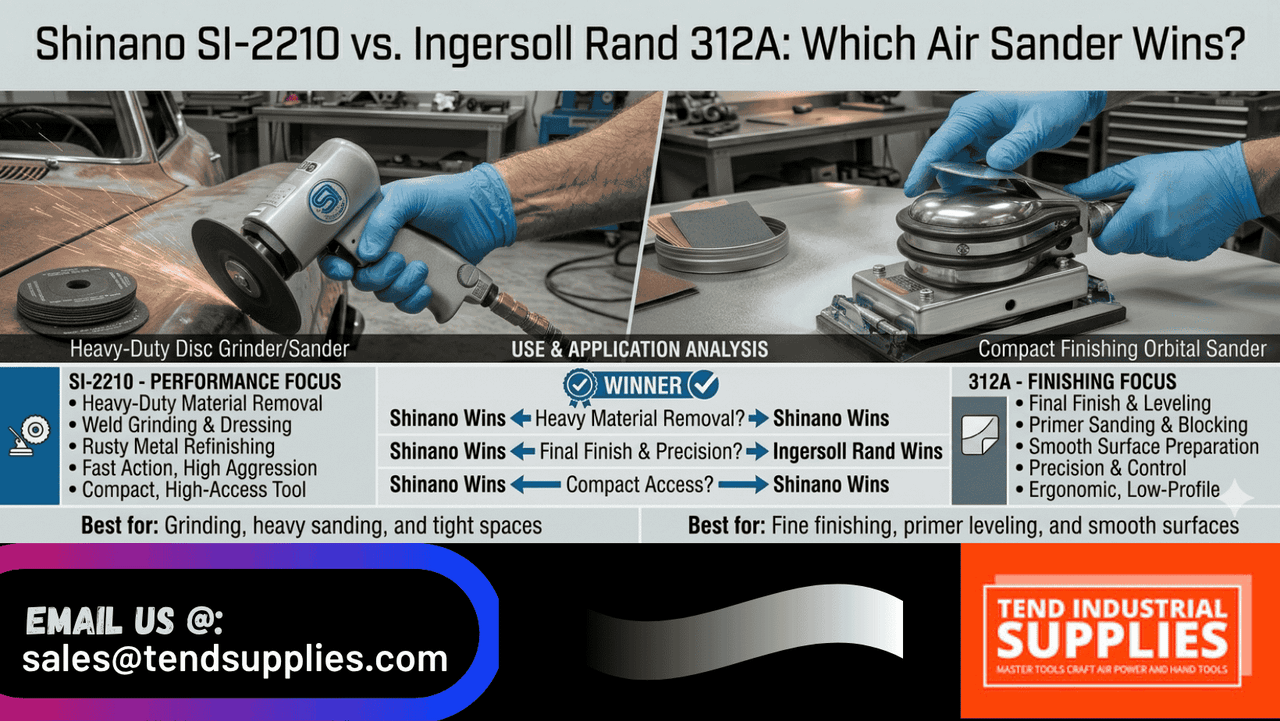
Shinano SI-2210 vs. Ingersoll Rand 312A
The Shinano SI-2210 vs Ingersoll Rand 312A comparison is a useful one for buyers who want a compact pneumatic sander for body-shop work, but the matchup becomes more revealing the closer you look. Both are recognizable names in air tools, yet they are built around different sanding philosophies. The Shinano SI-2210 is a high-speed 3-inch/4-inch disc sander designed for precise, localized material removal and body prep. The Ingersoll Rand 312A is better known as an orbital-style finishing sander intended for broader smoothing tasks. That distinction matters because the “winner” depends on whether your work demands compact disc-sanding control or general-purpose orbital finishing.
If your purchase decision centers on spot repair, feathering, rust cleanup, and weld-area preparation, the buy Shinano SI-2210 case is very strong.
Tend Industrial Supplies is an authorized Shinano distributor. Links on this page may generate a commission at no extra cost to you.
Key Takeaways
•The Shinano SI-2210 vs Ingersoll Rand 312A debate is not just about brand; it is about tool format and workflow fit.
•The SI-2210 is the clear choice for technicians who need a compact disc sander for bodywork, weld prep, and localized surface correction.
•The SI-2210’s built-in regulator and dual 3-inch/4-inch pad flexibility give it a workflow advantage over the larger-format 312A.
•The 312A remains a valid option for broader orbital finishing, but it is not as purpose-built for targeted disc-sanding tasks.
•At $46.80 clearance pricing, the SI-2210 is the stronger value buy for most auto body and restoration users.
Shinano SI-2210 vs Ingersoll Rand 312A at a Glance
The fastest way to understand this matchup is to compare the published categories that most affect sanding performance, shop usability, and buyer value.
|
Spec/buying factor
|
Shinano SI-2210
|
Ingersoll Rand 312A
|
Practical takeaway
|
|
Tool type
|
Disc sander
|
Orbital / sheet-style air sander
|
They are not direct clones; intended use differs
|
|
Working face
|
Dual 3-inch and 4-inch pad compatibility
|
Approx. 3.67 x 6.75 in pad format
|
Shinano is more compact for localized automotive work
|
|
Free speed
|
19,000 RPM class
|
8,000 RPM class
|
Shinano favors rapid localized removal; IR favors smoother orbital finishing
|
|
Weight
|
Approx. 2.17 lb class
|
Approx. 4.6 lb class
|
Shinano is notably lighter and easier to maneuver
|
|
Average air consumption
|
Approx. 3.9 CFM class
|
Approx. 9 CFM class
|
Shinano is easier to support on more compressors
|
|
Speed control
|
Built-in regulator plus throttle control
|
Standard throttle-oriented operation
|
Shinano offers more fine-tuning for heat-sensitive work
|
|
Best fit
|
Featheredging, weld prep, rust spots, spot sanding
|
Broader smoothing and finishing
|
Buy according to the work you actually do
|
|
Price position
|
$119 clearance
|
Typically higher-priced in professional channels
|
Shinano is the value leader in this comparison
|
This table explains why many buyers who start by comparing brand names end up choosing based on task type. If you truly need a 4-inch disc sander for automotive repair, the SI-2210 enters the conversation with a built-in advantage because it is designed for that specific job category.
Why the Shinano SI-2210 vs Ingersoll Rand 312A Comparison Favors the Right Tool for the Job
Many tool comparisons are misleading because they assume all pneumatic sanders are interchangeable. They are not. Shops that perform collision repair, panel blending, rust remediation, and weld refinement do not need a sander that merely “works.” They need one that fits into tight repair zones, responds cleanly to throttle input, and can remove material quickly without becoming difficult to control.
That is where the SI-2210 separates itself. Its disc-sander configuration makes it far more natural for localized body-shop operations. In contrast, the 312A’s orbital finishing orientation works better for flatter, broader smoothing operations. There is nothing wrong with that, but it means the two tools serve different priorities.
For an auto body technician, this is not a small distinction. Tool shape affects line of sight, pad placement, edge access, and how much heat the operator can manage in a small repair area. A compact disc sander is often the more productive answer when the work is concentrated around a dent repair, patch seam, corrosion pocket, or blend perimeter.
Spec-by-Spec: RPM, Weight, and Air Consumption
RPM and material removal rate
In the Shinano SI-2210 vs Ingersoll Rand 312A discussion, free speed is a key differentiator. The SI-2210 sits in the 19,000 RPM class, which is exactly the kind of high-speed response technicians expect from a compact disc sander. That speed supports rapid abrasive action for weld cleanup, corrosion removal, and featheredging.
The 312A, by contrast, is in the 8,000 RPM class, which aligns with its orbital finishing role. That lower-speed, broader-pad approach can be perfectly suitable for smoothing body filler or refining broad areas, but it does not deliver the same compact, aggressive disc-sanding response. In practical terms, the SI-2210 is the more focused tool when the repair demands fast removal in a smaller zone.
Weight and operator fatigue
Weight affects more than comfort. It influences control, especially when the tool is being held at awkward angles around wheel lips, lower door edges, rocker areas, and patch repairs. The SI-2210’s approximately 2.17-pound class weight makes it much easier to wield one-handed and reposition repeatedly during precision work.
The 312A, at approximately 4.6 pounds, belongs to a heavier orbital category. That extra mass is not always a disadvantage on broad flat work, but it is less desirable when visibility, agility, and quick repositioning are priorities. A technician who spends long stretches doing localized body prep will usually prefer the lighter option.
Air consumption and compressor compatibility
Air consumption is one of the most overlooked buying factors, and it matters even more in small shops or home garages. The SI-2210’s approximately 3.9 CFM class average air demand is far easier to support than the 312A’s roughly 9 CFM class average demand. That difference can determine whether a buyer needs to upgrade a compressor, replace hoses, or accept longer recovery time between passes.
This is one of the strongest practical advantages of the SI-2210. It is not just lighter and more compact; it is also easier to integrate into a real-world shop air system. Buyers who are still matching tools to compressor capacity should review Tend Supplies’ air compressor guide before making a final decision.
Feature Deep-Dive: Built-In Regulator vs. Standard Throttle Feel
A major reason the Shinano SI-2210 vs Ingersoll Rand 312A debate tilts toward Shinano for bodywork is the SI-2210's built-in regulator. This feature gives the user a better way to tune tool speed to the material and stage of repair. That matters on thin automotive sheet metal where heat control and abrasive discipline are essential.
With a regulator, the user can shift from more aggressive removal to more measured blending without relying solely on finger modulation. That improves repeatability, especially during featheredging and spot prep. It also makes the SI-2210 more forgiving for technicians who switch between substrates or abrasive grits in the same job.
The 312A’s throttle-oriented operation is perfectly functional within its own application range, but it does not give the same targeted disc-sander feel for controlled localized removal. In other words, the SI-2210 is better optimized for technicians who want both speed and finesse in one compact air tool.
For buyers interested in maximizing service life and consistent performance, Tend Supplies’ guide to advanced air tool maintenance is also worth reading.
Pad Versatility: Shinano’s Dual 3-Inch/4-Inch Flexibility vs. the 312A’s Single Format
One of the clearest advantages in this comparison is pad versatility. The SI-2210 is built around dual 3-inch and 4-inch compatibility, giving it greater range for shop use. A technician can use the smaller setup where access is tighter, then step up to a 4-inch disc for slightly broader blending or cleanup. That flexibility is valuable when the same day includes rust work, weld cleanup, filler edge prep, and paint transition sanding.
The 312A is designed around a single larger pad format. That is not inherently a flaw; it simply locks the user into the style of work for which the tool was intended. For broader finishing, that can be perfectly appropriate. For body technicians who need one air sander to cover multiple localized automotive tasks, the SI-2210 is more adaptable.
This versatility also fits neatly with Tend Supplies’ larger professional air sanders collection and the broader pneumatic air tools hub.
Build Quality: Japanese Manufacturing vs. Mixed-Origin Mass-Market Production
Professional buyers often care as much about refinement as raw power. That is why Japanese pneumatic tools continue to earn respect among technicians who use them daily. The SI-2210 benefits from the strong perception of Japanese manufacturing discipline, especially in areas like balance, throttle feel, consistency, and long-term reliability.
That context matters. Shops do not just buy a specification sheet; they buy a tool that will either feel precise and confidence-inspiring or feel like a compromise. The Shinano brand page is relevant here because Shinano occupies a premium reputation bracket among professionals who value fit, finish, and control.
Ingersoll Rand remains a major industrial name with broad recognition. However, in this specific matchup, the 312A is a more general-purpose product within a larger global ecosystem, and it does not offer the same clear body-shop specialization as the SI-2210. For buyers who appreciate the reputation of Japanese air tool brands and want a more purpose-built automotive prep tool, Shinano has the stronger appeal.
Price Analysis: Why the SI-2210 Wins on Value
Price matters only when tied to performance, but here the value argument is unusually straightforward. The buy Shinano SI-2210 opportunity is compelling because the tool is available at $46.80 clearance pricing. That is an aggressive number for a professional-grade Japanese-brand pneumatic tool that offers regulator control, lighter weight, lower air demand, and greater pad flexibility.
The 312A is not a bad sander. It simply occupies a different position: heavier, more air-hungry, and better aligned with broader orbital finishing than with compact disc-sanding work. For a buyer who specifically wants a 4-inch air sander for automotive repair, paying more for a less specialized format does not make much sense.
That value case becomes even stronger when the SI-2210 is part of a broader shop system. It pairs naturally with the Shinano SI-4700B air saw for panel cutting, the Shinano SI-2001S straight die grinder for burr and detail work, and the Shinano SI-1200B mini air ratchet for teardown access in tight spaces.
Mid-Article CTA: Buy the SI-2210 if You Need a Real Body-Shop Disc Sander
If you are comparing brands but your actual need is a compact, controllable disc sander for rust cleanup, feathering, and weld prep, buy Shinano SI-2210 here. At $46.80, it is the strongest value in this matchup.
Final Verdict: Which Air Sander Wins?
In a broad sense, both brands are respected. In a practical buying sense, the Shinano SI-2210 vs Ingersoll Rand 312A comparison has a clear outcome for automotive body work. If you need a purpose-built compact disc sander with lighter weight, lower air demand, regulator-assisted control, and dual 3-inch/4-inch flexibility, the Shinano SI-2210 wins.
The Ingersoll Rand 312A still has a place as a broader orbital finishing tool, but it is not the better answer for the technician who specifically wants a 4-inch pneumatic disc sander. That is why the SI-2210 is the smarter buy for this use case, and its clearance price only strengthens that conclusion.
CTA: Shop the Shinano SI-2210 Clearance Deal
Ready to stop comparing and equip your shop with the right tool for localized automotive sanding? Shop the Shinano SI-2210 clearance deal now, then explore the wider Shinano pneumatic tool range, the air die grinders category, and Tend Supplies’ guide to the best Japanese tools worth importing for additional shop upgrades.
FAQs About Shinano SI-2210 vs Ingersoll Rand 312A
Is the Ingersoll Rand 312A the same type of tool as the Shinano SI-2210?
Not exactly. The SI-2210 is a compact disc sander designed for localized material removal and body-shop prep, while the 312A is better known as an orbital-finishing-style air sander for broader smoothing tasks.
Which tool is better for featheredging and rust spot cleanup?
The Shinano SI-2210 is the better choice for those jobs because its disc-sander format, higher-speed class, lighter body, and regulator-assisted control suit localized automotive repair work much better.
Does the SI-2210 use less air than the 312A?
Yes, based on commonly published specifications, the SI-2210 falls into a much lower average air consumption class than the 312A. That makes it easier to run on a wider range of compressor setups.
Why does pad flexibility matter in a body shop?
Pad flexibility matters because different repair areas reward different footprints. The SI-2210’s ability to work with both 3-inch and 4-inch setups gives technicians more adaptability in tight or irregular spaces.
Is the SI-2210 worth buying at $119?
Yes. At $119, the SI-2210 offers strong body-shop utility, lower operating demands, and Japanese-brand credibility at a price that is difficult to beat in the professional pneumatic tool category.
22nd Apr 2026

Newest Guide & products Updates
Air Regulators for Paint Booths: What to Buy Before You Order
For a paint-booth spray-air branch, buy a correctly sized filter-regulator without an oil-mist lubri...
Best 3/8-Inch Air Ratchet for Mechanics: SI-1205B or SI-1218EX?
Choose the Shinano SI-1205B when a light, compact 3/8-inch air ratchet is the priority; compare the...
Compact Air Impact Wrench for Tight Automotive Spaces: SI-1610SR Buying Guide
Buy a compact air impact wrench when access and manageable tool weight matter—but only after checkin...
WAALPC FRL Replacement Filters: Match the Part Before You Buy
Buy a replacement FRL filter element by its confirmed model family and dimensions—not by the words “...
Shinano 5-Inch Air Grinder Review: M14 vs 5/8-11 Spindle
Tend Industrial Knowledge Center / Product comparisons Looking for the best 5-inch air angle grinde...
Premium Air Impact Wrenches: Shinano vs CP, Dynabrade & Ingersoll Rand
Hero: original AI-generated editorial illustration; pictured tools are not exact product models. A s...