
The Importance of Collet Precision: Cheap vs. Professional Die Grinders

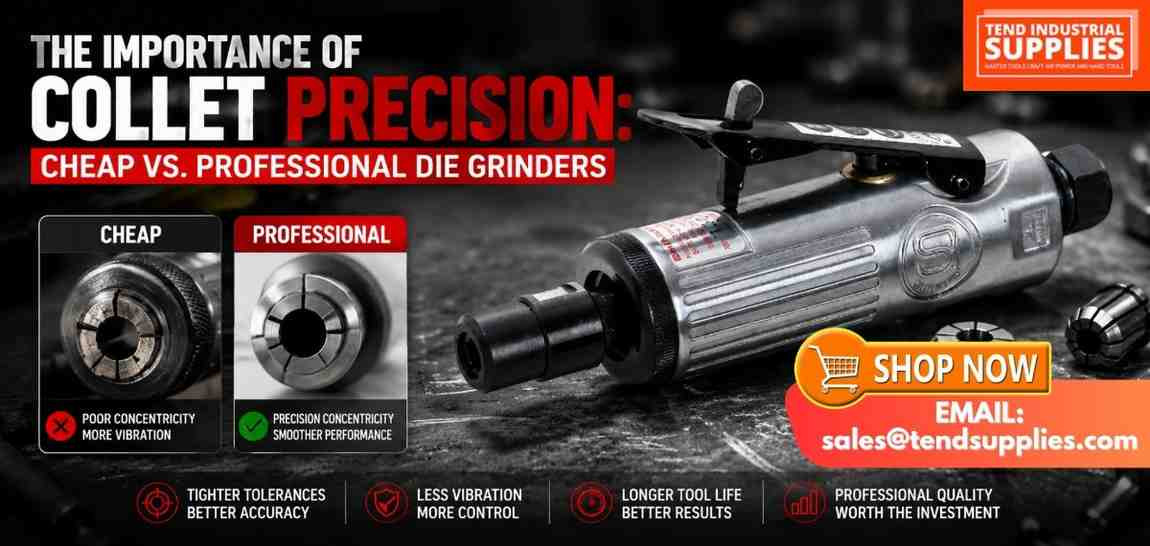
A Professional air die grinder is not defined only by brand name or maximum RPM. The real separator is precision, and much of that precision begins at the collet. Buyers who compare cheap die grinders against professional-grade models often focus on price, speed, or included accessories, but the more consequential question is how accurately the tool holds the burr or mounted point. When collet precision is poor, runout increases, vibration worsens, finish quality drops, accessory life shortens, and the operator loses confidence in the cut. That is why serious fabricators, engine builders, and technicians eventually learn that “cheap” often becomes expensive very quickly.
For buyers who want true value rather than false economy, the buy Shinano SI-2001S case is unusually strong.
Quick Answer
Collet precision is the most critical factor in a die grinder's performance, safety, and longevity. Professional die grinders feature precision-machined, hardened steel collets that hold the accessory perfectly centered, eliminating runout (wobble) and minimizing vibration. In contrast, cheap die grinders often use low-quality, stamped collets that cause severe vibration, uneven accessory wear, poor surface finishes, and an increased risk of dangerous accessory failure at high RPMs.
Tend Industrial Supplies is an authorized Shinano distributor. Links on this page may generate a commission at no extra cost to you.
Key Takeaways
- A Professional air die grinder needs precise collet alignment because poor runout destroys burrs, increases vibration, and reduces control.
- Cheap die grinders often hide their real cost in bearing wear, inconsistent machining, poor throttle feel, and accessory failure.
- Collet precision matters most in carbide burr work, cylinder head porting, weld cleanup, and any task where accuracy and finish quality are critical.
- The Shinano SI-2001S straight die grinder offers professional precision at a very accessible $54.00 clearance price.
- Buyers who care about long-term shop efficiency should evaluate tool balance, runout, and machining quality more seriously than sticker price alone.
Why Collet Precision Matters More Than Most Buyers Realize
The collet is the tool’s connection to the work. If that connection is poorly machined, inconsistent, or unable to clamp the accessory concentrically, the rest of the die grinder’s advertised performance becomes less meaningful. A Professional air die grinder should keep the burr or mounted point running true enough that the operator can shape, deburr, and blend with confidence.
This matters because die grinder accessories operate at very high speed. Even a small amount of runout becomes noticeable when a burr spins in the 25,000 RPM class. The result is a tool that feels nervous in the hand, cuts unpredictably, and transmits more vibration back to the operator. On precision tasks such as port matching or deburring machined components, that instability can ruin the work faster than many buyers expect.
This is one reason professionals tend to respect Japanese pneumatic tools. Buyers who use Shinano pneumatic tools from Japan often value them because refinement, balance, and machining quality matter as much as peak output.
What Is Runout, and Why Does It Destroy Carbide Burrs?
Runout is the amount by which a rotating accessory deviates from the true center as it spins. In simple terms, if the burr is not running perfectly straight, it is wobbling. That wobble may be small, but at die grinder speeds it has outsized consequences.
The first consequence is poor cut quality. Instead of tracking smoothly, the burr chatters and bounces, especially on harder materials or delicate edges. The second consequence is premature burr wear. Uneven load distribution means one side of the cutting edges takes more punishment than the other. The third consequence is bearing stress. Vibration caused by runout is not isolated to the accessory; it travels back through the spindle and bearings, shortening tool life. The fourth consequence is operator fatigue, because the user must constantly correct for instability.
In carbide burr work, this becomes especially destructive. Burrs are designed to cut cleanly when they rotate true. If the collet or spindle lets them wobble, they stop acting like precision cutters and start acting like unpredictable hammers. That is why experienced fabricators often judge a die grinder by feel before anything else. A precise tool feels composed. A cheap one often feels frantic.
|
Issue |
What Poor Collet Precision Causes |
Why It Matters |
|
Runout |
Burr or stone spins off-center |
Reduced accuracy and rougher finish |
|
Vibration |
Tool transmits more harshness into the hand |
More fatigue and less control |
|
Burr wear |
Cutting edges wear unevenly |
Higher consumable cost |
|
Bearing stress |
Internal components take more abuse |
Shorter tool life |
|
Surface quality |
Tool leaves inconsistent marks |
More cleanup and rework |
The Hidden Cost of Cheap Die Grinders
Cheap die grinders are tempting because they often promise high speed at a low price. The problem is that speed alone is not what makes a die grinder productive. The true cost shows up in the places budget buyers do not notice at first.
First, there is the cost of consumables. A burr or mounted stone that should last through multiple jobs wears out much sooner when the tool runs with excess vibration or poor concentricity. Second, there is the cost of rework. A tool that chatters leaves rougher cuts, demands more cleanup, and increases the risk of overshaping the part. Third, there is the cost of tool replacement. Bearings, throttles, and collet systems in low-grade tools frequently degrade faster under regular shop use. Fourth, there is the cost of lost time. A tool that feels sloppy slows the operator down because every move must be more cautious and corrective.
This is why a Professional air die grinder usually pays for itself faster than buyers expect. The difference is not marketing. It is the compound effect of better machining, better balance, better component life, and fewer ruined accessories. When the job is metal fabrication, those efficiencies matter every week.
Japanese Machining Tolerances: The Shinano SI-2001S Advantage
The Shinano SI-2001S straight die grinder has a strong advantage in this discussion because it represents the kind of tool buyers mean when they say “professional-grade.” It is a compact inline die grinder built for precision-oriented work, not a disposable commodity tool designed to look impressive in a catalog listing.
Published specifications place it in the 25,000 RPM class, with a 1/4-inch or 6 mm collet option and a very low 0.82-pound class weight. Those numbers matter, but the real value lies in the way a better-machined tool supports high-speed work without feeling unstable. That is where Japanese manufacturing reputation becomes meaningful. Buyers who care about consistent spindle behavior, clean collet engagement, and refined throttle response know that machining quality is not an abstract talking point. It directly affects the cut.
The SI-2001S also suits the kinds of jobs where collet precision matters most: carbide burr shaping, internal deburring, cylinder head work, weld cleanup, and detail finishing. In all of those applications, a true-running tool makes the work faster and more predictable.
Why Professional Users Feel the Difference Immediately
Operators who have spent time with low-cost die grinders usually notice the upgrade instantly when they move to a better tool. The first difference is often smoothness. A precise die grinder feels calmer at speed. The second difference is response. A better throttle gives the user more usable modulation. The third difference is confidence. The burr tracks where the hand directs it instead of wandering under vibration.
This confidence matters most in delicate tasks. If you are cleaning a weld toe, deburring a machined slot, or shaping a port roof, a sloppy tool makes every movement feel riskier. A better die grinder reduces that cognitive load. The operator can focus on the workpiece instead of fighting the tool.
That improvement fits naturally within a wider professional shop setup. Buyers who already rely on the air die grinders category or broader pneumatic air tools typically understand that tool quality compounds over time.
Price Analysis: Professional Precision at the $54.00 Clearance Price
Price is the reason many buyers hesitate before stepping up to a more precise die grinder. In this case, that hesitation is much easier to overcome because the buy Shinano SI-2001S opportunity sits at just $54.00 on clearance. That dramatically changes the usual cheap-vs-professional calculation.
Normally, buyers expect to pay a meaningful premium for a better-machined Japanese-brand die grinder. Here, the price difference between a questionable generic tool and a true professional-grade option narrows so much that the bargain-bin logic starts to collapse. Why accept higher runout, rougher feel, and shorter lifespan just to save a little upfront money when a much better tool is available near commodity pricing?
That is the key value argument in this article. The SI-2001S is not simply a premium choice. At $54.00, it is arguably the rational economic choice for anyone who uses a die grinder often enough to care about results.
Also Read: Straight vs. Angle Die Grinders: Which Do You Need for Metal Fabrication?
Mid-Article CTA: Buy the SI-2001S Instead of Replacing Cheap Tools Repeatedly
If you are tired of vibration, poor collet grip, and burned-up burrs, buy the Shinano SI-2001S here. The $54.00 clearance price gives you professional precision without the usual premium.
Cheap vs. Professional Die Grinder Comparison
|
Buying Factor |
Cheap Die Grinder |
Professional Air Die Grinder |
|
Collet precision |
Often inconsistent |
Better concentricity and burr grip |
|
Runout control |
More wobble likely |
Smoother true-running operation |
|
Bearing life |
Often shorter under regular use |
Better durability in daily work |
|
Throttle feel |
Can be abrupt or vague |
More predictable and controllable |
|
Vibration |
Usually higher |
Better balance and operator comfort |
|
Consumable life |
Burrs and stones wear faster |
Accessories last longer when tool runs true |
|
Long-term value |
Low upfront cost, higher hidden cost |
Higher real value over time |
Why the SI-2001S Makes Sense for Fabricators, Engine Builders, and Technicians
The Shinano SI-2001S straight die grinder fits several user groups especially well. Fabricators benefit from better deburring and slot cleanup. Engine builders gain a more trustworthy tool for port and passage work. Automotive technicians get a lighter, smoother option for detail grinding where access and control matter. In each case, collet precision is not a luxury feature; it is central to tool performance.
The tool also integrates naturally with other specialty air tools. A fabricator might use the SI-4700B air saw for a cut, the SI-2210 disc sander for edge prep, and the SI-2001S for fine deburring and internal cleanup. That kind of complementary workflow is what separates efficient shops from improvised ones.
For broader context, buyers interested in professional-grade pneumatic equipment should also review Tend Supplies’ resources on top Japanese air tool brands and the best Japanese tools worth importing.
Final Verdict
A Professional air die grinder earns its keep through precision, and collet precision is where that story begins. Poor runout destroys burrs, worsens vibration, reduces finish quality, and shortens tool life. Cheap die grinders may look economical, but their hidden costs add up quickly in any shop that uses them regularly.
That is why the Shinano SI-2001S straight die grinder is such an easy recommendation. It offers the kind of machining quality and true-running performance serious users want, and its $54.00 clearance price makes it one of the most attractive values in the entire Shinano clearance campaign.
CTA: Shop the Shinano SI-2001S Clearance Deal
Ready to stop gambling on cheap die grinders? Shop the Shinano SI-2001S clearance deal now, then explore the broader Shinano tool range, the air die grinders collection, and the air tool maintenance guide to protect your investment.
FAQs About Collet Precision and Professional Air Die Grinders
What is runout in a die grinder?
Runout is the amount an accessory deviates from the true center as it spins. In a die grinder, more runout means more wobble, more vibration, and less accurate cutting.
Why does poor collet precision damage carbide burrs?
Because a poorly centered burr loads unevenly as it rotates. That uneven stress accelerates wear, increases chatter, and can cause the burr to cut unpredictably.
Is a professional die grinder really worth more than a cheap one?
Yes, especially for frequent users. A better die grinder usually saves money over time by improving cut quality, reducing consumable wear, and lasting longer under shop use.
What makes the Shinano SI-2001S professional grade?
Its compact design, high-speed capability, low working weight, and the machining quality associated with a Japanese professional pneumatic tool platform all contribute to its professional-grade character.
Is the SI-2001S a good value at $54.00?
Yes. At $54.00, the SI-2001S offers a level of precision and credibility that is difficult to match among bargain-priced die grinders, making it a standout clearance value.
Related Articles:
What to Look for in a Professional Pneumatic Air Saw for Automotive Repair
5 Ways a Pneumatic Air Saw Saves Time in Collision Repair
7 Impossible Fasteners You Can Reach with a Mini Air Ratchet
A Beginner's Guide to Cylinder Head Porting with a Pneumatic Die Grinder
The Ultimate Guide to Choosing a 4-Inch Pneumatic Disc Sander for Auto Body Work
How to Prep Weld Seams and Rust Spots with a Pneumatic Disc Sander

Newest Guide & products Updates
Air Regulators for Paint Booths: What to Buy Before You Order
For a paint-booth spray-air branch, buy a correctly sized filter-regulator without an oil-mist lubri...
Best 3/8-Inch Air Ratchet for Mechanics: SI-1205B or SI-1218EX?
Choose the Shinano SI-1205B when a light, compact 3/8-inch air ratchet is the priority; compare the...
Compact Air Impact Wrench for Tight Automotive Spaces: SI-1610SR Buying Guide
Buy a compact air impact wrench when access and manageable tool weight matter—but only after checkin...
WAALPC FRL Replacement Filters: Match the Part Before You Buy
Buy a replacement FRL filter element by its confirmed model family and dimensions—not by the words “...
Shinano 5-Inch Air Grinder Review: M14 vs 5/8-11 Spindle
Tend Industrial Knowledge Center / Product comparisons Looking for the best 5-inch air angle grinde...
Premium Air Impact Wrenches: Shinano vs CP, Dynabrade & Ingersoll Rand
Hero: original AI-generated editorial illustration; pictured tools are not exact product models. A s...