
Straight vs. Angle Die Grinders: Which Do You Need for Metal Fabrication?

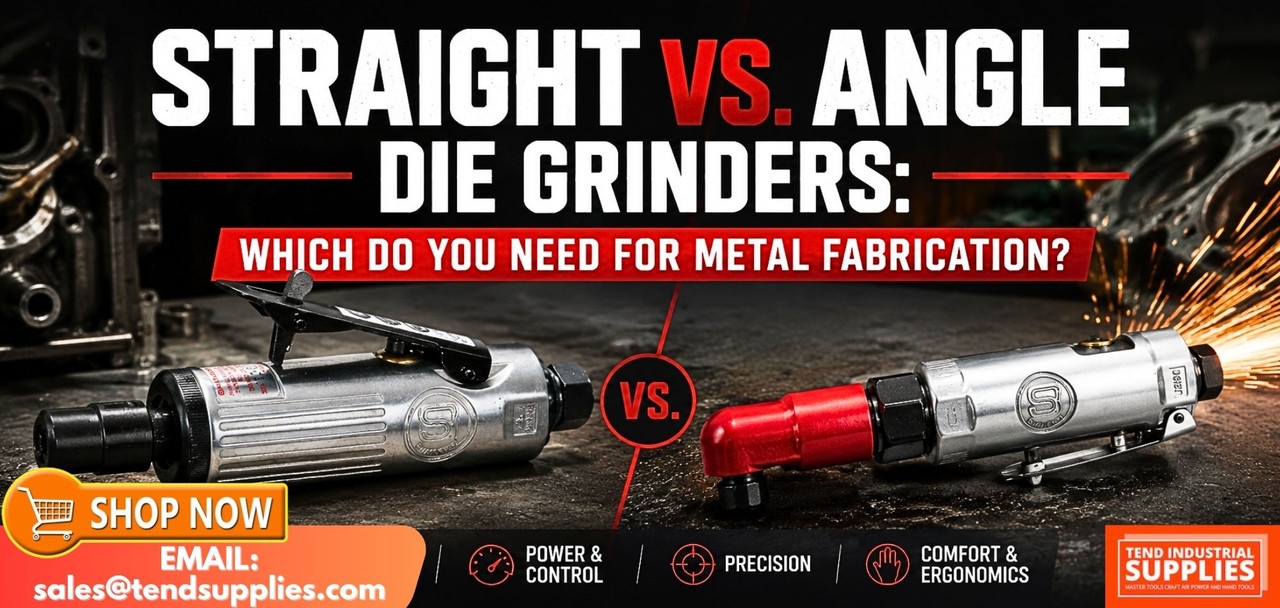
The straight vs angle die grinder debate matters because the two tools solve different fabrication problems. Both are staples in metalworking, automotive repair, and welding shops, but they are not interchangeable in practice. A straight die grinder excels when the work is inline, deep, narrow, or detail-oriented. An angle die grinder shines when surface access, broad deburring, and off-axis control matter more. Buyers who understand that distinction make better purchases, work faster, and destroy fewer burrs, stones, and abrasives.
For fabricators who need a compact inline tool for precision work, the Shinano SI-2001S straight die grinder is one of the most compelling options in the current clearance campaign.
Quick Answer
Straight die grinders are best for precision work, deep access, and inline grinding tasks such as porting, deburring, and reaching tight recessed areas. Angle die grinders are better for surface preparation, weld cleanup, edge blending, and general metal fabrication because their angled head offers improved ergonomics and control on flat or curved surfaces. For most fabrication shops, both tools serve different but complementary purposes.
Tend Industrial Supplies is an authorized Shinano distributor. Links on this page may generate a commission at no extra cost to you.
Key Takeaways
The straight vs angle die grinder choice should be based on access, tool orientation, and the type of abrasive or burr being used.
Straight die grinders are usually the better choice for inline access, cylinder head work, burr control, weld cleanup in recesses, and narrow fabrication tasks.
Angle die grinders are often better for surface blending, gasket cleanup, and working across broader areas at awkward approach angles.
RPM and collet precision matter because carbide burrs, mounted stones, and abrasive rolls all behave differently at speed.
The Shinano SI-2001S straight die grinder is an excellent buy at $54.00 clearance pricing for technicians who want a compact professional inline die grinder.
Why the Straight vs Angle Die Grinder Decision Matters in Metal Fabrication
A die grinder is one of the most deceptively important tools in fabrication. It is often the tool that refines a weld, opens a slot, deburrs a bracket, cleans a port, shapes a relief, or reaches the part of a component that a larger grinder cannot touch. That is why the straight vs angle die grinder decision should never be treated as cosmetic. The orientation of the tool directly affects reach, visibility, pressure control, and the kind of accessory that can be used safely and effectively.
In fabrication, small differences in tool geometry create big differences in results. A straight die grinder allows the operator to approach the work in line with the spindle. That makes it especially useful for internal passages, channels, holes, port openings, and other areas where the cutting motion needs to travel forward rather than sideways. An angle die grinder reorients the spindle so the operator can work across a face or edge more naturally. That can make it more comfortable for surface-based tasks, especially when access is limited vertically but open laterally.
The practical consequence is simple: choosing the wrong style slows the job down. It may also reduce accuracy, increase hand fatigue, and wear accessories prematurely. Buyers who understand how die grinders fit into the larger pneumatic air tools ecosystem usually make better workflow decisions across the whole shop.
How a Straight Die Grinder Works and Where It Excels
A straight die grinder places the rotating collet on the same axis as the motor body. That configuration makes the tool long, narrow, and highly effective where direct inline reach matters. In metal fabrication, this is an enormous advantage.
The straight design is especially useful in five kinds of work. First, it is excellent for porting and internal passage shaping, where the tool needs to enter a cavity cleanly. Second, it works well for precision deburring inside holes, slots, and brackets. Third, it is valuable for weld cleanup in recessed areas where a larger grinder would either not fit or would obscure the work. Fourth, it is highly effective for carbide burr control, particularly when the operator needs a stable, forward-directed approach. Fifth, it is often the best choice for tool-and-die style detail grinding where predictability matters more than brute force.
This is exactly the territory where the Shinano SI-2001S straight die grinder stands out. It is a compact straight tool intended for precisely the kind of inline work serious fabricators, engine builders, and automotive technicians do every week.
Straight die grinder strengths
The main strength of a straight die grinder is that it lets the operator push the accessory toward the work in a natural line. That helps with visibility, spindle stability, and fine control, especially when using carbide burrs. It is also easier to maintain a consistent entry angle in holes, runners, and edges that extend away from the hand.
Straight die grinder limitations
The limitation is that a straight tool is not always the best shape for broad surface work. If the task is mostly flattening, surface blending, or edge cleanup on an exposed face, the long inline form can be less comfortable than an angled layout.
How an Angle Die Grinder Works and Where It Excels
An angle die grinder changes the relationship between the hand and the spindle. Instead of driving the accessory straight out from the body, it places the head at an angle that allows the operator to work more naturally across a surface or around an obstruction. That makes the angle format useful in a different set of applications.
In fabrication and repair, angle die grinders are often preferred for surface conditioning, gasket removal, broad deburring along edges, working under overhangs, and cleaning flat or curved faces where a straight tool would force the wrist into an awkward position. The angled head can also feel more intuitive when using Roloc-style discs or other accessories intended to sweep across a plane.
That does not make the angle design “better.” It simply makes it better for tasks where lateral access matters more than forward reach. This is why many professional shops keep both forms on hand. The right tool depends on whether the work is happening inside something or across something.
|
Task Type |
Straight Die Grinder Advantage |
Angle Die Grinder Advantage |
|
Internal porting and runner work |
Excellent inline access and visibility |
Usually less suitable |
|
Burr work in holes, slots, or channels |
Better forward-directed control |
Less natural approach |
|
Surface blending and face cleanup |
Possible, but less ergonomic |
Often the better choice |
|
Tight clearance around flat panels |
Depends on access direction |
Often easier to position |
|
Precision detail grinding |
Strong option |
Useful when the angle improves hand position |
|
Gasket and flange cleanup |
Sometimes workable |
Often more comfortable and faster |
Straight vs Angle Die Grinder: Which One Is Better for Metal Fabrication?
If the question is strictly framed around metal fabrication, the answer often leans toward the job mix. Fabricators who routinely work with brackets, weldments, tube joints, manifolds, castings, and detailed steel or aluminum parts often get more long-term value from a straight die grinder first, especially if the shop already has flap wheels and angle grinders for surface work.
Why? Because the straight die grinder occupies a more specialized and less replaceable role. A standard angle grinder can already handle a lot of external face work, even though it is larger and rougher. But nothing substitutes as cleanly for a compact straight die grinder when the task is internal deburring, port entry cleanup, or burr work in a confined recess.
That is one reason the Shinano SI-2001S straight die grinder is such a strong recommendation. For many buyers, it fills the gap that larger grinders and surface tools cannot cover efficiently.
RPM Requirements for Carbide Burrs vs. Abrasive Stones
The straight vs angle die grinder decision becomes even more important when you think about the accessories being used. Burrs and stones do not behave the same way, and RPM influences both finish quality and tool control.
Carbide burrs usually perform best when they can spin fast enough to cut cleanly rather than chatter and grab. That is especially true in steel, cast iron, and aluminum shaping work. A straight die grinder with a stable inline grip often makes high-speed burr work easier to manage because the user can guide the burr more precisely into the work.
Mounted stones, cartridge rolls, and abrasive points are different. They still need appropriate speed, but they are often used in finishing, blending, or polishing transitions rather than aggressive material removal. Excess speed can overheat the part, shorten abrasive life, or make the accessory feel unstable.
The SI-2001S sits in a 25,000 RPM class, which is exactly the kind of speed range fabricators expect for a compact professional die grinder. That high-speed capability makes it suitable for a wide range of burr and small-abrasive applications when paired with proper technique and correct accessory selection.
|
Accessory Type |
Typical Use |
What Matters Most |
|
Carbide burrs |
Metal removal, shaping, deburring, and porting |
High RPM stability, low runout, and secure collet grip |
|
Mounted stones |
Blending, dressing, and refining surfaces |
Controlled speed, consistent contact, and low vibration |
|
Cartridge rolls / abrasive rolls |
Smoothing and finish work |
Steady throttle control and comfortable access |
|
Small cutoff or specialty attachments |
Limited specialty tasks |
Tool compatibility and precise operator control |
Product Spotlight: Why the Shinano SI-2001S Is the Premier Choice for Inline Work
The Shinano SI-2001S straight die grinder fits this buying discussion so well because it is purpose-built for the kind of work that favors the straight configuration. It is compact, light, and designed around control rather than bulk. Published specifications place it in the 25,000 RPM class, with a 1/4-inch or 6 mm collet option and a very light 0.82-pound class weight. Those are exactly the characteristics many fabricators want in an inline die grinder.
That lightweight body matters more than many buyers expect. In prolonged deburring or porting sessions, hand fatigue reduces accuracy. A lighter tool helps the operator stay precise longer. The SI-2001S also benefits from the reputation of Shinano pneumatic tools from Japan, which is relevant for buyers who care about refinement, balance, and dependable shop performance.
At $54.00 on clearance, the SI-2001S becomes even more attractive. It offers real professional utility at a price point that undercuts what many buyers expect to pay for a Japanese-brand pneumatic die grinder.
Mid-Article CTA: Buy the SI-2001S If Your Work Demands Inline Precision
If most of your grinding jobs involve burr work, port access, slot cleanup, or fine deburring in confined areas, buy the Shinano SI-2001S straight die grinder here. At $54.00, it is one of the best values in the Shinano clearance lineup.
How to Decide Which Style You Actually Need
The easiest way to choose between a straight and angle die grinder is to review the last ten jobs where you wished you had a better small grinder. Were you mostly reaching into a part, working down a channel, cleaning inside a runner, or guiding a burr forward into the work? If so, you probably need a straight die grinder.
Were you mostly blending along a face, cleaning a flange, removing gasket residue, or sweeping across an exposed surface? If so, you may want an angle die grinder first. Many shops eventually need both, but the first purchase should solve the most frustrating and least replaceable tasks.
This is also where broader shop planning helps. A fabrication bay that already uses a professional air sander or larger abrasive tools may find that a straight die grinder covers the remaining precision work best. A shop focused heavily on surface conditioning may prioritize angle access sooner.
Final Verdict
The straight vs angle die grinder decision should be driven by the shape of the work, not by habit. Straight die grinders are better when the task is inline, internal, or detail-focused. Angle die grinders are better when the job is surface-oriented and the hand position benefits from an angled head.
For many fabricators, restorers, engine builders, and metalworking professionals, the more essential first purchase is the straight configuration because it solves more specialized access problems. That is why the Shinano SI-2001S straight die grinder is such a strong recommendation. It delivers the size, speed, and control that inline work demands, and its $54.00 clearance price makes it especially hard to ignore.
CTA: Shop the Shinano SI-2001S and Build a Smarter Air Tool Setup
Ready to equip your shop with the right inline die grinder? Shop the Shinano SI-2001S straight die grinder now. While upgrading your setup, explore the air die grinders category, the broader air tools hub, and the related Shinano tools including the SI-2210 disc sander and SI-4700B air saw.
FAQs About Straight vs Angle Die Grinders
Is a straight die grinder better than an angle die grinder?
Not universally. A straight die grinder is better for inline access, internal passages, and burr work in confined areas. An angle die grinder is better for many surface-cleaning and face-blending tasks.
What is a straight die grinder best used for?
A straight die grinder is best used for deburring holes and slots, cylinder head porting, weld cleanup in recesses, shaping internal passages, and any application where direct forward spindle access matters.
Do carbide burrs work better in a straight die grinder?
Often yes, especially for inline precision work. A straight die grinder can make carbide burr control feel more natural because the tool body follows the same general direction as the cut.
Is 25,000 RPM enough for professional die grinder work?
Yes. A 25,000 RPM class tool is well within the range expected for professional small die grinder tasks such as deburring, burr work, and detail grinding with the proper accessories.
Is the Shinano SI-2001S a good value at $54.00?
Yes. The SI-2001S combines compact professional design, high-speed capability, lightweight handling, and Japanese-brand credibility at a $54.00 clearance price, making it an excellent value for serious users.
Related Articles:
What to Look for in a Professional Pneumatic Air Saw for Automotive Repair
5 Ways a Pneumatic Air Saw Saves Time in Collision Repair
7 Impossible Fasteners You Can Reach with a Mini Air Ratchet
A Beginner's Guide to Cylinder Head Porting with a Pneumatic Die Grinder
The Ultimate Guide to Choosing a 4-Inch Pneumatic Disc Sander for Auto Body Work
How to Prep Weld Seams and Rust Spots with a Pneumatic Disc Sander

Newest Guide & products Updates
Air Regulators for Paint Booths: What to Buy Before You Order
For a paint-booth spray-air branch, buy a correctly sized filter-regulator without an oil-mist lubri...
Best 3/8-Inch Air Ratchet for Mechanics: SI-1205B or SI-1218EX?
Choose the Shinano SI-1205B when a light, compact 3/8-inch air ratchet is the priority; compare the...
Compact Air Impact Wrench for Tight Automotive Spaces: SI-1610SR Buying Guide
Buy a compact air impact wrench when access and manageable tool weight matter—but only after checkin...
WAALPC FRL Replacement Filters: Match the Part Before You Buy
Buy a replacement FRL filter element by its confirmed model family and dimensions—not by the words “...
Shinano 5-Inch Air Grinder Review: M14 vs 5/8-11 Spindle
Tend Industrial Knowledge Center / Product comparisons Looking for the best 5-inch air angle grinde...
Premium Air Impact Wrenches: Shinano vs CP, Dynabrade & Ingersoll Rand
Hero: original AI-generated editorial illustration; pictured tools are not exact product models. A s...