
Mini vs. Standard Air Ratchets: Maximising Access in Tight Engine Bays

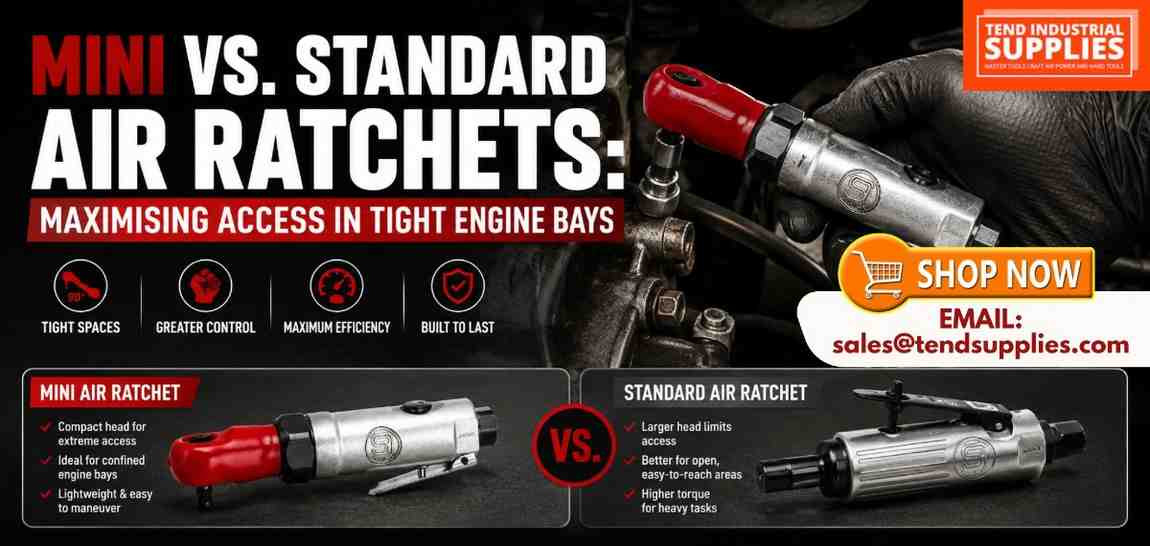
The Mini air ratchet vs standard decision matters because access problems waste more time in engine bays than many technicians care to admit. A ratchet that looks powerful on paper can still be the wrong tool if the head is too bulky, the swing arc is too large, or the housing forces the user to remove extra components just to reach a fastener. That is why professional technicians often value compactness and agility as much as headline torque. In tight engine compartments, the fastest tool is frequently the one that fits, not the one that boasts the biggest output number.
For technicians who regularly fight cramped spaces, the Shinano SI-1200B mini air ratchet deserves serious attention.
Quick Answer
Mini air ratchets are designed for maximum access in tight engine bays, making them ideal for dashboard work, HVAC fasteners, intake manifolds, transmission tunnels, and confined automotive repairs. Standard air ratchets provide more leverage and a more traditional feel for open work areas, but their larger head size can limit access in modern compact engine compartments. For professional mechanics, mini air ratchets often deliver faster workflow and better maneuverability where space is limited.
*Tend Industrial Supplies is an authorized Shinano distributor. Links on this page may generate a commission at no extra cost to you.*
Key Takeaways
The Mini air ratchet vs standard comparison is really about access versus bulk, not simply lower torque versus higher torque.
Mini air ratchets are better for tight engine bays, under-dash work, transmission access, and service jobs where a standard body will not fit cleanly.
Standard air ratchets still have a place when there is room to work and a little more leverage or output is useful.
Air ratchets are not substitutes for impact tools; they are best used for fastener running and quick removal after initial breakaway.
The Shinano SI-1200B mini air ratchet is a standout value at $49.50 clearance pricing for mechanics who want access without sacrificing professional tool quality.
Why the Mini Air Ratchet vs Standard Debate Matters in Real Engine Bays
Modern engine compartments are crowded. What used to be an easy fastener path can now be blocked by intake runners, wiring looms, cooling hardware, emissions equipment, firewall packaging, or underhood braces. In those environments, a ratchet that is theoretically more powerful may be functionally useless if it cannot physically get onto the fastener.
That is why the Mini air ratchet vs standard comparison matters so much in professional repair. A mini ratchet reduces the size of the head and overall body, which improves reach and shortens the swing arc needed to operate in tight spaces. This can save time not because the tool spins faster in open air, but because it avoids unnecessary teardown. If a mini ratchet reaches the bolt without removing adjacent parts, the job is already faster.
This is particularly relevant in engine service, HVAC work, dashboard removal, and accessory replacement. Mechanics often waste labor on access problems, not fastening problems. A compact air ratchet helps solve the first issue, which is often the larger one.
The Problem with Standard 3/8-Inch Air Ratchets
A standard air ratchet is not a bad tool. In fact, it remains a staple in many shops. The problem is that its strengths depend on having enough room around the fastener. Once the working area becomes narrow, deep, or obstructed, the standard form starts creating friction in the workflow.
The most common issue is head size. Larger heads block access between brackets, under intakes, behind radiators, and around firewall-adjacent fasteners. The second issue is body length and diameter. A bigger housing can interfere with hoses, harnesses, or nearby castings before the socket is fully seated. The third issue is the swing arc. Tight quarters punish tools that need just a bit more room to reposition.
Technicians know this intuitively. The frustrating fasteners are rarely the ones in open space. They are the ones hidden behind fans, under cowl edges, near transmission tunnels, or deep inside engine bays where every millimeter matters.
Why Mini Air Ratchets Solve Tight-Space Access Problems
A mini air ratchet exists to win where standard tools lose. The smaller head and shorter overall dimensions make it easier to get onto bolts and nuts that are awkwardly placed or partially obstructed. This is the real reason mini ratchets earn loyalty from professionals. They reduce the number of times the mechanic has to stop and change the plan.
The Shinano SI-1200B mini air ratchet is a good example of why these tools are so effective. Published specifications place it in a compact class with 200 RPM free speed, a light 1.11-pound class weight, and a 26 ft-lb maximum torque range, which is entirely appropriate for the kind of access-first work mini ratchets are designed to handle.
That combination matters because a tool this small can still move hardware quickly once the fastener is loosened. In other words, the tool is not meant to be a breaker bar. It is meant to save time after the stubborn part of the job is over.
|
Feature |
Mini Air Ratchet |
Standard Air Ratchet |
|
Head size |
Smaller, better for tight spaces |
Larger, may block access |
|
Swing arc needs |
Lower |
Higher |
|
Best use |
Tight engine bays, dash, HVAC, and transmission access |
More open service areas |
|
Typical advantage |
Access and speed on confined fasteners |
Familiar feel and sometimes more output |
|
Main compromise |
Less brute-force appeal |
Reduced fit in cramped areas |
Torque vs. Access: Finding the Right Balance
One reason some buyers hesitate before choosing a mini tool is torque. That concern is understandable, but it often reflects the wrong expectation. Air ratchets are not usually the tool you rely on for breaking high-torque fasteners loose. That is a job for manual leverage or an impact wrench. Once the fastener is cracked free, the air ratchet takes over and runs it out quickly.
This is why the mini air ratchet vs standard decision should prioritize access. A standard ratchet may offer more confidence on paper, but if it does not fit the fastener location it has no real advantage. A mini ratchet with enough speed and usable torque to run hardware efficiently is often the better working tool.
For heavy breakaway work, mechanics should be looking at air impact wrenches instead. The two tools play different roles. Confusing them leads to disappointing purchases.
When to Use an Air Ratchet vs. an Impact Wrench
This distinction is crucial for buyers. An air ratchet is ideal when the fastener is already loose enough to run quickly, when the work area is tight, or when controlled spin-up is preferable to hammering action. An impact wrench is the right choice when a fastener needs substantial loosening force, especially on suspension, wheel, or rusted structural hardware.
That is why well-equipped mechanics rarely choose one or the other. They choose both, each for its own stage of work. A technician might break a bracket fastener loose manually or with a compact impact, then use a mini ratchet to zip it out the rest of the way in a confined space. This workflow is common in engine work, interior service, and transmission jobs.
For buyers evaluating broader shop tool strategy, Tend Supplies’ article on the impact wrench showdown provides useful context. So does the guide to 10 essential air tools every mechanic needs.
Product Spotlight: Shinano SI-1200B Mini Air Ratchet
The Shinano SI-1200B mini air ratchet fits this buying discussion almost perfectly because it is engineered for the exact scenario mini ratchets are supposed to solve: working in cramped service areas without giving up professional-grade feel. Published specs identify it as a compact 1/4-inch mini ratchet with 200 RPM free speed, approximately 26 ft-lb maximum torque, and a lightweight 1.11-pound class body.
Those numbers make sense in context. The SI-1200B is not trying to be a substitute for a high-torque removal tool. It is designed to give technicians access, control, and fastener-running speed in places where a standard ratchet becomes bulky and frustrating. It also benefits from the reputation of Shinano pneumatic tools from Japan, which matters to buyers who care about real-world refinement and long-term shop reliability.
At $49.50 on clearance, the tool becomes even more attractive. That pricing makes it an easy addition for mechanics who know they lose time every week to access-limited fasteners.
Mid-Article CTA: Buy the SI-1200B for Tight Engine Bay Work
If your day-to-day work involves inaccessible fasteners under hoods, under dashes, and around tight brackets, buy the Shinano SI-1200B mini air ratchet here. At $49.50, it is one of the smartest access tools in the clearance campaign.
When a Standard Air Ratchet Still Makes Sense
Standard air ratchets still earn their keep in jobs with more working room. If the fasteners are in accessible positions and the tool does not need to snake through obstructions, a standard ratchet may feel more familiar and may offer a bit more output in some product families. Shops that do a lot of general bench or open-engine work may still rely on them heavily.
The point is not that mini ratchets replace every standard ratchet. It is that the mini format often solves the harder, slower, more frustrating jobs better. For many technicians, that makes the mini tool the more valuable purchase even if it is not the only ratchet in the drawer.
This is also where broader repair trends matter. Mechanics who have compared air and cordless systems may appreciate Tend Supplies’ article on why technicians are choosing cordless ratchets over pneumatic ones. Even if a shop uses cordless platforms, a compact pneumatic ratchet can still be the right answer when size, weight, and continuous-use comfort matter.
Final Verdict
The mini air ratchet vs standard decision becomes easy once you frame it around actual shop frustration. If your problem is access, the right answer is usually a mini ratchet. Standard tools still have value, but in tight engine bays they often become the obstacle rather than the solution.
That is why the Shinano SI-1200B mini air ratchet is such a strong recommendation. It gives mechanics the compact reach, adequate speed, and professional build quality needed to save time where it counts most. The fact that it is available at $49.50 on clearance only makes the decision easier.
CTA: Shop the Shinano SI-1200B and Upgrade Your Tight-Space Tool Kit
Ready to stop losing time to inaccessible fasteners? Shop the Shinano SI-1200B mini air ratchet now, then explore the wider air tools hub, the Shinano brand page, and the air impact wrench category to complete your setup.
FAQs About Mini vs. Standard Air Ratchets
Is a mini air ratchet better than a standard air ratchet?
Not in every situation, but it is usually better in tight spaces. Mini air ratchets excel where head size, body length, and swing arc limit what a standard ratchet can reach.
What is a mini air ratchet best used for?
A mini air ratchet is best used for engine-bay fasteners, dashboard and HVAC work, transmission access, brackets behind accessories, and any service task where space is limited.
Can a mini air ratchet replace an impact wrench?
No. An air ratchet is mainly for running already-loosened fasteners quickly. An impact wrench is the better choice for high-torque breakaway tasks.
Does lower torque mean a mini ratchet is less useful?
Not necessarily. In many repair jobs, access matters more than maximum torque because the fastener is loosened by another method before the ratchet is used to run it out.
Is the Shinano SI-1200B a good value at $49.50?
Yes. At $49.50, the SI-1200B offers compact professional-grade utility and strong brand credibility at a price that makes it easy for mechanics to justify as a time-saving specialty tool.
Related Articles:
What to Look for in a Professional Pneumatic Air Saw for Automotive Repair
5 Ways a Pneumatic Air Saw Saves Time in Collision Repair
7 Impossible Fasteners You Can Reach with a Mini Air Ratchet
A Beginner's Guide to Cylinder Head Porting with a Pneumatic Die Grinder
The Ultimate Guide to Choosing a 4-Inch Pneumatic Disc Sander for Auto Body Work
How to Prep Weld Seams and Rust Spots with a Pneumatic Disc Sander

Newest Guide & products Updates
Air Regulators for Paint Booths: What to Buy Before You Order
For a paint-booth spray-air branch, buy a correctly sized filter-regulator without an oil-mist lubri...
Best 3/8-Inch Air Ratchet for Mechanics: SI-1205B or SI-1218EX?
Choose the Shinano SI-1205B when a light, compact 3/8-inch air ratchet is the priority; compare the...
Compact Air Impact Wrench for Tight Automotive Spaces: SI-1610SR Buying Guide
Buy a compact air impact wrench when access and manageable tool weight matter—but only after checkin...
WAALPC FRL Replacement Filters: Match the Part Before You Buy
Buy a replacement FRL filter element by its confirmed model family and dimensions—not by the words “...
Shinano 5-Inch Air Grinder Review: M14 vs 5/8-11 Spindle
Tend Industrial Knowledge Center / Product comparisons Looking for the best 5-inch air angle grinde...
Premium Air Impact Wrenches: Shinano vs CP, Dynabrade & Ingersoll Rand
Hero: original AI-generated editorial illustration; pictured tools are not exact product models. A s...