
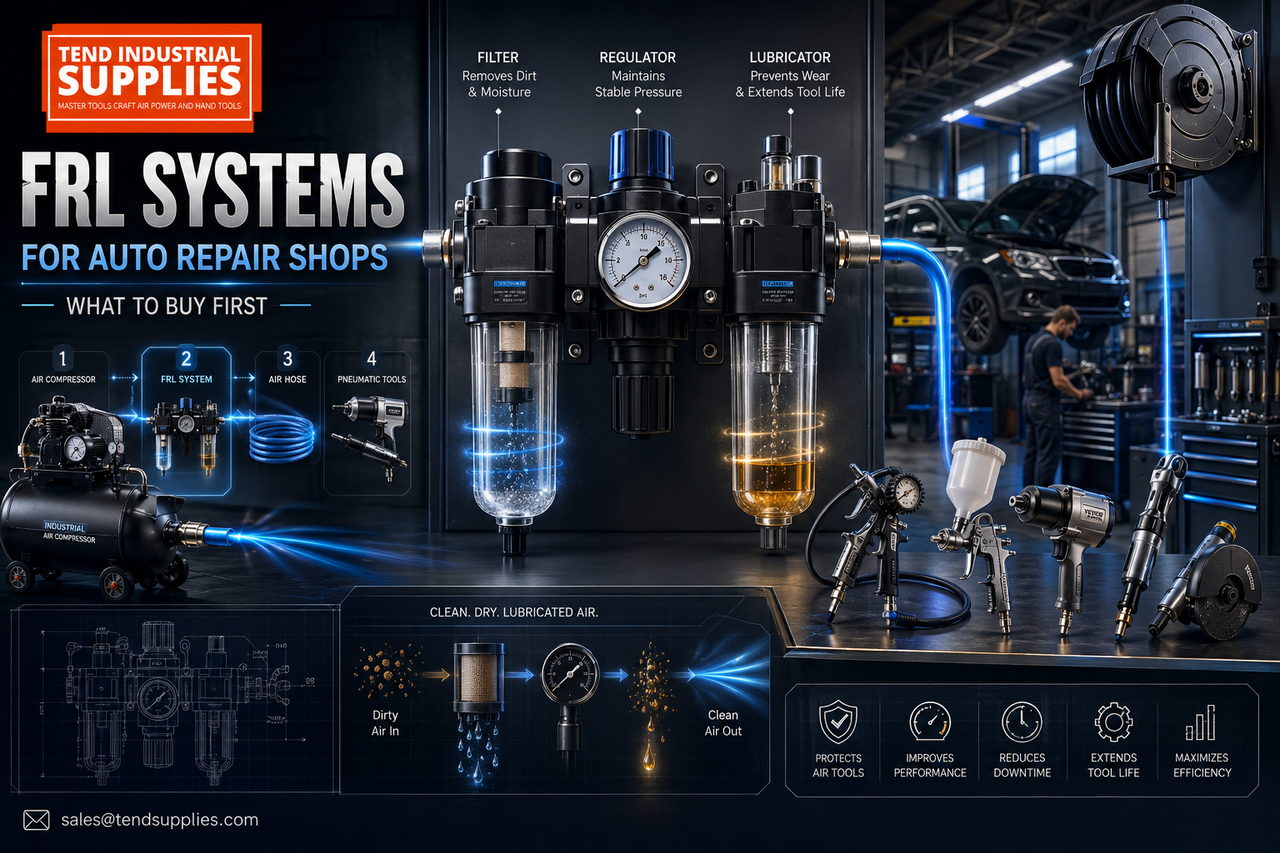
FRL Systems for Auto Repair Shops: What to Buy First

Last verified: July 30, 2026.
For most auto repair shops, the first air preparation purchase should be a correctly sized filter regulator. Add a lubricator only when the connected pneumatic tools require oil in the air stream. This avoids pressure loss, protects tools from water and debris, and prevents oil from reaching paint or tire inflation lines.
Ready to improve your shop air? Compare FRL and air preparation equipment, or request technical help and bulk pricing for a multi-bay installation.
[EDITOR IMAGE SLOT: Upload a wide workshop air-line image here. Recommended alt text: FRL system installed for an auto repair shop compressed air line.]
What should an auto repair shop buy first?
Start with filtration and pressure regulation at the point where air enters the work area. A filter removes liquid water and particles. A regulator sets the downstream pressure that the tools actually receive. A lubricator adds a controlled oil mist, but it should serve only compatible tool lines. Paint guns, breathing air, some plasma equipment and many inflation tasks must remain oil free.
Recommended purchase order
- Confirm compressor delivery. Record usable CFM at the pressure your tools require, not only the compressor displacement rating.
- List the tools that may run together. A single impact wrench is a different load from two impacts, an air ratchet and a blow gun working at once.
- Choose the port and flow capacity. Select an FRL whose rated flow exceeds realistic simultaneous demand with room for short peaks.
- Separate oil-free and lubricated branches. This is essential in collision repair and paint work.
- Add isolation and drainage. Install a shutoff and make condensate removal part of the maintenance routine.
FRL selection by shop size and bay count
| Shop profile | Typical simultaneous demand | Practical starting point | What to verify |
|---|---|---|---|
| One service bay | One intermittent air tool plus inflation or blow-off | Compact filter regulator close to the bay | Tool CFM, hose length and pressure drop |
| Two to three bays | Two tools may overlap during peak work | Larger main filter regulator with branch controls | Peak combined CFM and future tool additions |
| Four to eight bays | Several impacts, ratchets and blow guns | Central high-flow preparation plus point-of-use regulation | Main line diameter, dryer capacity and pressure at the farthest bay |
| Collision or paint shop | Body tools plus paint and finishing equipment | Separate lubricated tool branch and oil-free paint branch | Coalescing filtration, dew point and contamination control |
| Fleet maintenance shop | High torque tools, tire service and multiple technicians | High-flow central unit with zoned branches | Shift peak demand, hose reels and expansion margin |
This table is a purchase framework, not a substitute for actual flow data. For a detailed calculation, use our five-step FRL sizing method.
How to calculate the flow capacity you need
Add the CFM of tools likely to operate at the same time, then apply a reasonable operating factor rather than summing every tool in the building. Add capacity for leakage, hose losses and growth. The chosen unit must maintain the required downstream pressure while air is flowing. A port size that physically connects to the pipe does not guarantee enough airflow.
Example for a three-bay workshop
Assume one impact wrench uses 24 CFM during a demanding fastening task, one die grinder uses 18 CFM, and a blow gun uses 8 CFM. If the impact and grinder may overlap, the realistic peak is about 42 CFM before leakage and growth allowance. The final selection should be based on the manufacturer’s flow curve at the intended inlet pressure and acceptable pressure drop.
Filter, regulator and lubricator: what each part does
Filter
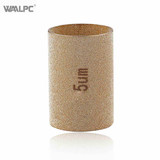
The filter captures particles and separates bulk liquid water. A 5 micron general-purpose element is a practical starting point for many workshop tool lines. Paint and sensitive instrumentation may need finer or coalescing filtration downstream.
Regulator
The regulator reduces higher compressor line pressure to a stable working pressure. Install a readable gauge and set pressure while air is flowing. Setting pressure with no load can hide a severe drop caused by an undersized filter, fitting, hose or regulator.
Lubricator
The lubricator meters oil into the air stream for tools that need continuous mist lubrication. It must be installed after the filter and regulator. Do not place it upstream of paint guns or other processes where oil contamination will damage the result.
When the WAALPC AC2000-02 is a suitable starting point
The WAALPC AC2000-02 is a compact combination unit with 1/4 inch NPT connections, manual drain and 5 micron filtration. It is a practical candidate for a single bay, a point-of-use station or a dedicated low-to-moderate flow tool branch. It should not be selected only because its threads match the hose. Confirm the required flow and allowable pressure loss first.
For larger shops, long distribution runs or several technicians operating simultaneously, request a larger body and port size. A central unit that is too small wastes compressor energy and produces slow tools even when the compressor itself is adequate.
Installation mistakes that reduce tool performance
- Installing the unit backward instead of following the flow arrow.
- Using undersized quick couplers or long narrow hoses after a correctly sized regulator.
- Mounting the lubricator on a paint or inflation branch.
- Setting pressure with all tools off.
- Ignoring drain maintenance until water reaches the tool.
- Choosing by pipe thread alone without checking the flow curve.
- Placing the unit where the bowl, gauge or drain cannot be inspected safely.
Maintenance schedule for workshop FRL systems
| Interval | Inspection | Action |
|---|---|---|
| Daily | Bowl water level, pressure and visible leaks | Drain condensate and correct abnormal pressure |
| Weekly | Hoses, couplers and lubricator level | Repair leaks and refill with the approved lubricant |
| Monthly | Filter condition and gauge accuracy | Clean or replace components as required |
| Quarterly | Pressure drop under normal peak load | Investigate restriction, contamination or undersizing |
| Annually | System demand and bay configuration | Resize branches if tools or staffing have changed |
Information to send when requesting an FRL quote
For a faster and more accurate recommendation, provide the number of service bays, compressor horsepower and receiver size, compressor outlet pressure, main pipe size, longest hose run, tool models, individual CFM requirements, tools that may run together, and whether any line must remain oil free. Also state the desired port thread and whether manual or automatic drainage is preferred.
Buying one unit? Browse the air preparation and FRL category. Equipping several bays? Request a shop quote with the bay-count information above. You can also compare related equipment in our pneumatic air tools department.
Frequently asked questions
Does every auto repair shop need a lubricator?
No. Every shop benefits from clean, regulated air, but lubrication should be limited to tool branches that require an oil mist. Keep paint, inflation and other contamination-sensitive lines oil free.
Is a 1/4 inch FRL large enough for an impact wrench?
It may be suitable for one intermittent tool when its rated flow supports the tool’s real CFM demand. The connection size alone does not prove adequate flow.
Where should the FRL be installed?
Install central preparation after the receiver and dryer as applicable, then use point-of-use regulation near the work area. Follow the manufacturer’s flow direction and leave room for inspection and drainage.
What pressure should pneumatic tools receive?
Use the tool manufacturer’s recommended pressure, commonly stated at the tool inlet while the tool is operating. Excess pressure accelerates wear and does not correct an undersized air line.
How often should an FRL filter be replaced?
Replace it according to condition, pressure drop and the manufacturer’s instructions. Wet or dirty compressor systems will require more frequent service than clean, dry systems.
Should a multi-bay shop use one large FRL or several smaller units?
Many shops perform best with central filtration and properly sized branch or point-of-use regulation. Separate branches also make it easier to keep paint air oil free while lubricating selected tool lines.
Next purchase checks for your workshop
For an oil-free spray branch, use our paint-booth filter-regulator buying guide. For servicing an existing assembly, follow the WAALPC replacement-filter matching and maintenance guide.
When matching tool demand to your air system, compare the Shinano SI-1205B and SI-1218EX 3/8-inch ratchets, or check access and air requirements in the SI-1610SR compact-impact buying guide.

Newest Guide & products Updates
Air Regulators for Paint Booths: What to Buy Before You Order
For a paint-booth spray-air branch, buy a correctly sized filter-regulator without an oil-mist lubri...
Best 3/8-Inch Air Ratchet for Mechanics: SI-1205B or SI-1218EX?
Choose the Shinano SI-1205B when a light, compact 3/8-inch air ratchet is the priority; compare the...
Compact Air Impact Wrench for Tight Automotive Spaces: SI-1610SR Buying Guide
Buy a compact air impact wrench when access and manageable tool weight matter—but only after checkin...
WAALPC FRL Replacement Filters: Match the Part Before You Buy
Buy a replacement FRL filter element by its confirmed model family and dimensions—not by the words “...
Shinano 5-Inch Air Grinder Review: M14 vs 5/8-11 Spindle
Tend Industrial Knowledge Center / Product comparisons Looking for the best 5-inch air angle grinde...
Premium Air Impact Wrenches: Shinano vs CP, Dynabrade & Ingersoll Rand
Hero: original AI-generated editorial illustration; pictured tools are not exact product models. A s...