
Best 3/8-Inch Air Ratchet for Mechanics: SI-1205B or SI-1218EX?

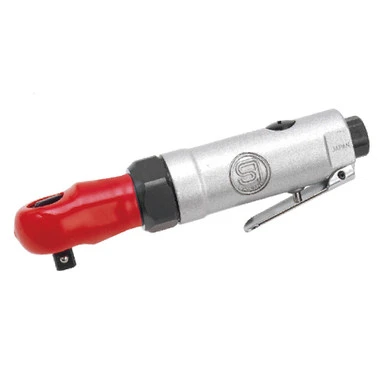
Choose the Shinano SI-1205B when a light, compact 3/8-inch air ratchet is the priority; compare the SI-1218EX when you prefer a higher published free speed and slightly higher torque within a similar small-tool role. Neither is a substitute for an impact wrench on stubborn fasteners or for a calibrated torque wrench when completing a specified tightening procedure.
For professional mechanics, the right purchase is the ratchet that reaches the job with the intended socket attached and suits the air supply already in the bay. This guide narrows that decision to two specific models instead of ranking tools by unsupported “best overall” claims.

SI-1205B versus SI-1218EX: the decision table
| Manufacturer-published specification | SI-1205B | SI-1218EX |
|---|---|---|
| Square drive | 3/8 inch | 3/8 inch |
| Maximum torque | 40 Nm | 45 Nm |
| Working torque range | 0–30 Nm | 0–36 Nm |
| Free speed | 220 rpm | 300 rpm |
| Tool weight | 0.51 kg | 0.54 kg |
| Average air consumption | 1.6 CFM | 1.6 CFM |
| Published air-inlet size | 1/4 inch | 1/4 inch |
Sources: Shinano’s SI-1205B specification page and SI-1218EX specification page. Free speed is a no-load rating, not a measured job-completion time. Average air consumption is not a full statement of continuous running demand.
Which one should you buy?
Choose the SI-1205B for a simple, lightweight compact ratchet
The Shinano SI-1205B 3/8-inch air ratchet is the starting choice when your requirement is controlled access to smaller fasteners and rapid run-down or run-out after initial loosening. It suits buyers who value a small tool and do not need to pay for capability that belongs in a different tool category.
Check its fit with the actual socket arrangement. A compact bare ratchet can become awkward once a deep socket, adapter, air fitting and hose are added. “Mini” is a description, not a guarantee that it will fit a particular alternator bracket, under-dash location or engine-bay gap.
Compare the SI-1218EX for its different speed and handling features
The Shinano SI-1218EX 3/8-inch air ratchet offers the higher free-speed and torque figures shown above. Shinano also describes a composite body cover and a swivelling air inlet. Consider those differences when comparing the tool’s feel and how the hose will be positioned.
Do not assume the higher number makes it the correct choice for every technician. A faster no-load speed does not prove an advantage in a restricted location, and neither model’s maximum torque rating tells you the exact torque delivered to a particular joint.
Three checks that matter more than the headline torque
Check the complete access envelope
Measure the available space around representative jobs with the intended socket installed. Allow room to operate the direction control, hold the tool without trapping fingers and route the hose without a sharp bend. Share a photo and measurements for a buying discussion, but do not treat a remote photo assessment as a guaranteed vehicle fitment.
Check how the fastener will first be loosened
A mini air ratchet is useful once an appropriate method has broken a tight fastener free. Where the work requires substantial breakaway capability, choose the correct manual or impact tool for that first operation. Do not add a cheater pipe to the air ratchet or assume its small mechanism is intended to absorb unlimited manual force.
Check the tool’s running air supply
Confirm the actual operating-pressure and air-supply requirements in the supplied instructions, plus the fitting thread type for the unit being delivered. A 1/4-inch inlet description should not be read as permission to force a different pipe thread into the housing.
For planning several tools in one bay, start with Tend’s air-tool and compressor planning calculator, then verify the inputs against manufacturer data. A compressor’s tank size or an average-CFM figure alone cannot confirm performance through your regulator, couplers and hose.
What your order should include
Specify the exact model, quantity and 3/8-inch socket interface. Ask whether the quoted price covers a bare tool or a kit, which air fittings or accessories are included, and which maintenance items are recommended for that supplied version. Do not assume sockets, oil or a carrying case are included because they appear in another product photograph.
For a shop order, separate the tool from supporting items in the quote: suitable sockets, correct couplers, compatible hose and any manufacturer-required lubrication supplies. This makes it easier to compare complete costs instead of a low tool-only price followed by several additional purchases.
Where neither model matches the job, browse Tend’s air-ratchet range and request a model-specific alternative. State whether the unmet requirement is head clearance, reach, drive size or a different fastening task; “more powerful” is often too vague to identify the right replacement.
Frequently asked questions
Is the SI-1205B suitable for professional mechanics?
It is a candidate for a professional bay that needs its compact size and published performance. Match it to the job and supply rather than treating professional use as one universal torque requirement.
Can either ratchet remove wheel nuts?
Do not choose a mini ratchet as the primary wheel-nut breakaway tool. Use equipment appropriate to that fastener and complete installation with the specified tightening procedure.
Does 300 rpm make the SI-1218EX proportionally faster on every job?
No. Free speed does not account for load, access, thread condition, hose restrictions or operator workflow.
Will my small compressor run one?
Possibly, but that must be checked against pressure, delivered airflow, usage pattern and the complete air path. The shared average-air figure does not guarantee continuous operation.
Can I order multiple ratchets for my workshop?
Yes—request a business quote with model, quantity, delivery postcode and required date. Ask for confirmation of availability and included items rather than assuming every quantity can ship immediately.

Newest Guide & products Updates
Air Regulators for Paint Booths: What to Buy Before You Order
For a paint-booth spray-air branch, buy a correctly sized filter-regulator without an oil-mist lubri...
Best 3/8-Inch Air Ratchet for Mechanics: SI-1205B or SI-1218EX?
Choose the Shinano SI-1205B when a light, compact 3/8-inch air ratchet is the priority; compare the...
Compact Air Impact Wrench for Tight Automotive Spaces: SI-1610SR Buying Guide
Buy a compact air impact wrench when access and manageable tool weight matter—but only after checkin...
WAALPC FRL Replacement Filters: Match the Part Before You Buy
Buy a replacement FRL filter element by its confirmed model family and dimensions—not by the words “...
Shinano 5-Inch Air Grinder Review: M14 vs 5/8-11 Spindle
Tend Industrial Knowledge Center / Product comparisons Looking for the best 5-inch air angle grinde...
Premium Air Impact Wrenches: Shinano vs CP, Dynabrade & Ingersoll Rand
Hero: original AI-generated editorial illustration; pictured tools are not exact product models. A s...