
Air Regulators for Paint Booths: What to Buy Before You Order


For a paint-booth spray-air branch, buy a correctly sized filter-regulator without an oil-mist lubricator. Then confirm whether the coating and spray-gun requirements call for additional drying, fine filtration or oil-vapour treatment. A compact workshop filter-regulator can control pressure and provide a first filtration stage; it should not be sold as a complete clean-air solution simply because it has a bowl and gauge.
This buying guide is for collision-repair shops, refinishing businesses and maintenance teams choosing equipment for an existing compressed-air supply—not for customers seeking a general explanation of an FRL.
What should you buy for your particular setup?
| Your situation | Buying direction | Check before paying |
|---|---|---|
| You already have suitable dried and filtered spray air, but need local pressure control | A regulator or filter-regulator with adequate working flow | Pressure stability at the gun while it is flowing, not just a static gauge reading |
| Your line carries liquid water or particles | Correct the upstream problem and select suitable separation and filtration | Drain operation, filter specification and whether a dryer is also required |
| Your coating system has demanding air-purity requirements | A treatment train specified for that coating process | Oil-aerosol removal, oil-vapour treatment and moisture requirements |
| Your existing air branch also lubricates impact wrenches or grinders | A dedicated spray-air branch separated before oil is introduced | No shared downstream oily hose or equipment |
Manufacturer equipment illustrates why the distinction matters. SATA offers different stages for bulk separation, fine filtration and activated-carbon treatment; those stages do different jobs. This does not mean a SATA component is supplied with a WAALPC unit or that the two are interchangeable. See SATA’s manufacturer description of a multi-stage paint-air system.
Where the WAALPC AW2000-02 fits—and where it does not
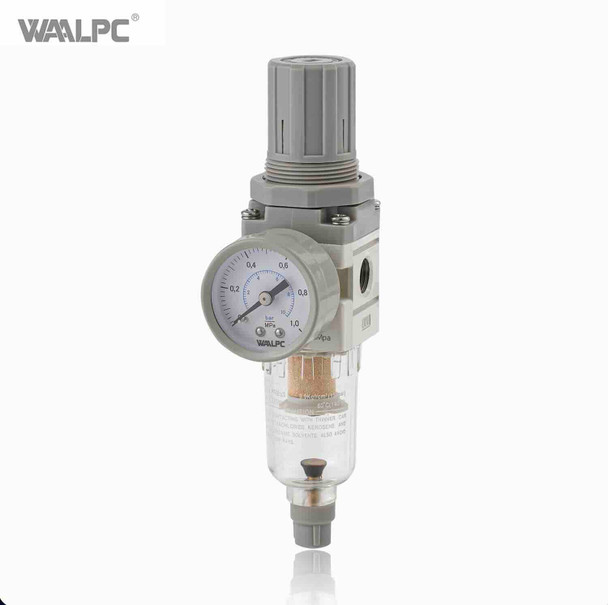
The WAALPC AW2000-02 filter-regulator listing describes a compact, manual-drain unit with 1/4-inch NPT ports and 5-micron filtration. The listing also contains inconsistent model identifiers and drain descriptions. Request written confirmation of the supplied model, drain arrangement and filtration specification before ordering; do not treat the page as confirmation of a paint-system match.
Do not select it merely because your hose has a 1/4-inch fitting. Port compatibility answers whether a fitting can connect; it does not establish whether the component will maintain the required downstream pressure during spraying. Request the relevant flow information when the gun’s demand or the permissible pressure drop is uncertain.
For a broader choice of first-stage components, review Tend’s air-filter and filter-regulator products. Keep the purchase specific: regulation, filtration, drying and any specialist treatment should appear as separate requirements in the quote.
Five details that make the quote accurate
1. Spray-gun airflow and specified inlet pressure
Provide the gun’s exact model and technical data, including the conditions at which airflow is stated. Include the number of guns that may run at the same time. Avoid replacing actual model data with a generic pressure for all HVLP or other spray equipment.
2. Existing treatment and contamination history
List the dryer, separators, filters and drains already installed. Tell the supplier whether the concern is water in the bowl, pressure instability, visible contamination or a coating defect. A regulator purchase alone is not a diagnosis or a guaranteed cure for a finishing problem.
3. Hose, couplers and connection threads
Give the hose’s internal diameter and length, the quick-coupler type and the actual port thread. Similar-looking NPT and other pipe connections must not be treated as interchangeable. Photograph the labels and fittings when the existing installation is uncertain.
4. Location, bowl material and maintenance access
Confirm ambient conditions and exposure to solvents or cleaning chemicals. Choose and locate the unit according to its material compatibility and installation instructions, with access to the gauge and drain. A transparent bowl is not permission to install a component anywhere inside a paint operation.
5. Manual versus automatic drainage
A manual drain suits a routine that genuinely includes inspection and draining. Automatic drainage may reduce manual intervention, but it still needs inspection and must match operating conditions. Do not buy on a “maintenance-free” promise.
Do not mix spray air with lubricated tool air
A body shop may use the same compressor for spraying, sanding and fastening, but that does not mean every branch should receive oil mist. Separate the spray supply from branches that intentionally add tool oil, and keep the downstream hoses identified. Our existing FRL buying guide for auto repair shops explains the broader branch-selection decision without turning the spray line into a lubricated tool station.
What to put on the purchase request
Use this short specification: “Supply a filter-regulator for [gun model], serving [number] simultaneous guns, with [required pressure] at the gun under flow. Existing treatment is [details]. Hose is [internal diameter and length]. Confirm connection threads, available flow information, filtration grade, drain type, bowl/material suitability, included mounting items and replacement-element availability. No oil-mist lubricator on this branch.”
Ask for the current price, available quantity, included components and delivery estimate in the same reply. This guide does not promise stock or a dispatch deadline; those are order-specific facts.
Frequently asked questions
Can I use a complete FRL on a paint gun?
Do not introduce lubricator oil into the spray-air supply. Specify a filter-regulator and any additional treatment the process requires, rather than assuming every three-part FRL is suitable.
Will a water separator replace an air dryer?
No. Removing separated liquid water is not the same as controlling water vapour or meeting a dew-point requirement. Verify what your process needs.
Is a 5-micron element enough for every paint finish?
No. The grade describes one filtration characteristic. It does not, on its own, establish the required overall air quality.
Should I choose the larger port automatically?
No. Compare flow performance, permitted pressure loss, mounting and the complete hose-and-coupler path. Larger threads alone do not validate the system.
Can Tend quote more than one spray-air station?
Submit the number of stations and simultaneous gun demand, together with the existing system details. Request a matched quote rather than multiplying a single compact unit without checking capacity.

Newest Guide & products Updates
Air Regulators for Paint Booths: What to Buy Before You Order
For a paint-booth spray-air branch, buy a correctly sized filter-regulator without an oil-mist lubri...
Best 3/8-Inch Air Ratchet for Mechanics: SI-1205B or SI-1218EX?
Choose the Shinano SI-1205B when a light, compact 3/8-inch air ratchet is the priority; compare the...
Compact Air Impact Wrench for Tight Automotive Spaces: SI-1610SR Buying Guide
Buy a compact air impact wrench when access and manageable tool weight matter—but only after checkin...
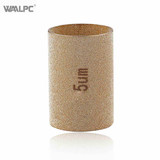
WAALPC FRL Replacement Filters: Match the Part Before You Buy
Buy a replacement FRL filter element by its confirmed model family and dimensions—not by the words “...
Shinano 5-Inch Air Grinder Review: M14 vs 5/8-11 Spindle
Tend Industrial Knowledge Center / Product comparisons Looking for the best 5-inch air angle grinde...
Premium Air Impact Wrenches: Shinano vs CP, Dynabrade & Ingersoll Rand
Hero: original AI-generated editorial illustration; pictured tools are not exact product models. A s...