
The Ultimate Guide to Choosing a 4-Inch Pneumatic Disc Sander for Auto Body Work

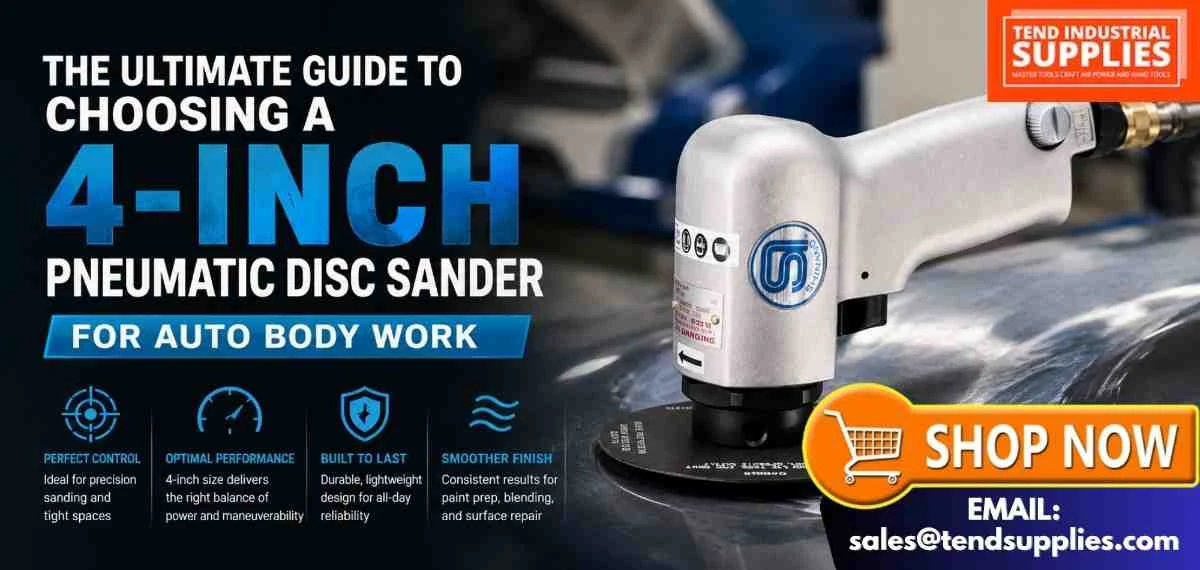
A 4 inch pneumatic disc sander is one of the most useful finishing and prep tools in an auto body shop because it covers the gap between a broad dual-action sander and a narrow die grinder. When you are featheredging paint, blending filler edges, cleaning corrosion, or refining weld areas on patch panels, the right 4-inch tool gives you speed without sacrificing control. That is exactly why buyers comparing sanders for body repair should pay close attention to regulator design, pad size flexibility, air demand, ergonomics, and overall value before they buy a tool that will be used every day.
For technicians who want a professional-grade option at clearance pricing, the Shinano SI-2210 disc sander deserves close attention.
Tend Industrial Supplies is an authorized Shinano distributor. Links on this page may generate a commission at no extra cost to you.
Quick Answer
A 4-inch pneumatic disc sander is one of the best tools for auto body work because it offers the ideal balance of control, maneuverability, and material removal. It is perfect for featheredging paint, blending filler, rust removal, weld cleanup, and spot repairs where larger sanders may be too aggressive or difficult to control.
Key Takeaways
- A 4 inch pneumatic disc sander is the sweet spot for featheredging, rust cleanup, spot repair, and weld preparation on automotive panels.
- A built-in air regulator matters because it helps you control speed and heat on thin sheet metal, not just peak RPM.
- Compressor matching is critical; buyers should evaluate real-world airflow delivery at 90 PSI, hose size, and duty cycle instead of relying on tank size alone.
- The Shinano SI-2210 disc sander stands out because it combines body-shop-friendly control with strong value at its $46.80 clearance price.
- Shops can get more out of this purchase by pairing it with the Shinano SI-4700B air saw the Shinano SI-2001S straight die grinder, and the Shinano SI-1200B mini air ratchet.
Why a 4 Inch Pneumatic Disc Sander Is the Sweet Spot for Auto Body Work
The reason body technicians keep reaching for a 4 inch pneumatic disc sander is simple: it removes material fast enough to be productive, but it is still compact enough to stay controllable near body lines, panel edges, wheel arches, and repair boundaries. A 6-inch sander covers more surface area, but it can feel oversized when you are working around localized damage. A small roll-lock tool can be excellent for detail work, but it often slows the technician down on broader blending tasks. Four inches is the practical middle ground.
In collision repair and restoration, that balance matters. Featheredging requires an abrasive footprint large enough to create a smooth transition without digging a trench into the surrounding finish. Spot sanding requires enough stability to stay flat over body filler and primer edges. Rust cleanup requires firm contact without so much pad overhang that the operator loses control and heats the panel excessively. In each of those scenarios, a properly sized disc sander offers repeatability that helps both experienced technicians and serious DIY users produce better results.
The 4-inch format is also highly versatile in mixed-material workflows. A body technician may use the same tool to strip paint from a repair perimeter, level a small weld area, and then refine the workpiece before a primer stage. That flexibility is one reason professional air sanders remain core equipment in high-throughput shops.
|
Auto Body Task |
Why 4 Inches Works Well |
Where a Larger or Smaller Tool Falls Short |
|
Featheredging paint edges |
Creates a smooth transition while staying manageable near contours |
A 6-inch pad can be too broad for localized work |
|
Spot repair sanding |
Covers enough area to stay productive |
Small detail tools may be too slow |
|
Rust removal on isolated spots |
Gives better control over pressure and angle |
Larger tools can generate unnecessary heat |
|
Weld seam prep and cleanup |
Balances removal rate and visibility |
Tiny tools can chatter; larger tools obscure the work area |
|
Blending filler and primer edges |
Helps keep the surface consistent |
Oversized pads can roll off sharp contours |
Better control around contours and repair zones
Auto body work is rarely flat and open. Quarter panels, rocker sections, door bottoms, wheel lips, and fender edges all force the operator to manage contact pressure carefully. The 4-inch footprint lets the technician keep the abrasive where it belongs without allowing the tool to dominate the repair.
Fast enough for production, precise enough for finish prep
Technicians do not choose air tools only for power. They choose them for consistency over long shifts. A quality 4 inch pneumatic disc sander can remove enough material for productive prep work while still letting the operator slow down and finesse the finish as the surface approaches primer-ready condition.
How to Choose a 4 Inch Pneumatic Disc Sander for Auto Body Work
When comparing body-shop sanders, buyers should look beyond brand recognition and focus on the features that affect finish quality, fatigue, and operating cost. The most important considerations are speed control, balance, grip comfort, pad compatibility, and realistic air requirements.
|
Buying Factor |
Why It Matters in a Body Shop |
What to Prioritize |
|
RPM range and controllability |
High speed is useful, but controllable speed protects thin sheet metal |
A responsive throttle plus regulator control |
|
Built-in regulator |
Helps trim speed for paint prep and heat-sensitive metal |
A design that adjusts easily during work |
|
Pad options |
Different repairs favor different disc diameters |
Compatibility with 3-inch and 4-inch pads is a major plus |
|
Weight and balance |
Affects operator fatigue and precision over long jobs |
A compact, well-balanced housing |
|
Air consumption |
Determines whether your compressor can sustain work |
Match tool demand to real compressor output at 90 PSI |
|
Build quality |
Impacts bearing life, vibration, and daily reliability |
Proven shop-grade construction |
A buyer who only looks at maximum speed often ends up with the wrong tool. For example, peak RPM can help with aggressive stripping, but body work usually rewards usable speed rather than uncontrolled speed. Similarly, a low advertised price may look attractive until poor balance, inconsistent throttle control, or weak accessory support begin to affect the repair process.
Shops that already rely on pneumatic air tools understand this dynamic well. The right purchase is the one that improves workflow quality, not the one that merely checks a catalog box.
Why the Best 4 Inch Pneumatic Disc Sander Includes a Built-In Air Regulator
A built-in air regulator is one of the most practical features a buyer can ask for in a 4 inch pneumatic disc sander intended for automotive work. It gives the operator a more refined way to manage speed than simple trigger pressure alone. That matters because many body repairs are performed on thin, heat-sensitive steel or aluminum panels where too much friction can distort the metal, smear filler, or overwork the abrasive.
With a regulator, a technician can tune the tool to the job. If the task is aggressive coating removal, more speed may be appropriate. If the task is featheredging primer near a blend edge or cleaning a fresh weld without blueing the surrounding steel, a reduced speed setting can be more effective. In practice, regulated control is less about making the tool slower and more about making it more predictable.
This is one reason the Shinano SI-2210 disc sander deserves attention. A built-in regulator gives the operator more flexibility across different stages of body repair, which is exactly what busy technicians need when moving from stripping to blending to prep. That kind of practical feature also aligns well with the reputation of Shinano pneumatic tools from Japan among buyers who value refined control and long service life.
For professionals who want to go deeper into tool longevity, Tend Supplies also publishes guidance on advanced air tool maintenance techniques and the broader Ultimate guide to pneumatic air tools.
Air Consumption Realities: What Compressor Do You Actually Need?
One of the most common mistakes buyers make is assuming that any compressor with a large-looking tank will automatically run a sander properly. In real shop use, the key measurement is delivered airflow at working pressure, not tank size by itself. A 4 inch pneumatic disc sander can only perform consistently if the compressor keeps up with the tool’s sustained demand.
That means buyers should evaluate the entire air system: compressor output at 90 PSI, regulator setting, hose diameter, coupler restrictions, and how often the tool will be run continuously. A home garage user doing short bursts of spot repair can get by with less capacity than a production technician who runs the tool repeatedly through the day. Even so, starvation is the enemy in both cases. An under-supplied sander will lose speed, feel inconsistent, and encourage the operator to push harder than necessary, which can worsen finish quality.
|
Use Pattern |
Compressor Guidance |
Practical Recommendation |
|
Light DIY spot repairs |
Small compressor may work in short bursts |
Expect recovery pauses between sanding intervals |
|
Regular garage restoration work |
Mid-capacity compressor is more realistic |
Prioritize stable PSI and proper hose sizing |
|
Daily professional body shop use |
Continuous airflow matters most |
Choose a compressor with headroom, not just minimum output |
If you are unsure how to size your setup, review Tend Supplies’ air compressor buying guide for home garage and shop use. It is also worth remembering that a clean, lubricated, properly regulated air system will help any sander perform better and last longer.
Product Spotlight: Why the Shinano SI-2210 Is a Smart Clearance Buy
The Shinano SI-2210 disc sander is compelling because it addresses the exact selection criteria serious buyers should care about. It is designed for body-shop-style control, it features a built-in regulator for speed management, and it offers useful pad flexibility rather than forcing the user into a one-size-fits-all setup. In value terms, the standout fact is the current clearance price of $46.80, which puts professional-grade capability within reach of independent technicians, restoration shops, and committed DIY users who would normally expect to pay more for Japanese-engineered air tools.
The buying case becomes even stronger when you think in workflow terms. A body repair technician can use the SI-2210 for featheredging and spot prep, then move to the Shinano SI-4700B air saw for panel cutting, the Shinano SI-2001S straight die grinder for burr work and detail grinding, and the Shinano SI-1200B mini air ratchet for fastener access during teardown and reassembly. That makes the clearance event more than a single-tool purchase; it is an opportunity to round out a highly effective pneumatic tool kit.
If you follow Japanese tool manufacturing closely, the SI-2210 also fits naturally alongside the themes explored in Tend Supplies’ articles on the top Japanese air tool brands and the best Japanese tools worth importing.
Mid-Article CTA: Get the SI-2210 While Clearance Pricing Lasts
If your shop needs a 4 inch pneumatic disc sander for spot repair, featheredging, or rust cleanup, this is the right time to shop the Shinano SI-2210 disc sander clearance deal. At $46.80, it is one of the strongest value plays in the Shinano clearance campaign.
Common Buying Mistakes to Avoid
The first mistake is overbuying for raw speed and underbuying for control. Body work is about finish quality. A tool that is too aggressive or poorly regulated can do more harm than good.
The second mistake is ignoring air supply realities. If your compressor cannot sustain the tool, you will not see the performance you paid for. Review compressor capacity before ordering, and make sure your hose and fittings are not choking the system.
The third mistake is overlooking shop ecosystem fit. Buyers often evaluate each tool in isolation, but productivity comes from having the right mix of tools for cutting, grinding, sanding, and assembly. That is why it makes sense to view the SI-2210 alongside related resources such as Tend Supplies’ guide to 10 essential air tools every mechanic needs and, where heavy fastener work is involved, the category for air impact wrenches.
Final Verdict
For auto body technicians, restorers, and serious DIY users, a 4 inch pneumatic disc sander remains one of the most practical tools for localized surface preparation. The best models are not just fast; they are controllable, comfortable, and easy to integrate into a real air system. That is exactly why the Shinano SI-2210 disc sander stands out. It addresses the features that matter most in body repair, and its $46.80 clearance price gives it a value proposition that is difficult to ignore.
CTA: Buy the Shinano SI-2210 Disc Sander
If you want a body-shop-ready 4 inch pneumatic disc sander with better speed control and stronger value than most bargain-bin alternatives, buy the Shinano SI-2210 disc sander here. While you are there, explore the wider Shinano air tool lineup and the full air tools collection to build out a more capable shop setup.
FAQs About Choosing a 4-Inch Pneumatic Disc Sander
What is a 4 inch pneumatic disc sander best used for in auto body work?
A 4-inch pneumatic disc sander is best used for featheredging paint, spot sanding repairs, cleaning rusted areas, refining weld zones, and blending filler or primer edges. It offers better control than larger sanders when the repair area is localized.
Does a built-in regulator really matter on a pneumatic sander?
Yes. A built-in regulator helps the operator fine-tune speed to the material and task. That improves control, reduces the risk of overheating thin panels, and makes the tool more versatile across stripping, blending, and prep work.
Can a small home compressor run a 4 inch pneumatic disc sander?
It can for short, intermittent jobs, but sustained sanding usually requires more airflow than many entry-level compressors can provide comfortably. The safest approach is to check your compressor’s delivered airflow at 90 PSI and size for headroom rather than the bare minimum.
What pad size flexibility should buyers look for?
Pad versatility is valuable because different repairs benefit from different footprints. A tool that supports both 3-inch and 4-inch work expands your options for tight areas and general spot prep without requiring multiple sanders.
Is the Shinano SI-2210 a good value at the clearance price?
Yes. The SI-2210 combines shop-relevant features, Japanese-brand credibility, and a body-work-friendly design with a $46.80 clearance price, making it a strong value choice for professionals and serious DIY buyers alike.
Related Articles:
The Ultimate Guide to Pneumatic Air Tools: Everything You Need to Know
5 Ways a Pneumatic Air Saw Saves Time in Collision Repair
7 Impossible Fasteners You Can Reach with a Mini Air Ratchet
The Essential Guide to Pneumatic Tools in Industrial Settings: Maximizing Efficiency and Safety
A Beginner's Guide to Cylinder Head Porting with a Pneumatic Die Grinder

Newest Guide & products Updates
Shinano 5-Inch Air Grinder Review: M14 vs 5/8-11 Spindle
Tend Industrial Knowledge Center / Product comparisons Looking for the best 5-inch air angle grinde...
Premium Air Impact Wrenches: Shinano vs CP, Dynabrade & Ingersoll Rand
Hero: original AI-generated editorial illustration; pictured tools are not exact product models. A s...
WAALPC AC2000 vs AC3000 vs AC4000: Which FRL System Does Your Workshop Need?
WAALPC AC2000 compact FRL and AC4000 higher-flow FRL. Match body size, port and flow to the comp...
VEVOR Drain Camera Replacement Parts: Cables, Camera Heads, Screens, Skids and Chargers
A complete VEVOR drain-camera system includes model-specific electronic, cable and camera-head com...

Why Industrial Suppliers Are Finally Ditching Spreadsheets for Real Systems
Why Industrial Suppliers Are Finally Ditching Spreadsheets for Real Systems Walk into most tool dist...

The Technical Evolution of Automotive Electronics: Why Professional Dashcam Hardwiring is No Longer Optional
Why Professional Dashcam Hardwiring is No Longer Optional The automotive industry is undergoing a m...