
A Beginner's Guide to Cylinder Head Porting with a Pneumatic Die Grinder

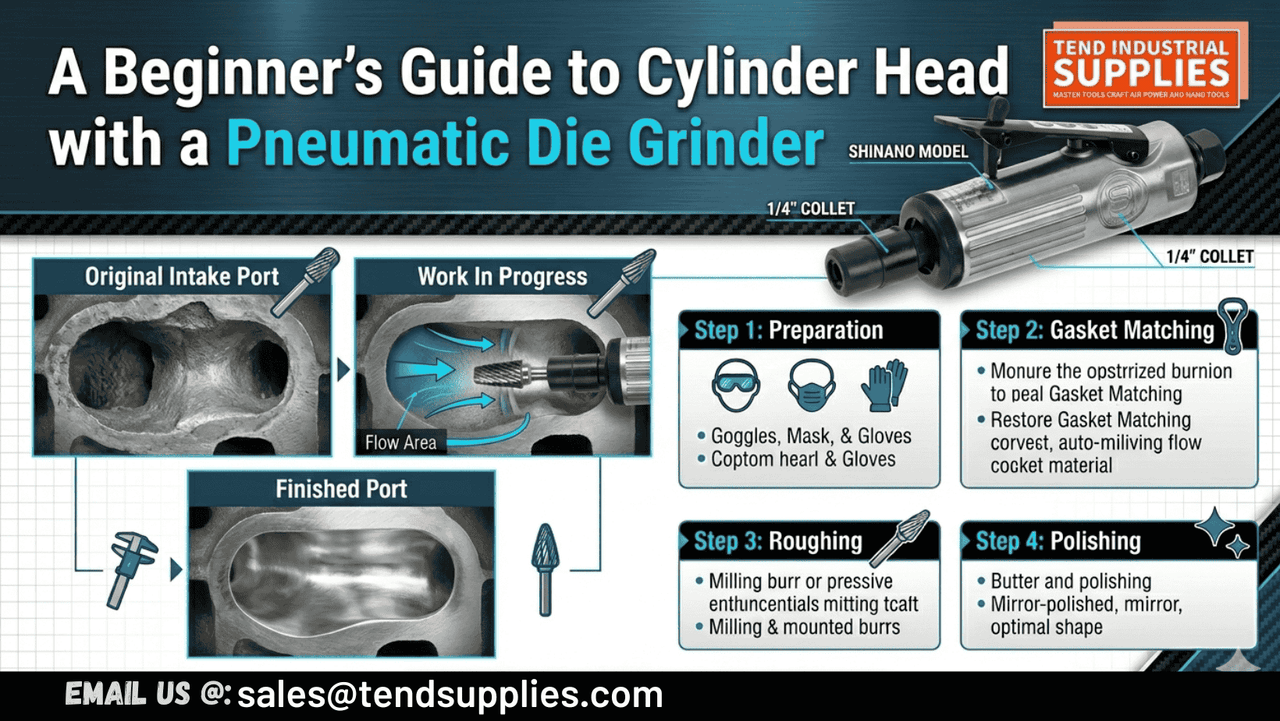
A cylinder head porting die grinder setup is one of the most important parts of beginner engine work because the wrong tool makes careful shaping feel impossible. Porting is not about wildly hogging out metal. It is about controlled airflow improvement, careful material removal, and repeatable hand position. Beginners who approach porting with the wrong grinder often end up fighting tool size, unstable burr tracking, and poor throttle control long before they learn what the ports actually need. That is why choosing a compact pneumatic die grinder with the right speed and feel matters so much.
For entry-level porting and general inline grinding work, the Shinano SI-2001S straight die grinder is a particularly strong fit.
Tend Industrial Supplies is an authorized Shinano distributor. Links on this page may generate a commission at no extra cost to you.
Quick Answer
Cylinder head porting with a pneumatic die grinder involves carefully reshaping and smoothing the intake and exhaust ports to improve airflow, which boosts engine efficiency and performance. Beginners should start with basic carbide burrs, work slowly, maintain consistent angles, and focus on smoothing imperfections rather than removing excessive material.
Key Takeaways
- A cylinder head porting die grinder should be compact, stable, and easy to control because porting is a precision task, not brute-force grinding.
- Beginners should focus first on port matching, casting cleanup, and short-side refinement rather than aggressive material removal everywhere.
- Carbide burr selection matters as much as tool choice because different burr shapes and cuts produce very different results.
- Lever or safety-throttle control is valuable in porting because it helps the operator manage speed and re-entry more precisely.
- The Shinano SI-2001S straight die grinder offers the high-speed inline control beginners need, and its $54.00 clearance price makes it an excellent starting point.
Why Cylinder Head Porting Demands the Right Die Grinder
Porting is one of the most misunderstood grinding tasks in automotive work. New builders often assume it is mainly about enlarging the port. In reality, it is mostly about shaping the path the air sees. That means the tool has to help the operator be precise, calm, and consistent. A cylinder head porting die grinder should therefore feel like an extension of the hand, not a noisy object that resists fine input.
This is why straight die grinders dominate the category. Porting happens inside the runner and around shapes that extend away from the operator’s hand. A straight grinder allows the burr to enter the port in a natural line, which improves visibility and control. An angle die grinder can still be useful in some general shop tasks, but for true internal runner work, the inline format is far easier to guide accurately.
Porting also puts unusual demands on stability. Even a small amount of extra vibration becomes tiring when the work requires slow, deliberate passes inside a casting. That is why experienced builders tend to care deeply about tool refinement and collet quality, not just horsepower or headline RPM.
The Basics of Intake and Exhaust Port Matching
For beginners, the smartest place to start is port matching, not radical port enlargement. Port matching means aligning the opening of the cylinder head port more closely with the intake manifold, exhaust manifold, or gasket outline so that airflow does not hit unnecessary ledges or abrupt transitions.
This is important because a step or misalignment at the entrance or exit of the port can disturb flow. Correcting obvious mismatch can offer a more controlled and teachable improvement than wholesale reshaping of the runner. It also trains the beginner to remove only what is necessary.
That restraint matters. A head port is not a tunnel that always benefits from being bigger. Removing too much metal in the wrong place can reduce velocity, hurt mixture quality, or weaken the casting. The goal is usually to improve the shape and transition, not to make every passage enormous.
Intake-side beginner priorities
On the intake side, beginners should usually focus on gasket matching only where appropriate, smoothing obvious casting flash, and maintaining consistency from port to port. The emphasis should remain on shape discipline and symmetry.
Exhaust-side beginner priorities
On the exhaust side, light cleanup, short-side attention, and removal of restrictive casting roughness can be beneficial. But again, the rule is caution. Porting rewards patient shaping far more than aggressive grinding.
Why a Straight Pneumatic Die Grinder Is Better for Porting
A cylinder head porting die grinder works best when the tool body aligns with the direction of the cut. That is one reason a straight pneumatic die grinder is the standard choice. It allows the operator to enter the runner naturally and maintain a more predictable relation between hand movement and burr position.
A pneumatic tool also tends to remain compact and relatively light compared with many electric alternatives. That improves maneuverability during long sessions and reduces wrist fatigue. When the tool is also well balanced, the user can focus on airflow shape and burr contact instead of constantly correcting for tool awkwardness.
The Shinano SI-2001S straight die grinder fits this use case especially well. Published specifications place it in the 25,000 RPM class, with a 1/4-inch or 6 mm collet option and a very light 0.82-pound class weight. That is an appealing combination for engine builders who want a small, responsive inline grinder for precision work.
Selecting the Right Carbide Burrs: Shapes and Cuts
Choosing the grinder is only half of the beginner equation. Burr selection determines how the tool interacts with the casting, and different burr profiles solve different shaping problems.
Tree, flame, egg, cylinder, and taper shapes all have roles in porting. Some are better for opening the entrance and blending transitions. Others are better for roof shaping, bowl work, or working near the guide area. The goal is not to own every burr immediately. It is to choose a few shapes that let you work deliberately and learn how each one behaves.
Cut pattern matters too. Double-cut burrs are often friendlier for general steel and cast-iron work because they can feel more controllable and leave a somewhat finer finish. Single-cut styles may remove material aggressively in certain situations, while aluminum-cut burrs are optimized to resist loading in soft materials. The correct choice depends on the head material and the amount of removal needed.
|
Burr Type |
Common Beginner Use |
Why It Helps |
|
Tree / Pointed Tree |
Working into transitions and corners |
Good for directed shaping |
|
Flame |
General blending and contour work |
Versatile profile for learning |
|
Egg / Oval |
Bowl and curved passage shaping |
Useful on rounded surfaces |
|
Cylinder |
Straightening walls and enlarging areas |
Stable contact in broader sections |
|
Taper |
Entry shaping and guided blending |
Ideal for approaching port openings |
Throttle Control: Why a Lever Throttle Is Essential for Porting
One of the most overlooked features in a cylinder head porting die grinder is throttle behavior. Porting is not a task where you want an abrupt, all-or-nothing tool response. It often involves repositioning, checking the cut, re-entering the port, and making short, precise contact. That is why a lever or safety-throttle design is so useful.
A good throttle lets the operator feather the tool into the work instead of shocking the burr against the casting. It also makes restarts less nerve-racking. Beginners especially benefit from this because they are still learning how lightly a burr can cut when the speed and angle are right.
The SI-2001S is well aligned with that need. As a compact professional straight die grinder, it gives the user a more controlled feel than many rougher budget tools. That matters in porting because tool calmness supports decision-making. The less you are fighting the grinder, the more you can pay attention to the shape of the port.
A Beginner Porting Workflow That Makes Sense
The best beginner workflow starts with marking the work, not grinding it. Match the gasket or manifold reference appropriately, inspect the casting, identify obvious flash or steps, and decide what the objective is for each port. Once the plan is clear, begin with the least aggressive necessary material removal.
Keep sessions short at first. Stop frequently and inspect. Compare ports. Maintain symmetry. Avoid chasing mirror finishes or dramatic enlargement simply because the tool makes metal removal easy. Most beginner success comes from consistency and restraint, not from aggressive reshaping.
After carbide work, many builders move to abrasive rolls or finer finishing tools to smooth transitions. This is another reason collet precision and speed control matter. A stable die grinder supports both roughing and refinement more effectively than a cheap, shaky one.
For shops building a more complete compressed-air setup, it also helps to understand the rest of the system. Tend Supplies’ air compressor guide is relevant if you are setting up a garage workspace for regular die grinder use.
Tool Recommendation: Using the Shinano SI-2001S for Engine Work
The Shinano SI-2001S straight die grinder is a strong tool recommendation for beginners because it covers the things that matter most in porting. It is compact enough to stay manageable. It is fast enough for carbide burr work. It is light enough to reduce fatigue. Most importantly, it is a professional-style inline grinder rather than a disposable bargain tool that undermines precision work.
At $54.00 on clearance, the SI-2001S becomes even more attractive. Beginners usually hesitate to spend real money on a specialty tool until they know they will use it often. This pricing lowers that barrier dramatically while still giving the buyer a tool with the credibility of Shinano’s Japanese pneumatic lineup.
It also fits naturally into a broader engine and fabrication toolkit. The SI-2210 disc sander can help with related prep tasks, while the SI-4700B air saw supports cutting and fabrication work elsewhere in the shop.
Mid-Article CTA: Buy the SI-2001S for Entry-Level Porting and Precision Grinding
If you want a beginner-friendly cylinder head porting die grinder that will still serve you well as your skills improve, buy the Shinano SI-2001S straight die grinder here The $54.00 clearance price makes it an easy tool to justify.
Mistakes Beginners Should Avoid
The first mistake is removing material without a clear objective. The second is choosing the wrong burr shape and forcing it to do every job. The third is grinding too long without stopping to compare, inspect, and think. The fourth is underestimating tool quality. A shaky grinder makes good technique much harder to learn.
Another common mistake is neglecting tool maintenance. Pneumatic grinders depend on clean, dry, lubricated air. Shops that ignore lubrication or moisture control shorten tool life and worsen performance. Tend Supplies’ guide to advanced air tool maintenance is a valuable reference for anyone planning to do regular grinding work.
Final Verdict
A cylinder head porting die grinder should help the beginner learn precision, not punish every small mistake with extra vibration and awkward access. That is why a compact straight pneumatic tool is usually the best place to start. Porting rewards patience, symmetry, good burr choice, and careful throttle control. The tool should support all of those things.
The Shinano SI-2001S straight die grinder is an excellent fit for that role. It delivers the inline control, high-speed capability, and lightweight handling that porting work demands, and its $54.00 clearance price makes it one of the smartest entry points in the Shinano clearance campaign.
CTA: Shop the Shinano SI-2001S for Cylinder Head Porting Work
Ready to start porting with a tool that gives you better control and better long-term value? Shop the Shinano SI-2001S straight die grinder now, then review the air compressor guide, the air die grinders category, and the broader pneumatic tools guide to build out your setup.
FAQs About Cylinder Head Porting with a Pneumatic Die Grinder
What type of die grinder is best for cylinder head porting?
A straight pneumatic die grinder is usually the best choice because it provides inline access into the port and better control when working inside runners and bowls.
What burr shape should a beginner start with for porting?
Many beginners do well starting with a few versatile profiles such as flame, tree, and egg shapes. These allow controlled work across common porting tasks without needing a huge burr collection immediately.
Is 25,000 RPM enough for a porting die grinder?
Yes. A 25,000 RPM class die grinder is well suited to carbide burr work and general porting tasks when paired with correct burr choice and good technique.
Why is throttle control important in cylinder head porting?
Throttle control helps the operator enter the cut smoothly, make smaller adjustments, and reduce the risk of sudden overcutting. This is especially important for beginners still learning burr behavior.
Is the Shinano SI-2001S a good value for beginners?
Yes. At $54.00, the SI-2001S gives beginners access to a professional-style compact straight die grinder at a price that is far more approachable than many comparable tools.
Related Articles:
The Ultimate Guide to Pneumatic Air Tools: Everything You Need to Know
5 Ways a Pneumatic Air Saw Saves Time in Collision Repair
7 Impossible Fasteners You Can Reach with a Mini Air Ratchet
The Essential Guide to Pneumatic Tools in Industrial Settings: Maximizing Efficiency and Safety

Newest Guide & products Updates
Shinano 5-Inch Air Grinder Review: M14 vs 5/8-11 Spindle
Tend Industrial Knowledge Center / Product comparisons Looking for the best 5-inch air angle grinde...
Premium Air Impact Wrenches: Shinano vs CP, Dynabrade & Ingersoll Rand
Hero: original AI-generated editorial illustration; pictured tools are not exact product models. A s...
WAALPC AC2000 vs AC3000 vs AC4000: Which FRL System Does Your Workshop Need?
WAALPC AC2000 compact FRL and AC4000 higher-flow FRL. Match body size, port and flow to the comp...
VEVOR Drain Camera Replacement Parts: Cables, Camera Heads, Screens, Skids and Chargers
A complete VEVOR drain-camera system includes model-specific electronic, cable and camera-head com...

Why Industrial Suppliers Are Finally Ditching Spreadsheets for Real Systems
Why Industrial Suppliers Are Finally Ditching Spreadsheets for Real Systems Walk into most tool dist...

The Technical Evolution of Automotive Electronics: Why Professional Dashcam Hardwiring is No Longer Optional
Why Professional Dashcam Hardwiring is No Longer Optional The automotive industry is undergoing a m...