
7 Impossible Fasteners You Can Reach with a Mini Air Ratchet

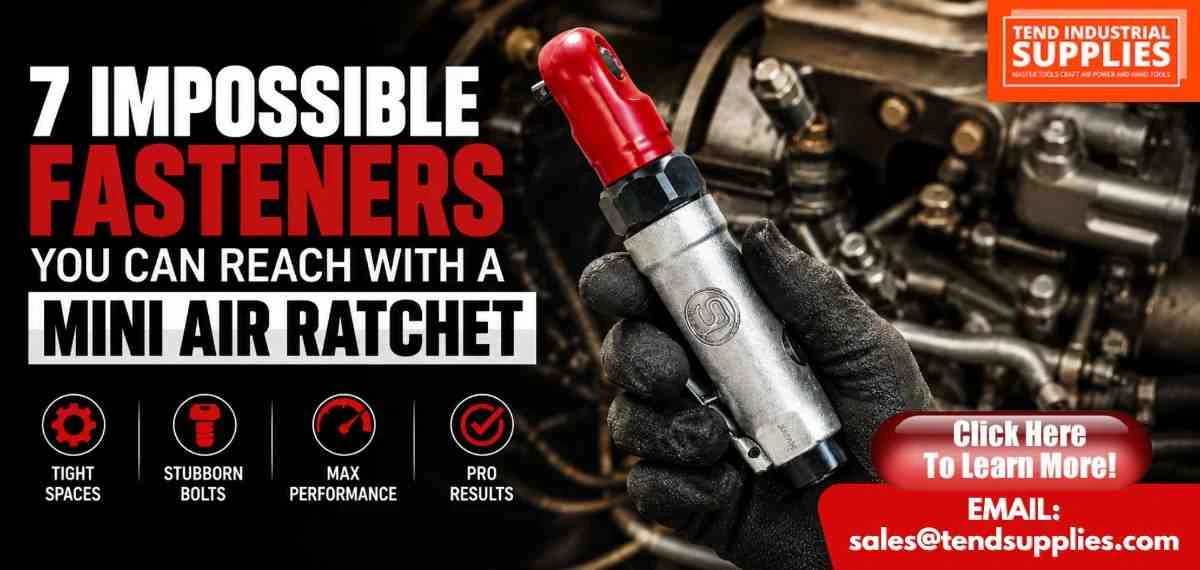
The best uses for mini air ratchet tools become obvious the moment a technician runs into a fastener that a standard ratchet, cordless tool, or larger pneumatic wrench simply cannot reach cleanly. Every mechanic knows these moments. A bolt is buried behind an accessory bracket, hidden under the cowl, tucked behind a radiator fan, or half-blocked by HVAC ducting. The fastener itself may not be especially tight, but the path to it is miserable. That is where a compact mini air ratchet earns its keep. It turns “impossible” fasteners into routine service work by shrinking the tool, reducing the swing arc, and giving the user enough speed to get the hardware out quickly once access is gained.
For this kind of daily frustration, the Shinano SI-1200B mini air ratchet is an especially practical solution.
Tend Industrial Supplies is an authorized Shinano distributor. Links on this page may generate a commission at no extra cost to you.
Quick Answer
A mini air ratchet allows you to reach and loosen or tighten fasteners in extremely tight and confined spaces where standard tools cannot fit. Its compact head, low-profile design, and pneumatic power make it ideal for working behind engines, under dashboards, inside wheel wells, and other hard-to-access areas, saving time and reducing manual effort.
Key Takeaways
- The most valuable uses for mini air ratchet tools involve fasteners that are not highly torqued but are extremely difficult to access.
- Mini air ratchets save time by reducing head size, minimizing required swing arc, and allowing quicker fastener run-out in cramped locations.
- Tight engine bay, dash, transmission, and HVAC service jobs often become dramatically easier with a compact ratchet.
- The Shinano SI-1200B mini air ratchet is especially well suited to these jobs because it is lightweight, compact, and priced at $49.50 on clearance.
- Shops benefit most when the mini ratchet is used alongside appropriate impact tools, service procedures, and other compact air tools.
Why a Mini Air Ratchet Solves the Problems Bigger Tools Create
Technicians do not reach for a mini air ratchet because they want less power. They reach for it because access problems are often more expensive than torque problems. A larger ratchet or impact tool may be stronger, but if it cannot get onto the fastener without removing surrounding parts, it is slowing the job down.
That is why the best uses for mini air ratchet tools cluster around repair scenarios where packaging is tight and the fastener is already partly accessible. The mini format reduces head bulk, shortens the tool profile, and lowers the amount of repositioning space needed around the bolt. Once the fastener is loose, the tool runs it out quickly and saves the operator from finger-spinning or awkward short-stroke hand ratcheting.
This is especially useful in modern vehicles where engine bay density, cabin packaging, and emissions hardware make simple service work harder than it used to be. Compact pneumatic tools continue to matter because the physical size of the tool is often the limiting factor. For broader context, Tend Supplies’ pneumatic tools guide explains why access-focused air tools still earn their place in modern workshops.
1. Water Pump Bolts Behind the Radiator Fan
One of the classic uses for mini air ratchet tools is removing water pump bolts that sit in the cramped gap between the front of the engine and the radiator fan or shroud area. On many vehicles, these fasteners are not especially high-torque, but the access path is awkward and the working angle is poor.
A standard ratchet may contact the fan, shroud, or pulley before the socket is seated comfortably. A larger pneumatic ratchet can be even worse because its head and body take up more of the little space available. A mini air ratchet helps because it can slip into the gap, stay aligned, and spin the bolt out once it is cracked free.
This is exactly the kind of job where the Shinano SI-1200B mini air ratchet makes sense. A compact, lightweight tool is simply easier to maneuver around cooling system components without turning the job into partial front-end disassembly.
2. Transmission Bell Housing Bolts
Bell housing bolts are notorious because they combine awkward locations with inconsistent access. Some are easy. Others hide near the top of the tunnel, close to the firewall, or around structures that limit socket and ratchet movement. In these cases, the mini ratchet becomes a real time-saver.
Once the bolt has been broken loose, a compact pneumatic ratchet can run it out far faster than hand tools, especially when the technician is working by feel. The advantage is not just speed. It reduces frustration. Fewer resets and less hand cramping make a big difference during transmission work.
Because these jobs often involve alternating between different tool types, it also helps to keep the distinction clear: a mini ratchet is not an impact substitute. For harder breakaway work, shops should still rely on the right air impact wrenches or manual leverage where appropriate.
3. Dashboard and HVAC Blend Door Actuator Fasteners
Interior service is one of the most underrated use cases for compact pneumatic ratchets. HVAC actuator screws and bolts are often hidden behind dash structure, ducting, glovebox cavities, or support braces. These fasteners are usually small and lightly torqued, but access is limited and tool repositioning space is miserable.
A mini air ratchet shines here because it reduces the amount of wrist movement needed in a cramped passenger compartment. The mechanic can seat the socket, guide the tool carefully, and run the hardware out with much less tedious hand effort. In jobs where the body position is already uncomfortable, reducing tool bulk matters a great deal.
This is one reason professionals often value mini ratchets more than casual buyers expect. The most annoying service jobs are rarely about force. They are about limited motion and bad angles.
4. Accessory Bracket Fasteners Behind Pulleys and Hoses
Alternators, power steering brackets, belt tensioner supports, idler hardware, and other accessory-related fasteners often live in crowded front-engine zones. The bolts may sit behind hoses, near pulleys, or between bracket planes that block direct access by larger tools.
A mini ratchet helps because it gets the tool head closer to the fastener without requiring the handle to swing through a wide path. Once the socket is on, the tool’s speed saves time that would otherwise be spent making tiny manual ratchet movements. This is especially helpful on repetitive service work where access frustration adds up across multiple fasteners.
For engine-bay technicians, that is the heart of the value proposition. The Shinano SI-1200B mini air ratchet is not exciting because of extreme torque; it is valuable because it makes recurring service pain points more manageable.
5. Timing Cover and Front Cover Fasteners Around Tight Clearances
Timing cover bolts and front cover hardware often vary in length, location, and accessibility. Some are exposed. Others are partially blocked by frame rails, mounts, coolant pipes, or accessory hardware. When the technician is trying to preserve rhythm during a teardown, those few hidden fasteners become momentum killers.
A mini air ratchet solves this by giving the mechanic a compact powered option that can work where a standard air ratchet feels oversized. The tool is particularly useful once the hardware has been cracked free, because the powered action removes the need for endless fingertip turning in an awkward posture.
In many shops, this is exactly what determines whether a specialty tool feels worthwhile: it saves only a minute or two per fastener, but it does so over and over again on the jobs everyone hates.
6. Under-Intake and Firewall-Adjacent Bracket Hardware
Fasteners near the rear of the engine are often among the least pleasant in the shop. Firewall clearance limits arm movement, visibility is poor, and neighboring harnesses or hoses restrict how the tool can be oriented. These are classic uses for mini air ratchet tools because a compact body and small head can be the difference between “reachable” and “not worth attempting without removing more parts.”
Whether the job involves a support bracket, sensor mount, vacuum component, or emissions-related hardware, the mini ratchet reduces the amount of extra teardown needed just to gain tool clearance. That is a direct labor saver.
It is also why technicians who work regularly on late-model vehicles often consider a mini ratchet essential rather than optional. Packaging density is only increasing, and access-friendly tools are becoming more valuable, not less.
7. Seat, Console, and Interior Mounting Fasteners in Awkward Cabin Spaces
Interior disassembly creates its own kind of access problem. Seat bolts, console mounts, bracket hardware, and under-dash fasteners are often placed where a large tool is uncomfortable or physically blocked by trim. A compact air ratchet speeds these jobs up because it can work close to floor pans, seat rails, and dash supports without requiring much repositioning room.
This is especially helpful in repetitive shop work such as interior replacement, wiring repairs, HVAC service, or dash removal. Once again, the fasteners are often not extremely tight. The challenge is getting a tool onto them and running them out efficiently in a confined, uncomfortable space.
That is where a true mini ratchet format proves its worth. The smaller the tool can be while still remaining professional and reliable, the more jobs it can simplify.
Tool Recommendation: How the Shinano SI-1200B Solves These Access Problems
The Shinano SI-1200B mini air ratchet fits all seven of these scenarios because it is built around compact access rather than inflated torque expectations. Published specs place it in a lightweight 1.11-pound class, with 200 RPM free speed and approximately 26 ft-lb maximum torque, which is exactly the kind of specification profile that works for confined-space fastener-running.
The tool also benefits from the credibility of Shinano pneumatic tools from Japan, which matters to buyers who want something better than a throwaway access tool. At $49.50 on clearance, it becomes especially easy to justify as a dedicated solution for the fasteners that slow technicians down repeatedly.
This compact ratchet also pairs well with other Shinano clearance tools. A mechanic could use the SI-4700B air saw for tight cuts, the SI-2210 disc sander for surface prep, and the SI-2001S straight die grinder for deburring and fine cleanup.
Mid-Article CTA: Buy the SI-1200B for the Fasteners Other Ratchets Miss
If your workflow is constantly interrupted by cramped fastener access, buy the Shinano SI-1200B mini air ratchet here The $49.50 clearance price makes it an easy upgrade for any working mechanic.
Why Access Tools Improve Shop Efficiency More Than Buyers Expect
Mechanics often underestimate the value of access tools because the time loss on each fastener seems small. But a minute lost here, two minutes lost there, and extra disassembly done only for tool clearance adds up rapidly across the week. That is why the best uses for mini air ratchet tools are not dramatic. They are repetitive. They remove friction from the work.
This is also why many shops end up building a more specialized pneumatic lineup over time. Once the technician sees how much smoother the job becomes with the right compact tool, it is hard to go back. Tend Supplies’ essential air tools for mechanics guide offers a broader view of this logic, while the article on cordless ratchets vs pneumatic helps buyers think through platform choices.
Final Verdict
The best uses for mini air ratchet tools are the jobs where access, not force, is the bottleneck. Water pump bolts, bell housing fasteners, HVAC hardware, accessory brackets, timing cover bolts, firewall-adjacent hardware, and interior mounting fasteners all fit that pattern. In these tasks, a mini air ratchet saves time because it fits where other tools struggle and runs hardware out quickly once seated.
That is why the Shinano SI-1200B mini air ratchet is such a strong recommendation. It solves recurring shop frustrations with compact, professional-grade design, and its $49.50 clearance price makes it one of the easiest productivity buys in the Shinano clearance campaign.
Shop the Shinano SI-1200B Clearance Deal Now
Ready to make tight-space service work easier? Shop the Shinano SI-1200B clearance deal now, then explore the air tools hub, the Shinano brand page, and the air impact wrench category to build a better mechanic’s toolkit.
FAQs About the Best Uses for a Mini Air Ratchet
What is a mini air ratchet best used for?
A mini air ratchet is best used for tight-space fastener removal in engine bays, under dashboards, around HVAC hardware, behind brackets, and in other confined service areas where a standard ratchet struggles to fit.
Can a mini air ratchet remove stubborn fasteners?
It can help once the fastener is loosened, but it is generally not the best first-choice tool for high-torque breakaway. Manual leverage or an impact tool is usually better for stubborn fasteners.
Why is a mini air ratchet better than a standard air ratchet in tight spaces?
Because the smaller head and compact body improve access and reduce the swing arc needed to work around obstructions. That is often more important than torque in confined service work.
Are mini air ratchets useful for interior and HVAC repairs?
Yes. They are especially useful in dashboard, HVAC, and cabin service because these jobs often involve small fasteners in awkward spaces where wrist movement is limited.
Is the Shinano SI-1200B worth buying at $49.50?
Yes. At $49.50, the SI-1200B offers a strong combination of compact professional-grade utility and value, making it an excellent specialty tool for access-limited mechanic work.

Newest Guide & products Updates
Air Regulators for Paint Booths: What to Buy Before You Order
For a paint-booth spray-air branch, buy a correctly sized filter-regulator without an oil-mist lubri...
Best 3/8-Inch Air Ratchet for Mechanics: SI-1205B or SI-1218EX?
Choose the Shinano SI-1205B when a light, compact 3/8-inch air ratchet is the priority; compare the...
Compact Air Impact Wrench for Tight Automotive Spaces: SI-1610SR Buying Guide
Buy a compact air impact wrench when access and manageable tool weight matter—but only after checkin...
WAALPC FRL Replacement Filters: Match the Part Before You Buy
Buy a replacement FRL filter element by its confirmed model family and dimensions—not by the words “...
Shinano 5-Inch Air Grinder Review: M14 vs 5/8-11 Spindle
Tend Industrial Knowledge Center / Product comparisons Looking for the best 5-inch air angle grinde...
Premium Air Impact Wrenches: Shinano vs CP, Dynabrade & Ingersoll Rand
Hero: original AI-generated editorial illustration; pictured tools are not exact product models. A s...