
Top 3 Pneumatic Reciprocating Saws for Exhaust Work (2025 Comparison)

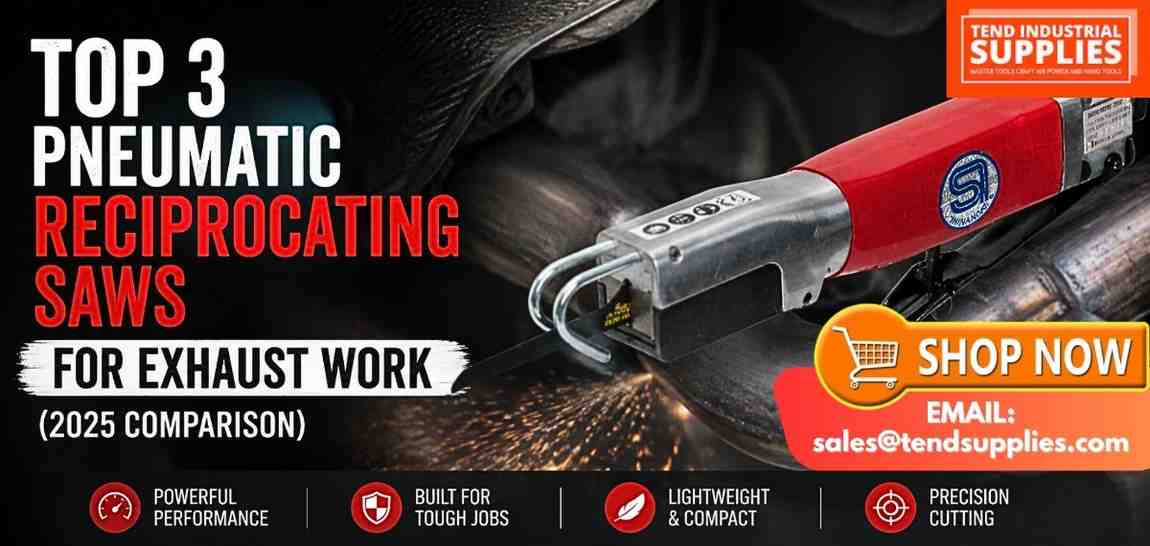
Finding the best pneumatic reciprocating saw exhaust technicians can rely on is not just about cutting speed. Exhaust work is one of the most frustrating tasks in automotive service because the pipes are often rusted, the fasteners are seized, and the cut area is buried among hangers, shields, suspension members, and underbody components. The right air saw has to cut predictably in cramped spaces, stay manageable when the operator cannot get a perfect body position, and keep vibration low enough to avoid fatigue on repeated jobs.
For buyers who want a serious value option, the Shinano SI-4700B air saw belongs at the top of the shortlist.
Quick Answer
The best pneumatic reciprocating saws for exhaust work in 2025 combine high stroke speed, lightweight control, low vibration, and compact access for tight undercarriage cutting. The Shinano SI-4700B stands out for precision and maneuverability, while the Chicago Pneumatic CP7902 is ideal for professional body shops needing proven durability. Budget-conscious users may prefer the Astro Pneumatic 930 for lighter-duty exhaust and sheet-metal work. Proper blade selection and adequate compressor airflow remain critical for fast, clean cuts.
Tend Industrial Supplies is an authorized Shinano distributor. Links on this page may generate a commission at no extra cost to you.
Key Takeaways
- The best pneumatic reciprocating saw exhaust work demands is compact, stable, and fast enough to keep moving through rusted tubing without excessive chatter.
- Inline design and low working weight matter just as much as headline stroke speed when you are cutting above your head or around underbody obstructions.
- Among the three commonly cross-shopped options here, the Shinano SI-4700B air saw offers the best balance of access, control, and value.
- Chicago Pneumatic remains a strong competitor in the category, while Astro Pneumatic offers a budget-friendly entry point for lighter-duty users.
- At **$52.20 clearance pricing**, the SI-4700B is the most compelling purchase for shops that want professional performance without overpaying.
Why Exhaust Work Is So Hard on Cutting Tools
Shops that do regular muffler and exhaust work know that the problem is rarely just the pipe itself. Rusted exhaust systems often sit in cramped, dirty, heat-cycled environments where access is poor and cut angles are awkward. A technician may be cutting overhead, cutting around hangers, or trying to remove a damaged section without nicking nearby brake lines, heat shields, or suspension parts.
That is why the best pneumatic reciprocating saw exhaust specialists choose is almost never the biggest or most aggressive tool on paper. Instead, the winner is the saw that offers the best blend of line-of-sight, compactness, blade control, and manageable vibration. A saw that is too large, too buzzy, or too air-hungry can turn an ordinary exhaust cut into a slow and exhausting fight.
Another reason pneumatic saws remain popular in this application is their footprint. Compared with larger electric saws, a compact air saw can fit into tighter spaces and allow the user to follow the pipe more naturally. That advantage becomes even more important on modern vehicles where underbody packaging is crowded.
Best Pneumatic Reciprocating Saw Exhaust Comparison Table
The three models below represent the most common buyer profiles in this category: a precision-oriented pro-grade option, an established heavy-duty competitor, and a budget-conscious body-saw alternative.
|
Model |
Best fit |
Speed class |
Stroke class |
Weight class |
Air use class |
Standout advantage |
Main compromise |
|
Shinano SI-4700B |
Best overall for exhaust access and control |
High 9,500–10,000 SPM class |
Compact precision stroke |
Approx. 1.27 lb class |
Low average air use class |
Light, compact, easy to control in tight spaces |
Less oriented toward heavy demolition-style cutting |
|
Chicago Pneumatic CP7902 |
Heavy-duty alternative for established-brand buyers |
Around 10,000 SPM class |
3/8 in class stroke |
Approx. 1.3 lb class |
Low-to-moderate air use class |
Strong market familiarity and body-shop credibility |
Typically costs more and offers less value at current pricing |
|
Astro Pneumatic 930 |
Budget-friendly choice for lighter-duty work |
Around 10,000 SPM class |
1/4 in stroke |
Approx. 1.76 lb class |
Around 4 CFM class |
Accessible entry price and decent versatility |
Heavier feel and less refined overall control |
This table shows why the Shinano has such a strong argument in real exhaust service. It is fast enough to stay productive, yet light enough to keep operator effort under control when cuts must be made in tight, rusty, inconvenient areas.
Best Pneumatic Reciprocating Saw Exhaust Buyers Should Consider: What Actually Matters
The most important thing to understand in this comparison is that exhaust work rewards access and precision just as much as raw speed. Cutting rusted tubing often means working one-handed, reaching around a shield, or starting a cut in a cramped spot where the blade cannot travel in a broad, comfortable path. Under those conditions, a compact inline saw immediately becomes more useful.
That is why the Shinano SI-4700B air saw is such a strong candidate. It is a lightweight inline design that lets the user stay close to the cut path. This improves visibility and reduces the tendency to twist the wrist or lever the saw awkwardly just to keep the blade aligned. On exhaust jobs, that ergonomic advantage translates directly into cleaner starts, faster cut completion, and less operator frustration.
The Chicago Pneumatic option remains a serious contender because the brand has long-standing recognition in body and repair tools. Buyers who want a familiar heavy-duty shop name continue to consider that platform. The Astro 930, meanwhile, appeals to users who need an economical air body saw for occasional work. The tradeoff is that it generally feels less refined in prolonged or more awkward exhaust cutting situations.
The Challenges of Cutting Rusted Exhaust Pipes in Tight Spaces
A rusted exhaust pipe does not behave like fresh sheet metal. Corrosion thickens some areas, weakens others, and makes the material less predictable under blade pressure. The cut often begins on an uneven, flaky surface. If the technician pushes too hard or uses the wrong angle, the blade can hop, snag, or wander.
Tight-space packaging adds to the problem. Catalytic converters, resonators, shields, and hanger rods all block natural arm movement. Many cuts happen under the vehicle with restricted shoulder and wrist position. In these situations, tool weight becomes a bigger issue than buyers expect. Even a modest weight difference becomes noticeable after multiple awkward starts and stop-and-go cutting sequences.
That is one reason the light weight of the SI-4700B matters so much. A saw in the 1.27-pound class is simply easier to reposition and stabilize. That advantage may sound small on paper, but in real undercar service it can be the difference between one clean cut and several frustrating corrections.
Vibration Analysis and Operator Fatigue
When technicians talk about one air saw “feeling better” than another, they are usually describing some mix of vibration behavior, balance, and throttle response. Vibration matters because it affects blade tracking, cut accuracy, and fatigue. A saw that transmits excessive harshness through the hand may still cut, but it will make the job slower and more tiring.
The best pneumatic reciprocating saw exhaust professionals choose is usually the one that feels composed rather than wild. This favors tools with a compact, well-balanced inline body and a predictable stroke action. The SI-4700B performs well in this kind of comparison because it is purpose-built for automotive precision cutting, not generic all-purpose demolition.
The Chicago Pneumatic body-saw platform has a strong reputation in the trade and remains a solid option for users who already run CP tools. However, the Shinano’s lighter, more nimble feel gives it an edge when repeated underbody positioning is part of the job. The Astro 930 can handle occasional exhaust and muffler work, but it typically feels more like a cost-conscious compromise than a premium daily-use solution.
Shops that regularly use air saws, die grinders, and sanders should also think about operator comfort more broadly. Tend Supplies’ article on noise control and reduction in pneumatic tool use is particularly relevant for busy exhaust and fabrication environments.
Why the SI-4700B’s Inline Design and High SPM Class Make It the Top Choice
The Shinano SI-4700B air saw wins this comparison because it aligns more closely with what exhaust technicians actually need. First, the inline form improves access in tight undercar spaces. Second, its high 9,500-10,000 SPM class cutting speed provides the fast cycling necessary for efficient exhaust service. Third, its lightweight build keeps fatigue under control when the saw is used repeatedly throughout the day.
Those traits are especially valuable when cutting around rusted hangers, trimming replacement sections, or splitting pipes that cannot be removed intact. The SI-4700B does not try to substitute brute size for precision. It is a smarter tool for awkward automotive cutting, and that is why it comes out ahead.
The value argument seals the result. At $52.20 on clearance, the SI-4700B delivers a level of usability that is difficult to match at the price. Buyers are not just getting an air saw; they are getting a compact, Japanese-brand tool that fits real-world automotive work exceptionally well.
Mid-Article CTA: Get the SI-4700B for Exhaust and Muffler Work
If your shop is tired of fighting rusted pipes with oversized or clumsy cutting tools, buy the Shinano SI-4700B air saw here. At $52.20, it is the standout value in this comparison.
Which Buyer Should Choose Each Saw?
The SI-4700B is the right choice for most professionals and serious DIY users who want a precise, lightweight tool for regular automotive cutting. It is especially strong for exhaust service, collision repair, and panel trimming.
The Chicago Pneumatic option makes sense for buyers who already prefer CP tools and want to stay within that ecosystem. It remains a credible heavy-duty choice, but it does not currently offer the same pricing advantage or the same overall value equation as the Shinano.
The Astro 930 is a workable option for lighter-duty or lower-budget users who need an air saw only occasionally. It can certainly perform useful work, but it is harder to justify when a better-balanced premium alternative is available at a clearance-level price.
For a more complete shop setup, exhaust and collision technicians should also consider pairing an air saw with the Shinano SI-2210 disc sander for edge cleanup and the Shinano SI-2001S straight die grinder for detail grinding. The broader air tools hub is also worth exploring.
Final Verdict
If the goal is to identify the best pneumatic reciprocating saw exhaust technicians should buy in 2025, the answer is the Shinano SI-4700B. It offers the best combination of compact access, high-speed cutting, low fatigue, and real-world value. Chicago Pneumatic remains a respected alternative, and Astro Pneumatic provides a budget option, but neither delivers the same overall balance for daily exhaust service.
In this category, the winning tool is the one that makes hard cuts easier. The SI-4700B does exactly that.
CTA: Shop the Shinano SI-4700B Clearance Deal
Ready to improve exhaust cutting speed and reduce undercar frustration? Shop the Shinano SI-4700B clearance deal now. While building out your setup, also review the Shinano brand page, the professional air sanders category, and the essential air tools for mechanics guide.
FAQs About the Best Pneumatic Reciprocating Saw for Exhaust Work
What makes an air saw good for exhaust work?
The best exhaust air saw is compact, lightweight, and stable enough to cut rusted pipe in cramped underbody spaces. High stroke speed helps, but access and control are just as important.
Is a lighter air saw always better for muffler and exhaust service?
Not always, but lower weight usually helps in tight-space automotive work because it reduces fatigue and makes the saw easier to position accurately, especially overhead or under the vehicle.
Can a pneumatic air saw cut rusted exhaust tubing effectively?
Yes. With the right blade and technique, a pneumatic air saw can cut rusted exhaust tubing very effectively, particularly where larger tools cannot fit cleanly.
Why is the Shinano SI-4700B ranked above the competitors here?
It ranks highest because it combines a compact inline layout, high-speed cutting performance, low working weight, and excellent value at its $52.20 clearance price.
Is the Astro Pneumatic 930 good enough for occasional exhaust work?
Yes. It can handle occasional exhaust and muffler tasks, especially for budget-conscious users, but it is generally less refined and less compelling than the Shinano for regular professional use.
Related Articles:
The Ultimate Guide to Pneumatic Air Tools: Everything You Need to Know
What to Look for in a Professional Pneumatic Air Saw for Automotive Repair
5 Ways a Pneumatic Air Saw Saves Time in Collision Repair
7 Impossible Fasteners You Can Reach with a Mini Air Ratchet
The Essential Guide to Pneumatic Tools in Industrial Settings: Maximizing Efficiency and Safety
A Beginner's Guide to Cylinder Head Porting with a Pneumatic Die Grinder
The Ultimate Guide to Choosing a 4-Inch Pneumatic Disc Sander for Auto Body Work
How to Prep Weld Seams and Rust Spots with a Pneumatic Disc Sander

Newest Guide & products Updates
Air Regulators for Paint Booths: What to Buy Before You Order
For a paint-booth spray-air branch, buy a correctly sized filter-regulator without an oil-mist lubri...
Best 3/8-Inch Air Ratchet for Mechanics: SI-1205B or SI-1218EX?
Choose the Shinano SI-1205B when a light, compact 3/8-inch air ratchet is the priority; compare the...
Compact Air Impact Wrench for Tight Automotive Spaces: SI-1610SR Buying Guide
Buy a compact air impact wrench when access and manageable tool weight matter—but only after checkin...
WAALPC FRL Replacement Filters: Match the Part Before You Buy
Buy a replacement FRL filter element by its confirmed model family and dimensions—not by the words “...
Shinano 5-Inch Air Grinder Review: M14 vs 5/8-11 Spindle
Tend Industrial Knowledge Center / Product comparisons Looking for the best 5-inch air angle grinde...
Premium Air Impact Wrenches: Shinano vs CP, Dynabrade & Ingersoll Rand
Hero: original AI-generated editorial illustration; pictured tools are not exact product models. A s...