
How to Prep Weld Seams and Rust Spots with a Pneumatic Disc Sander

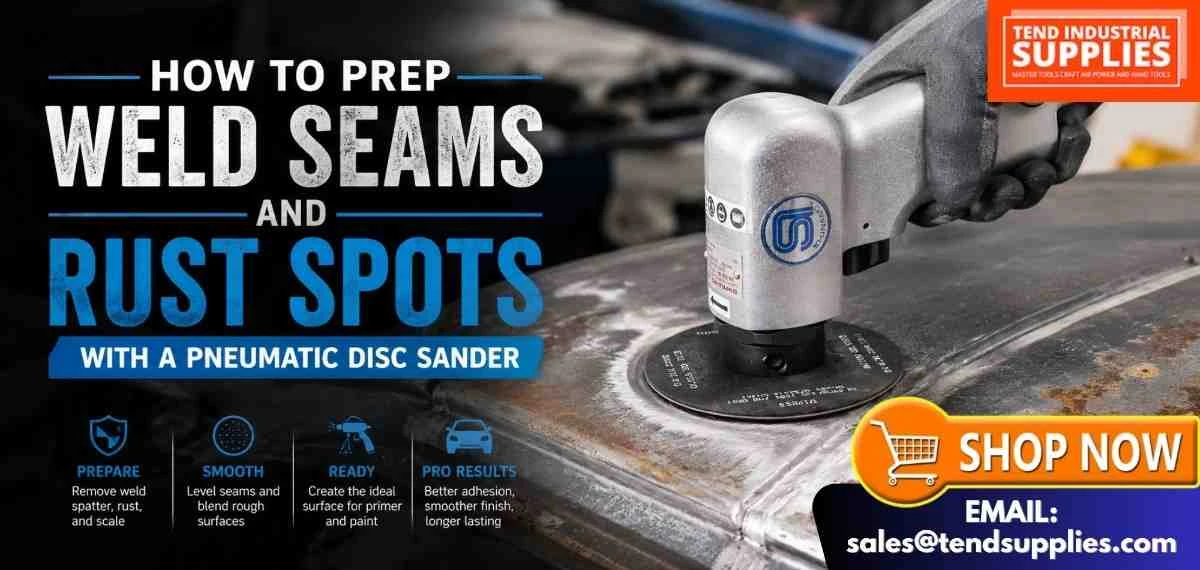
Learning how to prep weld seams pneumatic sander techniques correctly is one of the fastest ways to improve panel quality in restoration, fabrication, and collision repair. A pneumatic disc sander gives technicians the speed needed to level welds and strip corrosion, but the real advantage is control. When used with the correct grit, contact angle, and air regulation, the tool can flatten high spots, clean rust, and prepare a panel for primer without overheating thin sheet metal or creating unnecessary low spots.
For this workflow, the Shinano SI-2210 disc sander is especially relevant because it combines compact disc-sanding control with a built-in regulator that helps the user stay precise during heat-sensitive repair work.
Tend Industrial Supplies is an authorized Shinano distributor. Links on this page may generate a commission at no extra cost to you.
Quick Answer
A pneumatic disc sander is an effective tool for prepping weld seams and rust spots because it delivers controlled material removal, smooth surface blending, and fast cleanup. By using the correct grit progression and maintaining steady movement, you can level welds, remove corrosion, feather paint edges, and prepare metal surfaces for primer or refinishing without damaging surrounding panels.
Key Takeaways
- The right prep weld seams pneumatic sander technique starts with controlling heat, pressure, and abrasive choice rather than grinding as aggressively as possible.
- Weld seams and rust spots require different grit progressions; coarse discs remove material quickly, while finer grits refine the surface for primer.
- A built-in regulator helps reduce the risk of warping thin automotive sheet metal by letting the operator tune speed to the task.
- The Shinano SI-2210 disc sander is well suited to this work because it is compact, responsive, and priced aggressively at $46.80.
- A complete body-repair workflow often pairs the SI-2210 with the Shinano SI-4700B air saw and the Shinano SI-2001S straight die grinder.
Why a Pneumatic Disc Sander Works So Well for Weld Seams and Rust Repair
Weld seams and rust damage create a difficult combination of problems. Welded areas typically contain raised material, discoloration, and localized hardness changes. Rusted areas often include pitting, scale, soft surrounding paint, and contaminated surface layers. Both situations punish poor tool control. A large sander can remove material too broadly, while a tiny abrasive tool can be too slow and easy to gouge. A compact disc sander is often the ideal middle ground.
That is why the prep weld seams pneumatic sander approach is common in body shops and fabrication bays. A disc sander gives you enough contact area to stay productive, yet it still allows line-of-sight into a localized repair zone. That visibility matters when you are trying to level a plug weld, clean a butt-weld seam, or strip rust without destroying sound surrounding metal.
A pneumatic tool also provides consistency over long jobs. Unlike many consumer-grade electric tools, a quality air sander can maintain a more predictable feel under repeated use, provided the shop air supply is clean and properly regulated. For a broader look at how these tools fit into professional workflows, Tend Supplies’ ultimate guide to pneumatic air tools is a useful reference.
Prep Weld Seams Pneumatic Sander Workflow: Before You Touch the Panel
Before sanding begins, the technician needs to establish three things: the type of repair, the condition of the surrounding material, and the desired end state. A flush butt weld on a quarter-panel patch will be treated differently from a structural weld on thicker steel. A rust blister on an outer skin requires a different touch than scale on a bracket or support piece.
The right setup begins with inspection. Look at weld height, the width of the heat-affected zone, the panel thickness, and how close the work area is to an edge or contour. On rust work, determine whether you are cleaning for assessment, stripping to solid metal, or preparing the area for a repair section. This context affects both the grit selection and the amount of speed you can safely use.
Safety and setup checklist
A disciplined setup prevents sloppy results. Use eye protection, hearing protection, gloves appropriate for rotating abrasives, and adequate ventilation. Secure the workpiece if it is off the vehicle. Blow off dust and scale before switching abrasives, and keep the air line dry and lubricated. Shops that neglect lubrication and moisture control shorten tool life dramatically, which is why Tend Supplies’ article on extending air tool lifespan is worth following.
Choose the right companion tools
For complete panel repair, sanding is rarely the first step. If you are cutting away damaged sheet metal or splitting a panel before prep, the Shinano SI-4700B air saw is a logical companion. For detailed cleanup in corners or tight recesses, the Shinano SI-2001S straight die grinder extends the workflow where a disc sander cannot reach.
Step-by-Step Guide to Grinding Flush Weld Seams
A controlled sequence is the difference between a repair that disappears under primer and one that prints through later.
Step 1: Start with the weld crown, not the surrounding panel
The first objective is to reduce the raised portion of the weld bead or plug weld without flattening the adjacent panel. Keep the disc focused on the high material. Do not immediately sweep a wide area. A common beginner mistake is trying to blend everything at once, which quickly thins the parent metal.
Use light, repeatable passes instead of a single hard push. Let the abrasive do the cutting. If the tool begins to skip, chatter, or discolor the metal, reduce pressure and reassess speed.
Step 2: Work in short intervals to control heat
Heat is the enemy on thin automotive panels. Long, uninterrupted passes build temperature and increase the risk of distortion. The smarter technique is to make short passes, stop briefly, and check the surface often. If you cannot comfortably touch the surrounding area after a pass, you are working too hot.
This is exactly where a regulated tool becomes valuable. A disc sander with a built-in regulator allows the technician to dial back speed when transitioning from initial leveling to controlled refinement. That is one reason the Shinano SI-2210 disc sander is a smart choice for body-panel work.
Step 3: Cross the weld at a shallow angle
Instead of digging directly along the seam, approach the weld with a shallow, controlled angle and let the disc skim the high spot. This reduces the likelihood of trenching along the seam line. On butt welds, alternate your approach direction so the removal stays even.
Step 4: Finish the seam by blending, not chasing perfection with coarse grit
Once the weld is nearly flush, stop using the coarse approach that removed the crown. Switch to a finer abrasive and blend the area gradually into the surrounding metal. Chasing a perfectly invisible seam with an aggressive disc usually creates a thinner and wider damaged zone. The correct finish is one that is flush, stable, and ready for final prep, not one that has been overworked.
Selecting the Right Abrasive Grit for Rust Removal vs. Paint Prep
The abrasive that works best on a fresh weld is not always the right one for a rust spot or a paint-ready edge. This is one of the most important parts of the prep weld seams pneumatic sander process.
|
Job Type |
Typical Grit Approach |
Goal |
|
Fresh weld leveling |
Coarser initial grit followed by refinement |
Knock down high weld material without spreading damage |
|
Surface rust cleanup |
Moderate-to-coarse grit depending on scale severity |
Remove corrosion efficiently while preserving sound metal |
|
Paint edge feathering |
Medium-to-fine grit progression |
Create a smooth transition for primer and topcoat prep |
|
Final prep before primer |
Fine finishing grit |
Remove scratches and even the repair zone |
For weld seams, a coarse grit is often appropriate at the beginning because the task is material removal. For rust spots, the correct grit depends on whether you are stripping flaky scale or cleaning a shallow oxidized surface. If the panel still has usable surrounding paint, a more measured abrasive progression helps avoid unnecessary enlargement of the repair area.
When transitioning from metal correction to paint preparation, always remember that the panel does not care how fast you finish the job. It only reflects the quality of the scratch pattern you leave behind. That principle is just as important as tool selection.
Technique: Using the Throttle and Regulator to Prevent Heat Warping
Thin sheet metal can move more easily than many users expect. That is why disc-sanding technique matters so much during body repair. The goal is to remove material efficiently without concentrating so much friction in one area that the panel begins to distort.
The best practice is to combine three forms of control: throttle discipline, regulator adjustment, and movement pattern. First, avoid running at maximum aggression when the work no longer requires it. Second, use the regulator to reduce speed as soon as the heavy removal stage is over. Third, keep the tool moving and avoid parking the abrasive on a single spot.
A quality regulated sander helps enormously here. The Shinano SI-2210 disc sander gives the user a more refined way to manage energy input into the panel. That reduces the temptation to overwork the metal during the final flattening and blending stages.
Signs you are overheating the panel
If the metal turns blue, the panel becomes too hot to touch quickly, the weld area starts to dish, or the surrounding paint edge smears and loads the abrasive, you are generating too much heat. Back off immediately, reduce speed, and switch to shorter passes.
Let the disc skim, do not force it to cut
Many poor results come from pressure rather than the wrong tool. If you are leaning heavily into the sander, you are usually compensating for a dull abrasive, excessive speed, or a poor angle. Replace the disc or change the setup before you continue.
Tool Recommendation: Why the Shinano SI-2210 Fits This Workflow
The Shinano SI-2210 disc sander suits weld seam and rust-prep work because it matches the real demands of the job. A compact body helps the operator maintain visibility. Dual 3-inch and 4-inch compatibility adds flexibility across different repair sizes. Most importantly, the built-in regulator gives technicians better control over heat-sensitive work on body panels.
That functional fit matters even more when the tool is priced at $46.80 on clearance. Instead of settling for a low-cost generic sander with vague control and questionable balance, buyers can move into a better-quality pneumatic tool platform with stronger professional credibility. The tool also sits naturally within the broader Shinano pneumatic tool lineup, which appeals to technicians who value Japanese engineering and shop-ready refinement.
Mid-Article CTA: Add the SI-2210 to Your Body Repair Setup
If you regularly clean rust, level weld seams, or feather body repairs, this is a practical time to shop the Shinano SI-2210 disc sander clearance offer. At $46.80, it is an affordable upgrade for restoration and collision workflows.
Common Mistakes When Prepping Weld Seams and Rust Spots
The first mistake is trying to finish the entire repair with one grit. Coarse abrasives are for initial correction, not final refinement. The second mistake is letting the disc drift too far into good surrounding material. This enlarges the repair and increases finishing time. The third mistake is failing to adapt to speed as the job changes. Aggressive cutting may be appropriate early, but final blending calls for better control.
Another common error is ignoring the rest of the air system. Moisture, poor lubrication, weak couplers, or an undersized compressor all affect how smoothly a pneumatic tool performs. Shops that rely heavily on air equipment should review both the air compressor selection guide and Tend Supplies’ overview of essential air tools for mechanics.
Final Thoughts
The best prep weld seams pneumatic sander workflow is built on restraint and repeatability. A skilled technician does not simply grind until the defect disappears. Instead, they reduce the high material deliberately, control heat continuously, match the grit to the task, and stop as soon as the panel is ready for the next stage.
That is exactly why the Shinano SI-2210 disc sander is such a strong fit for this work. Its compact format, regulator-assisted control, and strong clearance value make it a practical choice for body shops, fabricators, and serious restorers who need reliable pneumatic sanding performance.
CTA: Buy the Shinano SI-2210 for Weld Prep and Rust Repair
Need a better tool for seam leveling, rust cleanup, and precision body prep? Buy the Shinano SI-2210 disc sander here and build out the rest of your setup with the professional air sanders collection, the air tools hub, and related Shinano options such as the SI-4700B air saw and SI-2001S straight die grinder.
FAQs About Prepping Weld Seams and Rust Spots with a Pneumatic Disc Sander
What grit should I start with on a weld seam?
Start with a grit coarse enough to remove the weld crown efficiently, but not so aggressive that it gouges the surrounding panel. After the weld is nearly flush, switch to a finer grit to blend and refine the area.
Can I use the same abrasive grit for rust removal and paint prep?
Usually no. Rust removal often requires a more aggressive abrasive than paint feathering or final primer prep. The best results come from changing grit as the task changes.
How do I avoid warping thin sheet metal with a pneumatic sander?
Use short passes, lighten pressure, keep the tool moving, and reduce speed as soon as the aggressive removal stage is complete. A built-in regulator helps a great deal with this control.
Is a pneumatic disc sander better than an angle grinder for weld prep on body panels?
For many automotive panel repairs, yes. A pneumatic disc sander generally offers better finesse and a more body-shop-friendly contact patch than a larger, more aggressive angle grinder.
Why is the Shinano SI-2210 a good choice for this job?
The SI-2210 is compact, easy to control, compatible with 3-inch and 4-inch work, and equipped with a built-in regulator. Those features make it well suited to weld seam prep, rust cleanup, and controlled body-panel sanding.
Related Articles:
The Ultimate Guide to Pneumatic Air Tools: Everything You Need to Know
5 Ways a Pneumatic Air Saw Saves Time in Collision Repair
7 Impossible Fasteners You Can Reach with a Mini Air Ratchet
The Essential Guide to Pneumatic Tools in Industrial Settings: Maximizing Efficiency and Safety
A Beginner's Guide to Cylinder Head Porting with a Pneumatic Die Grinder
The Ultimate Guide to Choosing a 4-Inch Pneumatic Disc Sander for Auto Body Work

Newest Guide & products Updates
Shinano 5-Inch Air Grinder Review: M14 vs 5/8-11 Spindle
Tend Industrial Knowledge Center / Product comparisons Looking for the best 5-inch air angle grinde...

Premium Air Impact Wrenches: Shinano vs CP, Dynabrade & Ingersoll Rand
Hero: original AI-generated editorial illustration; pictured tools are not exact product models. A s...

WAALPC AC2000 vs AC3000 vs AC4000: Which FRL System Does Your Workshop Need?
WAALPC AC2000 compact FRL and AC4000 higher-flow FRL. Match body size, port and flow to the comp...

VEVOR Drain Camera Replacement Parts: Cables, Camera Heads, Screens, Skids and Chargers
A complete VEVOR drain-camera system includes model-specific electronic, cable and camera-head com...

Why Industrial Suppliers Are Finally Ditching Spreadsheets for Real Systems
Why Industrial Suppliers Are Finally Ditching Spreadsheets for Real Systems Walk into most tool dist...

The Technical Evolution of Automotive Electronics: Why Professional Dashcam Hardwiring is No Longer Optional
Why Professional Dashcam Hardwiring is No Longer Optional The automotive industry is undergoing a m...