
5 Ways a Pneumatic Air Saw Saves Time in Collision Repair

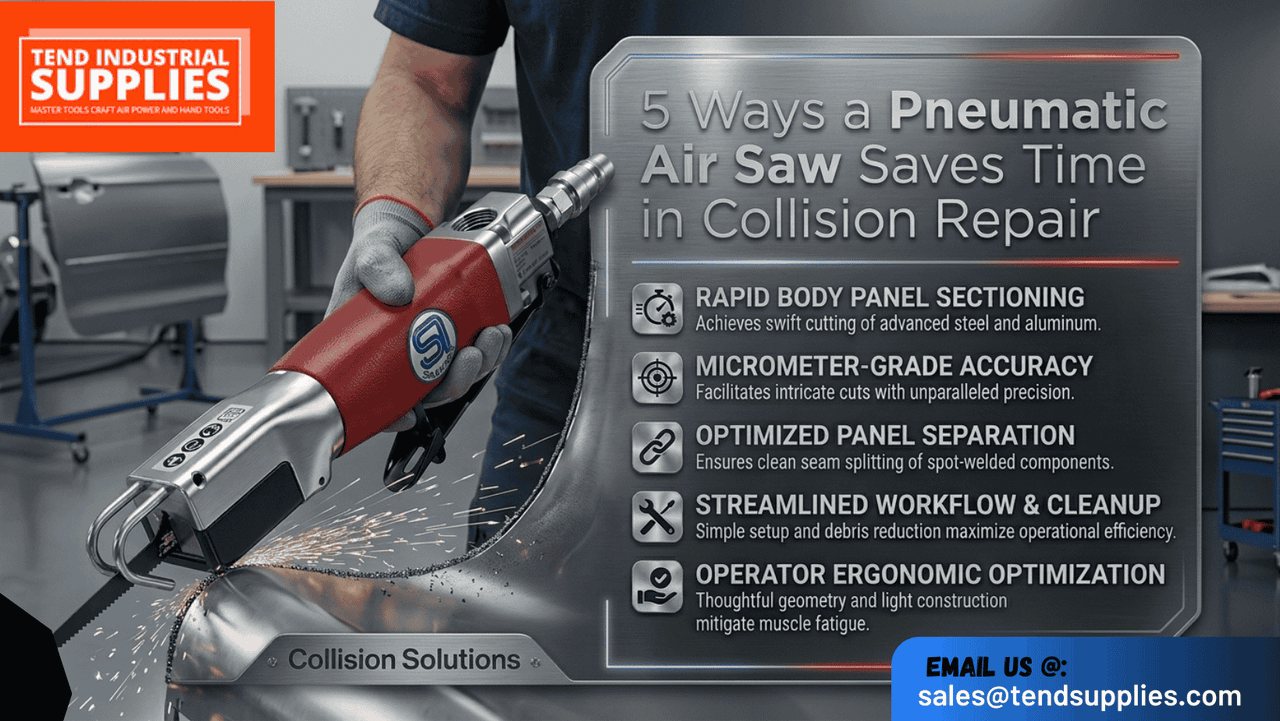
A “pneumatic air saw collision repair” workflow is all about speed with control. Collision shops do not make money by fighting damaged panels, forcing oversized cutting tools into bad positions, or spending extra time cleaning up cuts that wandered off line. They make money by using the right tool at the right stage of repair. That is exactly where a compact pneumatic air saw earns its place. It gives technicians a clean way to section damaged material, trim replacement pieces, reach awkward repair zones, and work faster without creating unnecessary secondary damage.
Among the tools in this category, the Shinano SI-4700B air saw is especially well matched to collision and body-shop work because it combines compact access with the kind of precision technicians need on modern vehicle structures.
Tend Industrial Supplies is an authorized Shinano distributor. Links on this page may generate a commission at no extra cost to you.
Quick Answer
A pneumatic air saw saves time in collision repair by delivering fast, precise cuts in metal, plastic, and body panels, reducing manual effort and improving workflow efficiency. In “5 Ways a Pneumatic Air Saw Saves Time in Collision Repair,” you’ll learn how this versatile air tool speeds panel removal, improves cut accuracy, reduces technician fatigue, and helps body shops complete repairs faster with professional results.
Amazon Affiliate Disclosure:
As an Amazon Associate, we earn from qualifying purchases. We only recommend products we genuinely believe in, which helps us continue to create valuable content for our readers.
Key Takeaways:
- A pneumatic air saw collision repair: setup improves productivity because it cuts cleanly in tight spaces where larger tools slow technicians down.
- Body shops save time with an air saw when sectioning damaged panels, trimming replacement pieces, and cutting near surrounding components without excessive cleanup.
- The Shinano SI-4700B air saw is particularly effective for collision work because it is compact, lightweight, and easy to control.
- Pairing an air saw with the Shinano SI-2210 disc sander creates a faster cut-and-prep workflow for body technicians.
- At $52.20 clearance pricing The SI-4700B offers an unusually strong value for shops that need a dedicated precision cutting tool.
Why a Pneumatic Air Saw Belongs in a Collision Repair Bay
Collision repair is full of cuts that are too delicate for heavy demolition tools but too awkward for broad abrasive wheels. Technicians need to remove damaged material without harming nearby structures, wiring, trim, glass, or surfaces that still need to be preserved. A pneumatic air saw collision repair approach works so well because the tool is narrow, maneuverable, and capable of following controlled cut lines in confined spaces.
That matters on modern vehicles. Body structures are tighter, trim packaging is denser, and access is often limited. The old habit of reaching for a bigger cutting tool can create more cleanup than progress. Air saws let technicians work more surgically. That means fewer accidental marks, less unnecessary metal removal, and a smoother handoff to the sanding and finishing stages.
The SI-4700B fits naturally into this environment. It is compact enough to work inside body apertures, around flange zones, and near overlapping panel structures where visibility is limited. For a broader view of how such tools fit into professional shop workflows, the pneumatic tools guide is a helpful reference.
1. Cutting Spot-Welded and Damaged Quarter-Panel Sections Faster
One of the clearest ways a pneumatic air saw collision repair setup saves time is during quarter-panel removal and sectioning. When a technician is cutting away damaged sheet metal, the goal is not simply to remove the panel. The goal is to remove it cleanly enough that the replacement process stays efficient.
A pneumatic air saw helps because it follows repair lines well and can work close to flanges, edges, and transition points without the bulk of larger electric saws. On quarter-panels and outer skins, this reduces the amount of collateral grinding and cleanup required after the cut. The operator can stay closer to the intended line and preserve more usable surrounding structure.
This is also where pairing tools makes a difference. Once the cut is complete, the Shinano SI-2210 disc sander is a logical next step for refining edges and preparing the area for fitting and welding. That kind of clean handoff is what actually saves labor time.
2. Slicing Through Rusted Suspension Bolts and Stubborn Hardware Access Areas
Although an air saw is not the first tool most technicians think of for seized hardware, it can be a major time-saver when a rusted fastener cannot be spun free and access around it is too restricted for a cut-off wheel. In collision and undercar repair, there are plenty of moments when a bracket, hanger, or rust-frozen bolt has to be cut to move the job forward.
A pneumatic air saw can reach these problem areas with a slimmer profile and better directional control. That reduces the need to disassemble adjacent components just to create room for a larger cutting tool. In practical terms, fewer parts removed means fewer minutes lost.
When the cut task shifts from hardware removal to edge cleanup or bracket refinement, technicians often step into a die grinder. That makes the Shinano SI-2001S straight die grinder a useful companion in the same repair environment.
3. Trimming Plastic Bumpers and Fiberglass Components with Better Control
Collision repair is not all steel. Bumper covers, fiberglass sections, reinforcement-adjacent plastics, and aftermarket body components often need trimming during fitment and repair. This is one area where a pneumatic air saw collision repair workflow can dramatically improve speed because it combines cutting precision with reduced mess and better line tracking.
Plastic and fiberglass behave differently from steel. They can chip, melt, fray, or crack depending on blade choice and feed pressure. A compact pneumatic air saw gives the operator more finesse than a bulkier saw or grinder, especially when contour-following matters. That means less rework after the trim line is cut.
This benefit is especially valuable when fitting bumper repairs and replacement pieces where the technician must remove a little material, check fit, trim again, and repeat. The better the tool follows the intended line, the less cleanup is required before final finishing.
4. Opening Access Windows and Relief Cuts Without Overcutting
Many collision repairs require temporary access cuts. A technician may need to open a section to reach hidden damage, separate overlapped material, or create a controlled relief cut before reforming or replacing a panel. These are not cuts you want to make with an oversized, aggressive tool.
An air saw saves time in these cases because it offers precision where overcutting would create extra repair work. Instead of overshooting a line and then correcting the mistake later, the technician can make the opening that is actually needed and move on. That reduces secondary metalwork and helps keep the repair plan on schedule.
This is another reason the Shinano SI-4700B air saw is so well suited to collision environments. Its compact body and precision-oriented feel make it easier to start and stop cuts intentionally, which is often more important than having the largest possible cutting stroke.
5. Trimming Replacement Panels Before Final Fit-Up
Replacement panels almost always need some degree of adjustment. Even quality aftermarket parts may require edge trimming, relief cuts, or sectioning changes to align cleanly with the vehicle. When those cuts are made with a tool that is too blunt or too difficult to control, technicians lose time in cleanup and refitting.
A pneumatic air saw speeds this stage up because it allows measured trimming without broad collateral damage. The operator can cut, test fit, and refine quickly. Once the panel is close, a compact sander can handle edge finishing and weld-area prep. Again, this is where the SI-4700B and SI-2210 make sense as a pair: one creates the cut, the other refines the surface.
That kind of complementary tool flow is exactly what body shops need. Productivity comes from reducing transitions, not just from having faster individual tools.
Tool Recommendation: The Shinano SI-4700B in Action
The Shinano SI-4700B air saw earns its recommendation because it matches the realities of collision repair better than generic, heavier, less refined alternatives. Its inline format improves access. Its lightweight build makes awkward-position cutting less tiring. Its precision orientation helps technicians stay on line and reduce cleanup after the cut.
The price strengthens the case. At $52.20 on clearance, the SI-4700B gives collision shops and serious DIY users a chance to add a purpose-built pneumatic cutting tool without paying a premium-brand premium. For professionals who value Japanese engineering and controlled tool feel, that is a compelling proposition.
The tool also integrates well into a broader body-shop kit. Beyond the SI-2210 for sanding and the SI-2001S for detail grinding, teardown and reassembly work often benefits from the Shinano SI-1200B mini air ratchet, especially in tight engine bay and under-dash spaces.
Mid-Article CTA: Shop the SI-4700B for Faster Collision Repair Cuts
If your technicians regularly section damaged panels, trim replacement parts, or fight for access around collision damage, shop the Shinano SI-4700B air saw here. The $52.20 clearance price makes it an easy productivity upgrade.
Why Shops Save More Than Time with the Right Air Saw
The labor savings from a good air saw are obvious, but there is another benefit: cleaner repairs. Better cuts reduce rework, preserve more surrounding material, and help the repair move through welding, sanding, and finishing with fewer surprises. That improves throughput and finish quality at the same time.
It also makes training easier. Less experienced technicians often struggle with oversized or overly aggressive cutting tools because they magnify every positioning error. A more compact, controllable air saw helps them develop better habits and cleaner technique sooner.
For shops thinking strategically about equipment, this is why air tools still matter. They are not just legacy shop hardware. They are workflow tools. Tend Supplies’ resources on essential air tools for mechanics and noise control in pneumatic tool use are useful extensions of that thinking.
Final Verdict
A pneumatic air saw collision repair strategy saves time because it reduces fighting, rework, and awkward tool changes. It helps technicians make cleaner cuts in tighter spaces and move faster from removal to preparation to fit-up. In busy body shops, those minutes add up quickly.
That is why the Shinano SI-4700B air saw is such a strong recommendation. It gives collision technicians the compact access, precision handling, and strong value they need to keep repairs moving without unnecessary compromises.
Buy the Shinano SI-4700B and Pair It with the Right Body Shop Tools
Ready to speed up panel cuts, trim work, and tight-space repair tasks? Buy the Shinano SI-4700B air saw here. Then complete your setup with the Shinano SI-2210 disc sander, the broader Shinano brand page, and the full air tools collection.
FAQs About Using a Pneumatic Air Saw in Collision Repair
What makes a pneumatic air saw useful in collision repair?
A pneumatic air saw is useful because it cuts accurately in tight spaces, follows controlled lines well, and reduces the cleanup that often comes with larger or more aggressive cutting tools.
Can an air saw cut damaged quarter panels and patch sections?
Yes. Air saws are commonly used to cut damaged quarter-panel sections, patch openings, and replacement panel trim lines because they offer better control than many bulkier cutting tools.
Is a pneumatic air saw good for plastic bumpers and fiberglass parts?
Yes. With the right blade and proper feed pressure, an air saw is very effective for trimming plastic and fiberglass components during body repair and fitment work.
Why pair the SI-4700B with the SI-2210 disc sander?
Because the air saw handles the cut while the disc sander refines the edge and prepares the area for welding, blending, or finishing. Together they create a faster collision-repair workflow.
Is the Shinano SI-4700B worth buying at $52.20?
Yes. At $52.20, the SI-4700B offers professional-level collision repair utility at a price that is difficult to beat, especially for buyers who value compact design and Japanese-brand quality.

Newest Guide & products Updates
Air Regulators for Paint Booths: What to Buy Before You Order
For a paint-booth spray-air branch, buy a correctly sized filter-regulator without an oil-mist lubri...
Best 3/8-Inch Air Ratchet for Mechanics: SI-1205B or SI-1218EX?
Choose the Shinano SI-1205B when a light, compact 3/8-inch air ratchet is the priority; compare the...
Compact Air Impact Wrench for Tight Automotive Spaces: SI-1610SR Buying Guide
Buy a compact air impact wrench when access and manageable tool weight matter—but only after checkin...
WAALPC FRL Replacement Filters: Match the Part Before You Buy
Buy a replacement FRL filter element by its confirmed model family and dimensions—not by the words “...
Shinano 5-Inch Air Grinder Review: M14 vs 5/8-11 Spindle
Tend Industrial Knowledge Center / Product comparisons Looking for the best 5-inch air angle grinde...
Premium Air Impact Wrenches: Shinano vs CP, Dynabrade & Ingersoll Rand
Hero: original AI-generated editorial illustration; pictured tools are not exact product models. A s...