
What Is an FRL System? A Practical Guide for Industrial Buyers

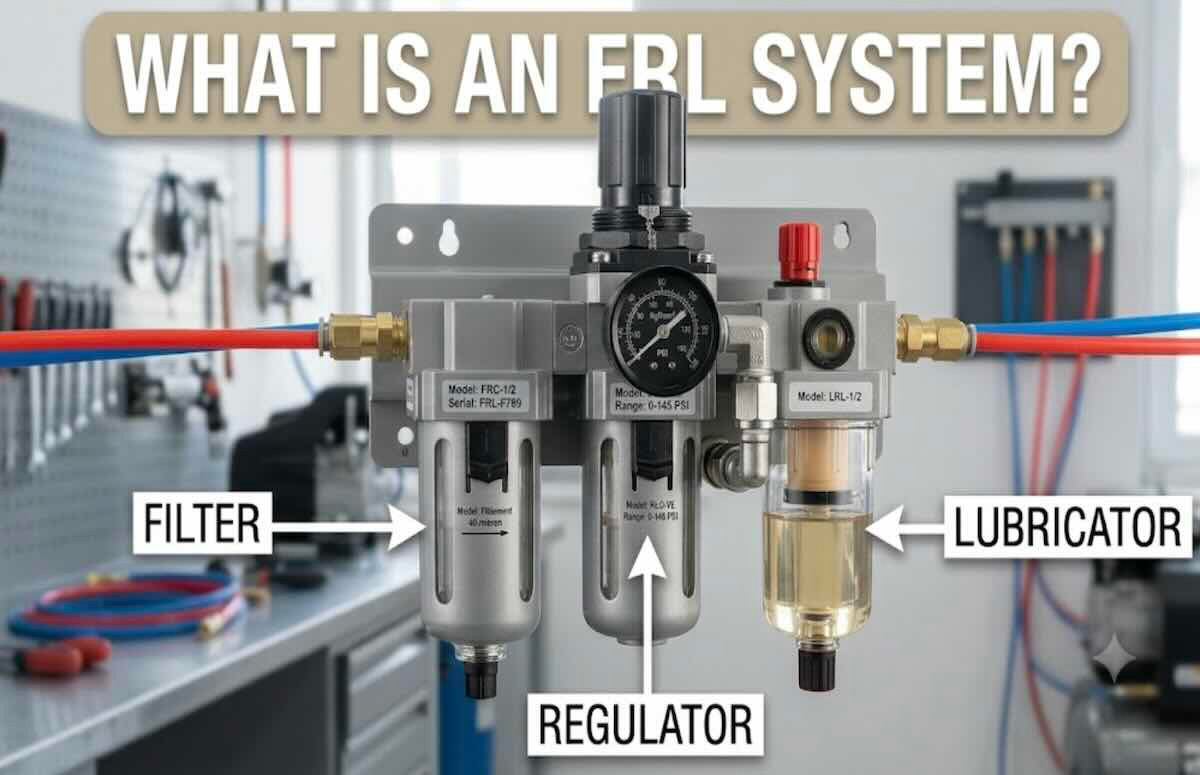
What Is an FRL System?
What Is an FRL? (Quick Answer)
An FRL — Filter, Regulator, Lubricator — is a three-stage air preparation system that conditions compressed air before it reaches your pneumatic tools, valves, and cylinders.
- The filter removes water and particulates.
- The regulator holds downstream pressure steady regardless of upstream swings.
- The lubricator injects a fine oil mist into the airstream to keep moving parts from wearing out.
If you operate any pneumatic equipment — an impact wrench, a paint spray gun, a manufacturing line, or an automotive shop — a high-quality FRL system is the difference between tools that last five years and tools that last five months.
What Does FRL Stand For?
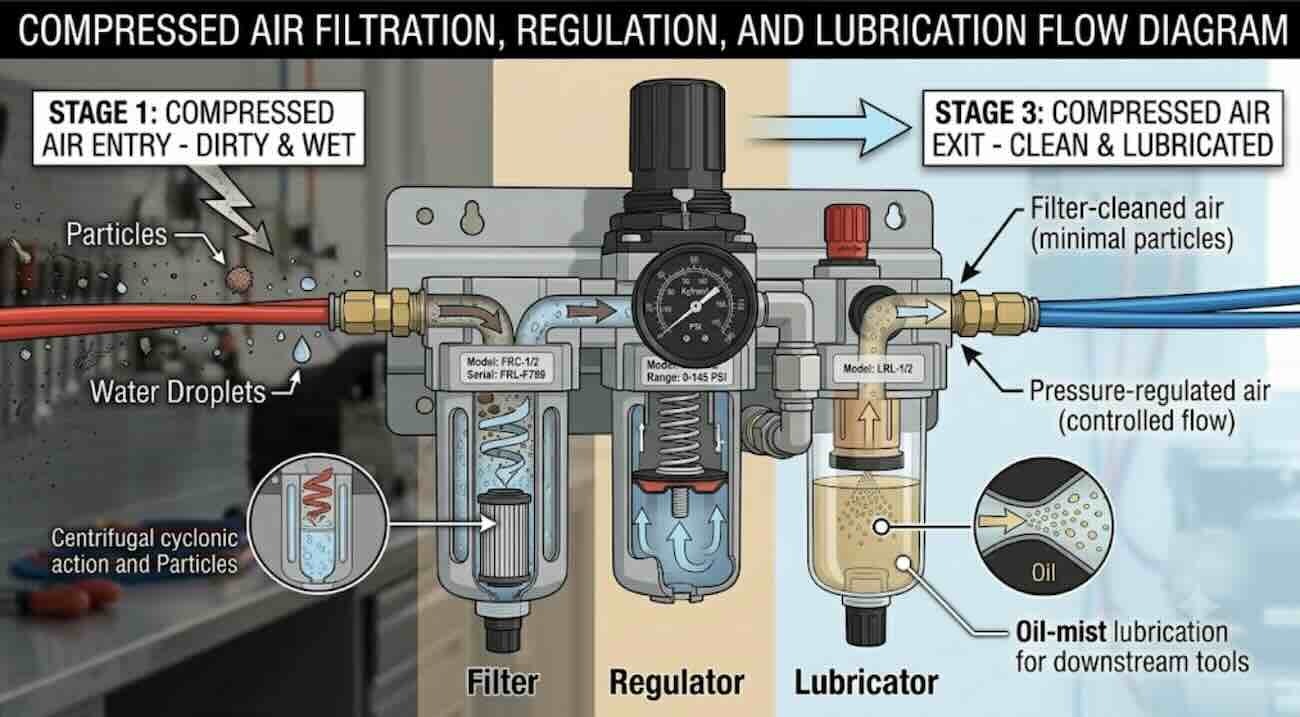
- F — Filter: Removes water, dirt, rust, and oil aerosol from compressed air.
- R — Regulator: Reduces and stabilizes line pressure to a set value.
- L — Lubricator: Adds a controlled amount of oil mist to lubricate downstream tools and components.
Together, these three functions prepare compressed air so it is clean, dry, pressure-controlled, and lubricated.
Is FRL the Same as FLR?
Functionally, yes. Industry convention puts the components in the exact order that air flows through them: Filter $\rightarrow$ Regulator $\rightarrow$ Lubricator. While some manufacturers and older literature use the acronym "FLR," they are referring to the exact same device.
Why Every Pneumatic System Needs an FRL
Compressed air is not clean by default. Atmospheric air naturally contains water vapor, dust, pollen, and hydrocarbons. The compression process concentrates those contaminants — and adds wear particles from the compressor itself. By the time compressed air reaches your tool, it can carry:
- Liquid water (from condensation as the air cools in the line).
- Particulates (rust, dust, compressor wear, pipe scale).
- Oil aerosol and vapor (from the compressor lubricant).
- Microorganisms (in certain industrial environments).
Without proper conditioning, that air destroys tools from the inside out. Installing an FRL stops the damage at the source.
The Three Threats Inside Compressed Air
|
Threat |
Source |
What It Damages |
|
Moisture |
Atmospheric humidity compressed into the air |
Cylinders, valves, tool internals, spray finish quality |
|
Particulates |
Compressor wear, pipe scale, ambient dust |
Bearings, seals, precision orifices, spray nozzles |
|
Oil Vapor |
Compressor carryover oil |
Food/pharma processes, paint finishes, downstream filtration |
What Happens Without an FRL
- Impact wrenches lose torque and develop deep rust inside the motor housing.
- Spray guns spit, fish-eye, and "orange-peel" on delicate finishes.
- Pneumatic cylinders score their bores and leak air past compromised seals.
- Solenoid valves stick and fail to shift reliably.
- Production uptime drops while maintenance and replacement costs climb.
Real Numbers from the Field: Most pneumatic tool failures in automotive and light-industrial shops trace back to one of three causes: water in the air, unregulated pressure, or lack of lubrication. An FRL priced between $40 and $300 prevents thousands of dollars in tool replacement and emergency downtime every year.
How an FRL Works — The Three Stages
Compressed air enters the FRL at the port marked IN and exits at the port marked OUT. Inside, it passes through three sequential stages.
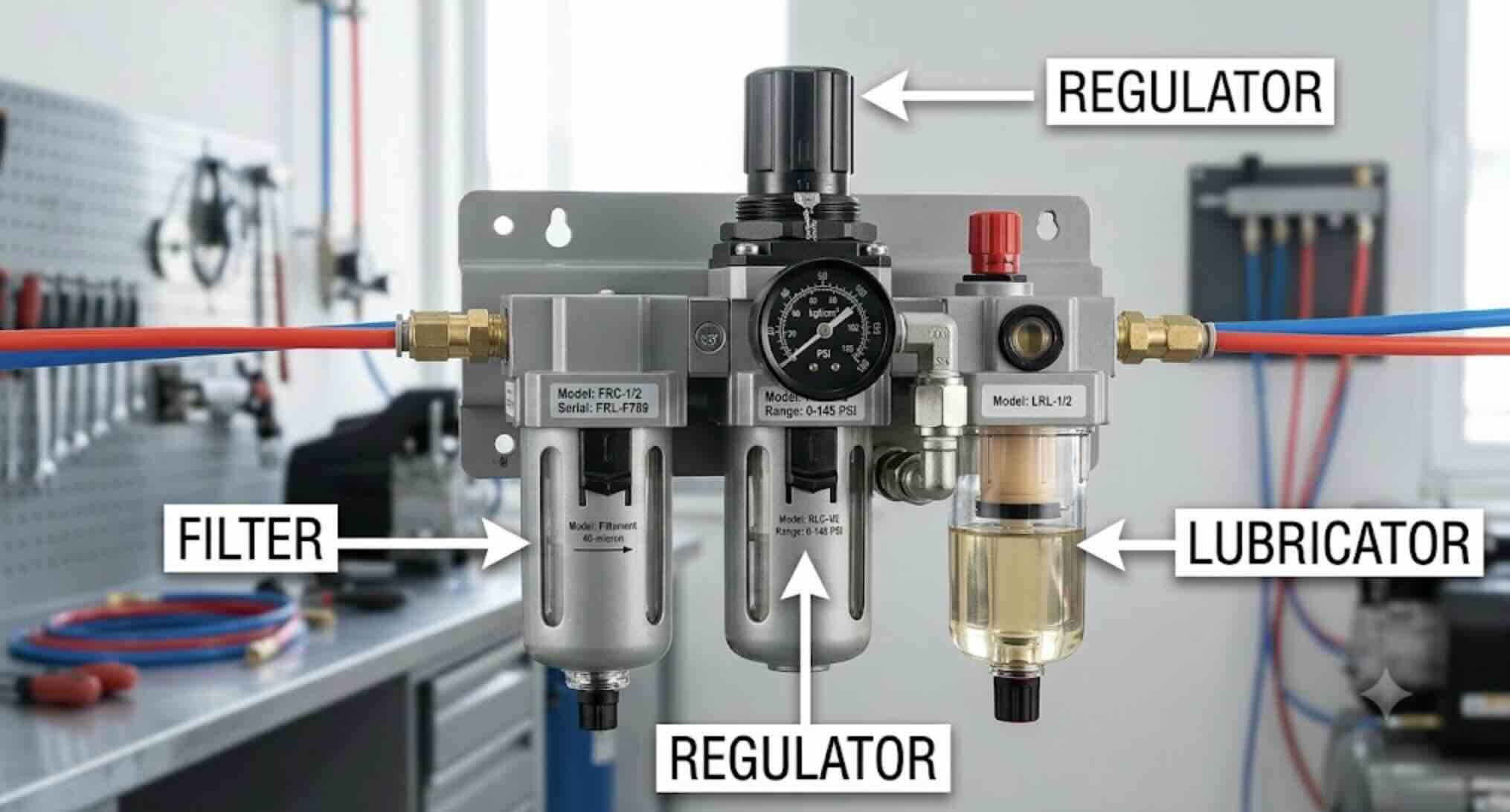
Stage 1: Filtration
The air filter element — typically a sintered bronze or porous plastic cartridge rated at 5, 25, or 0.01 micron — traps solid particulates as air flows through. A baffle and centrifugal action cause liquid water droplets to coalesce and fall into the bowl below. Most filter bowls feature a manual or automatic drain to evacuate this collected waste.
Stage 2: Regulation
The air regulator uses a flexible diaphragm or piston balanced against an adjustable spring to hold downstream pressure at your exact setpoint. As upstream pressure rises or downstream demand drops, the regulator opens or closes to compensate. The result is a steady working pressure at the tool, even when other heavy equipment on the same line cycles on and off.
Stage 3: Lubrication
The air lubricator introduces a precisely metered amount of oil aerosol into the airstream. There are two primary types used depending on your specific layout:
- Oil-Fog Lubricators: Produce larger droplets suited for general-purpose tools, large cylinders, and high-cycle applications.
- Micro-Fog Lubricators: Produce microscopic droplets suited for precision tools, smaller cylinders, and air motors with close-tolerance bearings.
The oil is carried downstream by the air currents and safely deposited on moving internal surfaces as the air expands inside the tool.
FRL Components Explained
1. Air Filter
As the crucial first stage, the air filter removes bulk water and particulates.
- Bowl Capacity: Typically ranges from 0.5 oz to 1 quart, which determines how often you must drain it.
- Polycarbonate Bowls: Transparent, lightweight, and ideal for easy visual inspection of water levels. Best restricted to indoor use.
- Metal Bowls (Aluminum/Zinc): Required for harsh industrial environments, high ambient temperatures, or areas where chemical solvents are present.
2. Air Regulator
The middle stage holds downstream pressure stable. Key specs to evaluate include:
- Relieving vs. Non-Relieving: Relieving air regulators safely vent downstream pressure when it drops below the setpoint; non-relieving models do not. Relieving designs are preferred for most industrial applications.
- Pressure Range: Common commercial ranges are 0–100 psi or 0–150 psi.
- Locking Knob: Prevents accidental pressure adjustments in active production environments.
3. Air Lubricator
The final stage adds vital oil mist to the treated air.
- Bowl Capacity: Larger bowls reduce the frequency of manual maintenance refills.
- Oil Adjustment: A fine metering needle controls drops per minute. Start with the manufacturer's base recommendation and tune based on tool performance.
- Fill Port: Some air lubricators allow you to refill oil while under system pressure, while others require depressurization. Under-pressure refills are faster and safer for active production lines.
Where Is an FRL Installed?
Option A: At the Compressor Outlet
A central FRL system installed at the main compressor outlet conditions air for your entire distribution piping network. This setup is highly efficient for shops with long pipe runs and consistent downstream demand.
Option B: At the Point of Use
A point-of-use FRL (often a compact mini unit) sits right next to the specific tool or workstation. This layout is ideal for:
- Critical applications where air pressure must be tightly and independently controlled.
- Scenarios where different tools on the exact same air line require vastly different operating pressures.
- Workstations that frequently swap out distinct tools or operations.
The Two-Stage Approach
Many industrial plants utilize both: a larger central FRL at the main compressor to remove bulk water and heavy contaminants, plus dedicated point-of-use mini FRLs at individual workstations to fine-tune local pressure and add precise lubrication.
Modular FRL vs. Combination FRL vs. Mini FRL
Choosing the right structure is key to performance and ease of maintenance:
|
Type |
Construction |
Best For |
Typical Application |
|
Modular FRL |
Separate filter, regulator, and lubricator modules clamped together |
Industrial plants, heavy manufacturing lines, maximum maintenance flexibility |
Large manufacturing shop, OEM plant |
|
Combination FRL |
All three air prep functions factory-assembled into one single body |
Quick installation, space savings, compact overall footprint |
Small to mid-sized shop, mobile service truck |
|
Mini FRL |
Compact combination unit, typically with 1/4" NPT ports |
Single-tool point-of-use isolation, light automotive work, precise fabrication |
Auto repair shop, service truck, hobbyist workspace |
Looking for Premium, Cost-Effective Equipment?
If you are currently sourcing high-performing pneumatic preparation units, Tend Supplies offers an extensive inventory of FRL systems. If you are running legacy layouts or looking to replace premium name-brand parts without paying a premium price, explore our high-quality, drop-in SMC alternatives that deliver industrial-grade performance at a fraction of the cost.
Do You Need an FRL? A Quick Decision Guide
You absolutely need an FRL if:
- You run commercial pneumatic tools daily and want to protect your investment.
- You spray paint, primers, or specialized coatings and require pristine finish quality.
- You operate pneumatic cylinders or automated valves in an active production environment.
- You manage food, beverage, pharmaceutical, or electronics processes that strictly demand clean, dry air.
- You are replacing worn-out tools more frequently than your budget allows.
You may not need a full 3-stage FRL if:
- You only run a single air tool occasionally (though a simple point-of-use filter-regulator combination is still highly recommended insurance).
- You already utilize an industrial refrigerated or desiccant air dryer at the compressor and your downstream tools are engineered to run completely oil-free.
Common FRL Mistakes (and How to Avoid Them)
- Undersizing the Unit: Always specify an FRL rated for at least $1.5\times$ the total SCFM demand of all downstream tools combined to prevent performance-killing pressure drops.
- Choosing the Wrong Micron Rating: A 25-micron element is excellent for general industrial use. Upgrade to a 5-micron element for precision tools and clean environments. Use a 0.01-micron coalescing filter specifically for painting and critical moisture-sensitive applications.
- Installing the Unit Backward: Air must flow strictly from filter to regulator to lubricator. Always verify the directional arrows stamped into the metal body before securing fittings.
- Neglecting the Filter Bowl: Manual drains must be opened daily to clear collected water. If you utilize auto-drains, test their functionality monthly.
- Setting Pressure Under Static Conditions: Never set your system pressure while tools are completely off (static pressure). Always adjust the regulator knob while the downstream tool is running under load (dynamic pressure) to account for real-world system drops.

Newest Guide & products Updates
Shinano 5-Inch Air Grinder Review: M14 vs 5/8-11 Spindle
Tend Industrial Knowledge Center / Product comparisons Looking for the best 5-inch air angle grinde...
Premium Air Impact Wrenches: Shinano vs CP, Dynabrade & Ingersoll Rand
Hero: original AI-generated editorial illustration; pictured tools are not exact product models. A s...
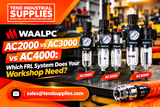
WAALPC AC2000 vs AC3000 vs AC4000: Which FRL System Does Your Workshop Need?
WAALPC AC2000 compact FRL and AC4000 higher-flow FRL. Match body size, port and flow to the comp...
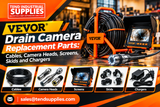
VEVOR Drain Camera Replacement Parts: Cables, Camera Heads, Screens, Skids and Chargers
A complete VEVOR drain-camera system includes model-specific electronic, cable and camera-head com...

Why Industrial Suppliers Are Finally Ditching Spreadsheets for Real Systems
Why Industrial Suppliers Are Finally Ditching Spreadsheets for Real Systems Walk into most tool dist...

The Technical Evolution of Automotive Electronics: Why Professional Dashcam Hardwiring is No Longer Optional
Why Professional Dashcam Hardwiring is No Longer Optional The automotive industry is undergoing a m...