
How To Size an FRL Unit: A 5-Step Engineering Method for Industrial Buyers

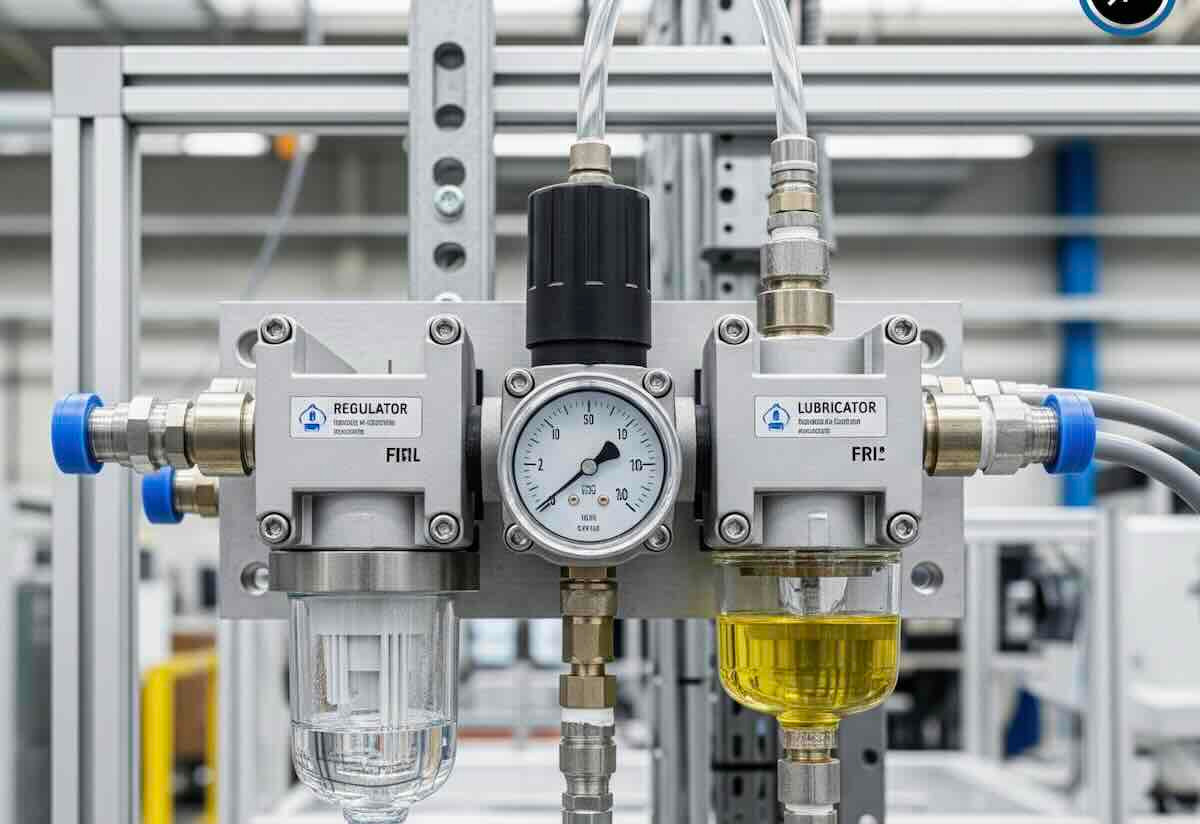
How To Size an FRL Unit:
FRL Sizing: Quick Answer
To size an FRL (Filter, Regulator, Lubricator) correctly, calculate the total Standard Cubic Feet per Minute (SCFM) air consumption of all downstream equipment running simultaneously, apply a safety margin of $1.5\times$ to $2\times$, and match this final flow requirement against the manufacturer’s flow curves at your target working pressure.
Most mid-sized industrial or automotive shops require a 200-body or 300-body FRL system equipped with $3/8\text{"}$ or $1/2\text{"}$ NPT port sizes to prevent restrictive pressure drops.
The 30-Second Rule
If you need a rapid, baseline estimate: sum the manufacturer-rated SCFM consumption values of every pneumatic tool that could run concurrently, multiply that total by $1.5$, and select the smallest FRL unit in our catalog rated to handle at least that calculated flow. For a robust, engineered system that avoids pressure drop and premature component wear, follow our detailed 5-step engineering method below.
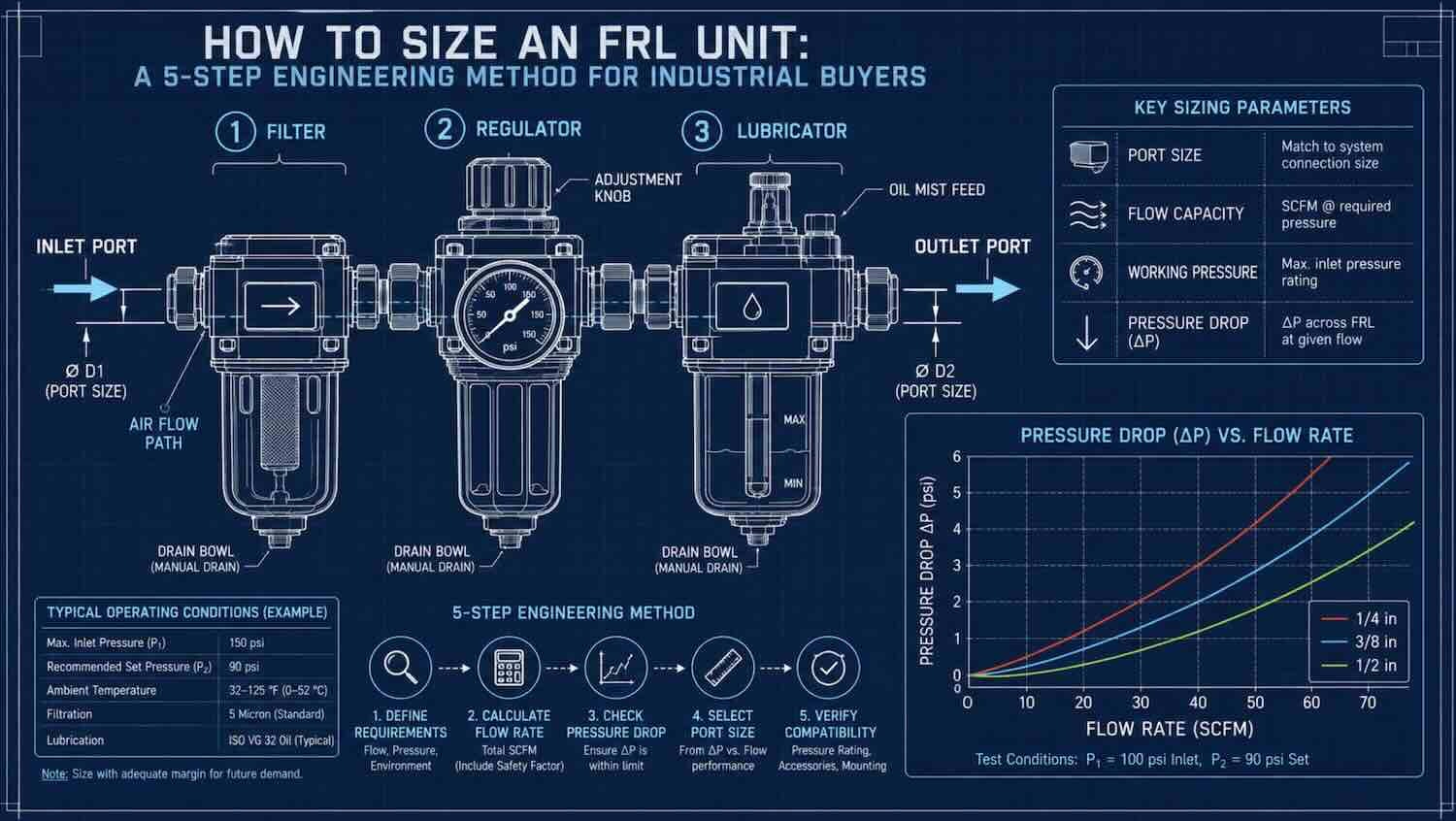
Why Sizing Your FRL Correctly Matters
Sizing an FRL is an exercise in balancing pneumatic efficiency, tooling life, and capital cost. If you have already reviewed our baseline guide, What Is an FRL System? A Practical Guide for Industrial Buyers, you understand that these components are highly interactive. Choosing the wrong size disrupts this synergy.
What Happens When an FRL Is Undersized
An undersized FRL acts as a severe bottleneck within your air line.
- Severe Pressure Drop ($\Delta P$): As air velocity increases through a restrictive orifice, pressure downstream drops sharply. Tools lose torque and speed.
- Regulator Chattering: The air regulator diaphragm oscillates rapidly (chatters) attempting to stabilize high-velocity air, accelerating mechanical fatigue.
- Filter Element Overload: High velocities pull moisture and particles straight through the air filter element rather than allowing centrifugal separation to work, quickly clogging the cartridge.
- Inadequate Lubrication: Air velocity outside design specs fails to generate the venturi effect needed for the air lubricator to atomize oil, leaving downstream cylinders dry.
What Happens When an FRL Is Oversized
While less damaging than undersizing, oversized units present distinct problems:
- Unnecessary Capital Expense: Large industrial-grade FRLs can cost significantly more than properly matched units.
- Sluggish Regulator Response: Large-area diaphragms react more slowly to micro-fluctuations in flow, causing pressure hunting during low-flow cycles.
- Lubricator Low-Flow Dropout: If downstream flow drops below the minimum threshold required by an oversized lubricator, the pressure drop across the venturi nozzle becomes too low to lift oil up the siphon tube.
Key Terms You Need to Know
Before beginning calculations, it is critical to align on standardized pneumatic terminology:
SCFM vs. CFM
- CFM (Cubic Feet per Minute): Measures the physical volume of air moving through a pipe at actual operating pressure and temperature. Because air is highly compressible, a CFM rating without pressure context is functionally meaningless for specification.
- SCFM (Standard Cubic Feet per Minute): Corrects the volumetric flow rate to standard conditions: $14.7\text{ psia}$ of pressure, $68^\circ\text{F}$ temperature, and $36\%$ relative humidity. Always use SCFM when sizing an FRL. Manufacturers publish engineering ratings and flow curves exclusively in SCFM.
Pressure Drop ($\Delta P$)
The net loss of air pressure between the inlet and outlet ports of the FRL assembly under dynamic flow conditions. While static pressure (no air flowing) remains equal across the system, dynamic pressure drops as air encounters restriction inside filters, regulator valves, and lubricators. An acceptable target pressure drop across a complete air preparation system is $\leq 5\text{ psi}$ ($\approx 0.34\text{ bar}$) at peak dynamic flow.
Safety Factor
A multiplier applied to calculated demand to account for unknown future loads, worn seals, simultaneous peak demands, and measurement uncertainty. For FRL sizing, 1.5× to 2× is standard.
Working Pressure vs. Set Pressure
- Working Pressure: The actual dynamic pressure required at the tool inlet to perform work (e.g., $90\text{ psig}$ for an impact wrench under load).
- Set Pressure: The target pressure adjusted at the regulator dial. To guarantee $90\text{ psig}$ working pressure at a tool downstream, the regulator must be adjusted to a higher set pressure (e.g., $93\text{ to }95\text{ psig}$) to offset line losses and FRL pressure drop.
The 5-Step FRL Sizing Method
[Step 1: Calculate Demand] --> [Step 2: Apply Safety Factor] --> [Step 3: Size Port] --> [Step 4: Check Flow Curve] --> [Step 5: Pick Body Size]
Step 1 — Calculate Total Air Demand (SCFM)
Identify every tool, actuator, and air-consuming device located downstream of your proposed FRL site. Note their average and peak consumption ratings in SCFM.
Baseline Tool Consumption Reference
|
Tool / Device |
Average Air Consumption (SCFM) |
Continuous Duty Rating |
|
$1/2\text{"}$ Impact Wrench |
$5$ |
Low (Intermittent) |
|
$3/8\text{"}$ Impact Wrench |
$3$ |
Low (Intermittent) |
|
Pneumatic Die Grinder |
$4$ |
High (Continuous) |
|
Paint Spray Gun (HVLP) |
$8$ |
High (Continuous) |
|
Industrial Blow Gun |
$2$ |
Low (Intermittent) |
|
Pneumatic Air Drill |
$4$ |
Medium (Intermittent) |
|
Heavy-Duty Tire Inflator |
$2$ |
Low (Intermittent) |
To compute cumulative demand, do not simply sum every tool in the facility. Instead, evaluate realistic simultaneous operations:
- Single-Tool Lines: Sizing matches the peak rating of that specific tool.
- Multi-Tool Lines (Simultaneous Factor): Estimate how many tools will actually run at the exact same split-second.
$$\text{Peak Demand} = \sum (\text{Tool SCFM} \times \text{Simultaneous Factor})$$
Example: An automotive service bay where one mechanic is operating a $3/8\text{"}$ impact wrench ($3\text{ SCFM}$) while a secondary air line operates a pneumatic die grinder ($4\text{ SCFM}$) simultaneously:
$$\text{Peak Demand} = 3\text{ SCFM} + 4\text{ SCFM} = 7\text{ SCFM}$$
Step 2 — Apply a Safety Factor
Multiply your dynamic peak demand by a safety factor of $1.5$ (standard industrial shop) or $2.0$ (critical automation lines or heavy-duty environments).
$$\text{Sized Flow Demand} = \text{Peak Demand} \times \text{Safety Factor}$$$$\text{Sized Flow Demand (Standard)} = 7\text{ SCFM} \times 1.5 = 10.5\text{ SCFM}$$$$\text{Sized Flow Demand (Industrial)} = 7\text{ SCFM} \times 2.0 = 14\text{ SCFM}$$
Step 3 — Determine Required Port Size
Use the guide below to match your sized SCFM requirements to an NPT thread configuration. This ensures the air velocity through the ports remains below critical thresholds, preventing sonic choking.
|
Sized Flow Demand (SCFM) |
Recommended Port Size (NPT) |
|
$< 15\text{ SCFM}$ |
$1/4\text{"}$ |
|
$15 \text{ to } 40\text{ SCFM}$ |
$3/8\text{"}$ |
|
$40 \text{ to } 90\text{ SCFM}$ |
$1/2\text{"}$ |
|
$90 \text{ to } 150\text{ SCFM}$ |
$3/4\text{"}$ |
|
$> 150\text{ SCFM}$ |
$1\text{"}$ or larger |
For our auto bay example ($10.5\text{ to }14\text{ SCFM}$), a $1/4\text{"}$ or $3/8\text{"}$ NPT port size is ideal.
Step 4 — Check Pressure Drop at Set Pressure
Locate the manufacturer's flow coefficient ($Cv$) or published flow characteristic curve for the specific FRL body size.
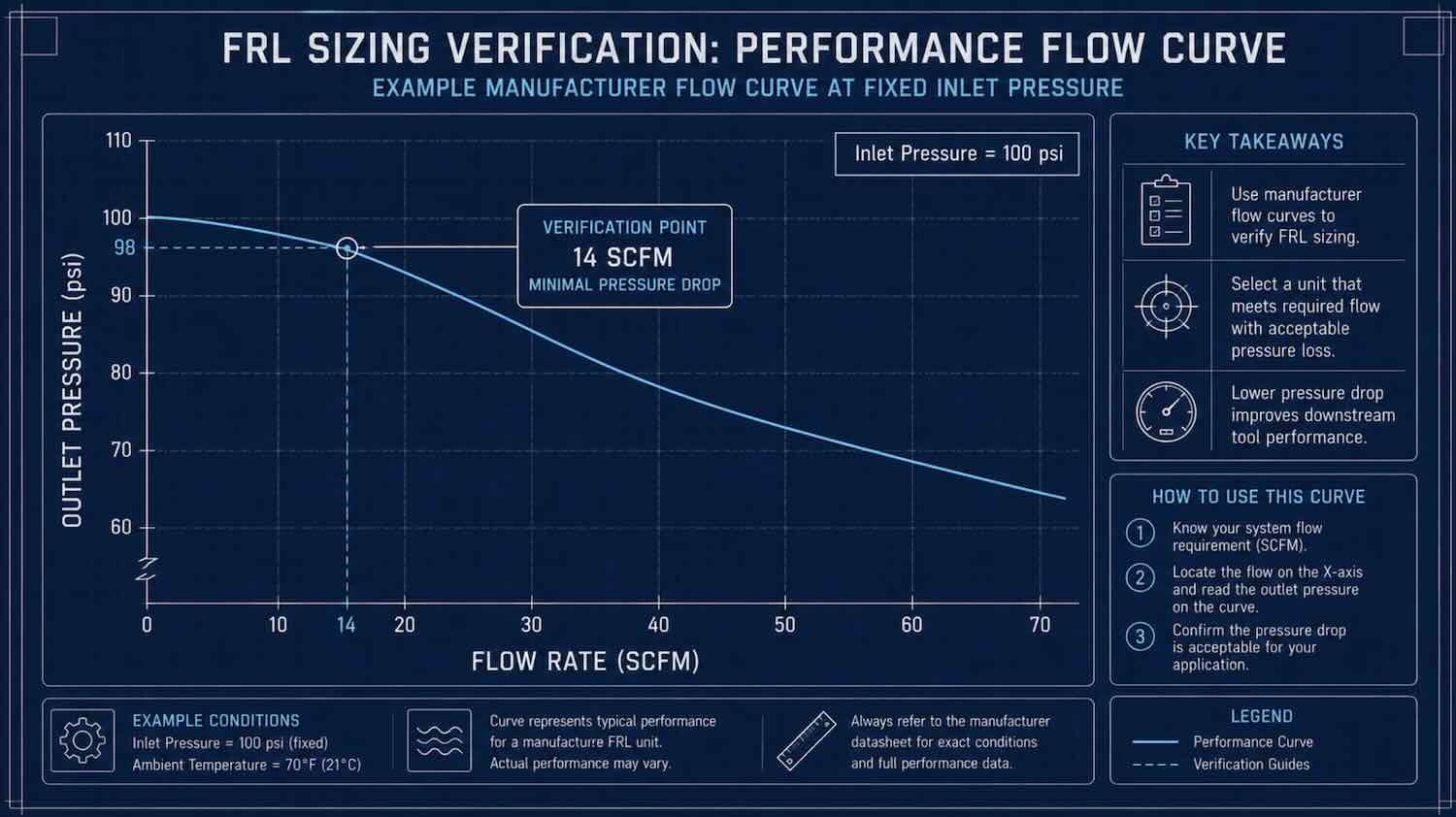
For a standard WAALPC 200-body unit equipped with $1/4\text{"}$ NPT ports, working with an inlet pressure of $100\text{ psig}$ and set pressure of $90\text{ psig}$ at $14\text{ SCFM}$, the expected pressure drop is $\approx 2\text{ psi}$ ($0.14\text{ bar}$). This sits safely within the $\leq 5\text{ psi}$ industrial threshold.
Step 5 — Select Body Size (Mini, 200, 300, 400)
Select the FRL body chassis that matches your dynamic demands and application envelope:
|
Body Size |
Flow Capacity Range |
Primary Application |
|
Mini |
Up to $15\text{ SCFM}$ |
Point-of-use isolation, mobile service rigs, single-tool lines |
|
200 Series |
Up to $50\text{ SCFM}$ |
Small commercial bays, light packaging cells, assembly lines |
|
300 Series |
Up to $150\text{ SCFM}$ |
Mid-sized machine shops, multi-cylinder automated equipment |
|
400 Series |
Up to $300\text{ SCFM}$ |
High-flow plant distribution lines, heavy fabrication centers |
Example Resolution: For our automotive bay running at a maximum scaled flow of $14\text{ SCFM}$, the WAALPC 200 Series with 3/8" NPT ports provides the perfect operational sweet spot, leaving generous headroom for tool upgrades.
Worked Example 1 — Sizing an FRL for an Auto Shop
Tool Inventory and Demand
We are sizing a system for a 4-bay automotive repair shop. Each individual bay contains:
- $1 \times 1/2\text{"}$ Impact Wrench ($5\text{ SCFM}$ intermittent)
- $1 \times 3/8\text{"}$ Impact Wrench ($3\text{ SCFM}$ intermittent)
- $1 \times$ Die Grinder ($4\text{ SCFM}$ continuous)
- $1 \times$ Tire Inflator ($2\text{ SCFM}$ intermittent)
- $1 \times$ Blow Gun ($2\text{ SCFM}$ intermittent)
Calculation Walkthrough
- Per-Bay Point-of-Use Sizing: Realistic worst-case simultaneous operation per bay is one technician running an impact wrench while a secondary tool or blow gun is used briefly.
$$\text{Peak Demand}_{\text{bay}} = 5\text{ SCFM (Impact)} + 4\text{ SCFM (Grinder)} = 9\text{ SCFM}$$$$\text{Sized Flow}_{\text{bay}} = 9\text{ SCFM} \times 1.5\text{ (Safety Factor)} = 13.5\text{ SCFM}$$
Port and Body Choice: $3/8\text{"}$ NPT, 200 Series. - Central Header Sizing (Sizing at the Compressor): It is highly statistically improbable that all 4 bays will pull maximum air at the exact same split-second. We apply a simultaneous diversity factor of $70\%$ to the combined peak bays:
$$\text{Peak Demand}_{\text{shop}} = (9\text{ SCFM/bay} \times 4\text{ bays}) \times 0.70 = 25.2\text{ SCFM}$$$$\text{Sized Flow}_{\text{shop}} = 25.2\text{ SCFM} \times 1.5\text{ (Safety Factor)} = 37.8\text{ SCFM}$$
Port and Body Choice: $1/2\text{"}$ NPT, 400 Series.
Recommended FRL Configurations
- Per Bay (Point-of-Use): WAALPC 200-Series ($3/8\text{"}$ NPT) pre-assembled compact combination unit.
- At Compressor Outlet: WAALPC 400-Series ($1/2\text{"}$ NPT) high-flow modular FRL system.
Worked Example 2 — Sizing an FRL for a Manufacturing Cell
Cylinder and Valve Inventory
A high-speed packaging machine features:
- $4 \times$ Double-acting pneumatic cylinders ($2\text{"}$ bore, $4\text{"}$ stroke, operating at $60\text{ cycles/min}$ at a working pressure of $90\text{ psig}$).
- $8 \times$ Solenoid control valves (combined pilot consumption of $4\text{ SCFM}$).
- $2 \times$ Continuous air blow-off nozzles ($2\text{ SCFM}$ each = $4\text{ SCFM}$ total).
- $1 \times$ Venturi vacuum generator ($6\text{ SCFM}$ continuous).
Calculation Walkthrough
First, we must calculate the actual dynamic SCFM demand of the double-acting cylinders.
- Calculate Cylinder Volume ($V_c$) per cycle: A double-acting cylinder consumes compressed air on both the extension and retraction strokes.
$$D = 2\text{ in} \implies \text{Area } (A) = \frac{\pi \cdot D^2}{4} = \frac{\pi \cdot 2^2}{4} \approx 3.1416\text{ sq. in}$$$$\text{Stroke Volume } (V_s) = A \cdot \text{Stroke } (L) = 3.1416 \cdot 4 = 12.566\text{ cubic inches}$$$$\text{Total Cycle Volume } (V_{\text{cycle}}) = V_s \times 2 = 25.132\text{ cubic inches per cycle}$$ - Calculate Free Air Volume at 60 Cycles per Minute:
$$\text{Uncompressed CFM} = \frac{25.132\text{ cu. in/cycle} \times 60\text{ cycles/min}}{1728\text{ (convert to cubic feet)}} \approx 0.873\text{ CFM of compressed air}$$ - Convert to Standard Conditions (SCFM) at $90\text{ psig}$ ($104.7\text{ psia}$):
$$\text{SCFM} = \text{CFM} \cdot \left(\frac{P_{\text{gauge}} + 14.7}{14.7}\right) = 0.873 \cdot \left(\frac{90 + 14.7}{14.7}\right) \approx 6.22\text{ SCFM per cylinder}$$$$\text{Total For 4 Cylinders} = 6.22\text{ SCFM} \times 4 = 24.88\text{ SCFM}$$ - Aggregate System Peak Demand:
$$\text{Total Peak} = 24.88\text{ SCFM (Cylinders)} + 4\text{ SCFM (Valves)} + 4\text{ SCFM (Blow-offs)} + 6\text{ SCFM (Vacuum)} \approx 38.88\text{ SCFM}$$$$\text{Sized Flow Demand} = 38.88\text{ SCFM} \times 1.5\text{ (Safety Factor)} \approx 58.32\text{ SCFM}$$
Recommended FRL Configurations
- System Choice: The scaled demand of $58.32\text{ SCFM}$ requires a $1/2\text{"}$ NPT port interface.
- Component Selection: To ensure the highest level of component protection, specify the WAALPC Modular B-Series 400. Utilizing separate, high-flow modular components ensures quick servicing of individual stages without breaking downstream piping connections.
FRL Sizing Chart by Application
Use this comprehensive index for quick, application-specific reference:
|
Application |
Peak Flow Range (SCFM) |
Recommended Body Size |
Recommended Port Size (NPT) |
Recommended Component Category |
|
Handheld Pneumatic Tools (Impacts, Drills) |
$5 \text{ to } 15$ |
Mini / 200 |
$1/4\text{"}$ |
Air Filters & Mini Regulators |
|
Single-Bay Auto Service Shop |
$10 \text{ to } 20$ |
200 |
$3/8\text{"}$ |
Compact Integrated Combinations |
|
Central Header (4-Bay Shop) |
$30 \text{ to } 60$ |
400 |
$1/2\text{"}$ |
High-Capacity Modular FRL Systems |
|
Light Packaging Automation Cells |
$20 \text{ to } 50$ |
300 |
$3/8\text{"}$ |
SMC Alternatives / Drop-In Modular Units |
|
Heavy Manufacturing & Assembly |
$50 \text{ to } 150$ |
400 |
$1/2\text{"}$ or $3/4\text{"}$ |
Industrial Air Preparation Systems |
|
Main Plant Air Distribution Headers |
$100+$ |
400+ |
$3/4\text{"}$ or $1\text{"}$ |
Specialized High-Volume Manifolds |
|
Paint & Powder Coating Booths |
$15 \text{ to } 40$ |
200 / 300 |
$3/8\text{"}$ |
Coalescing Air Filters & Air Regulators (No Lubricator) |
|
Food & Beverage Packaging |
$20 \text{ to } 80$ |
300 / 400 |
$1/2\text{"}$ |
Sterile Grade Filter-Regulators (No Lubricator) |
Common FRL Sizing Mistakes
1. Forgetting Simultaneous Demand (Worst-Case Sizing)
Sizing your FRL by adding up the maximum theoretical SCFM rating of every single tool in the facility results in massive over-sizing, wasted budget, and low-flow lubricator drop-out. Conversely, assuming only one tool runs at a time starves the facility.
- The Fix: Apply a real-world simultaneity factor based on the maximum number of operators working concurrently.
2. Ignoring Pressure Drop Curves
Many specifiers assume that if a manufacturer labels a regulator with "$1/2\text{"}$ NPT Ports," it is automatically suitable for all $1/2\text{"}$ system demands. A $1/2\text{"}$ NPT regulator running at its absolute limit may experience a massive, energy-wasting $\Delta P$ of over $15\text{ psi}$.
- The Fix: Always verify the flow curve to ensure your operating point resides within the flat, low-resistance zone of the curve ($\Delta P \leq 5\text{ psi}$).
3. Sizing for Static Instead of Dynamic Flow
Setting system pressure when tools are off (static state) is highly misleading. Once tooling triggers, air flow begins, and restrictions drop the pressure dynamically.
- The Fix: Size FRL flow parameters using dynamic air consumption, and adjust regulator set-pressure while the tool is operating under full structural load.
4. Forgetting Future Expansion
Installing an FRL matched exactly to your current, bare-minimum operational limit leaves no room for facility expansion. Adding a single sandblasting cabinet or high-flow valve cluster next year can choke your entire air preparation network.
- The Fix: Always scale your final system requirements with an additional $25\%$ to $50\%$ headroom to seamlessly accommodate growth.
FRL Sizing FAQs
How does inlet pressure affect FRL flow capacity?
Higher inlet pressures compress more air molecules into the same space, increasing the density of the fluid. This allows a higher SCFM volume to flow through the same FRL orifice with less resistance. Conversely, if your compressor operates at a low pressure (e.g., $70\text{ psig}$), you must oversize the FRL body to achieve your target SCFM without excessive pressure drop.
Can I mix port sizes on a modular FRL system?
Yes. Modular FRL systems offer modular spacer blocks and transition fittings. This allows you to construct a custom hybrid FRL—for example, utilizing a $1/2\text{"}$ filter for high fluid-capacity separation, stepping down to a $3/8\text{"}$ regulator for fine-tuned point-of-use control, and returning to $1/2\text{"}$ piping downstream.
Do I need a lubricator if I run oil-free pneumatic tools?
No. Many modern pneumatic valves, cylinders, and tools are pre-lubricated with grease and designed to operate completely oil-free. Injecting oil into these systems washes away the high-performance internal grease, forcing you to lubricate the system continuously for the rest of its operating life. Always verify tooling specs before selecting a 3-stage FRL system.
How do I size an FRL when replacing an SMC model?
When sourcing cost-effective SMC alternatives, you can easily map sizes by cross-referencing port threads and body profiles. For instance, SMC series AC2000, AC3000, and AC4000 units match directly with our standard WAALPC combination series in thread design, mounting orientation, and overall flow capability ($Cv$).
Use the Free FRL Sizing Calculator
Stop guessing and avoid manual computational errors. Tend Supplies provides an intuitive, web-based pneumatic sizing calculator that aggregates your tool roster, factors in system duty cycles, and suggests the exact WAALPC FRL system required for your application.
Launch the Tend Supplies FRL Sizing Calculator
Shop WAALPC FRLs by Size
Ready to secure high-performance, cost-effective air preparation systems? Explore Tend Supplies’ comprehensive collections:
- Shop 1/4" & 3/8" Point-of-Use Air Filters — Clean water and solid contaminants at individual stations.
- Shop High-Precision Air Regulators — Stop pressure fluctuations and stabilize dynamic tooling lines.
- Shop Industrial Air Lubricators — Deliver continuous, fine-mist oil protection to moving components.
- Browse Complete WAALPC FRL Systems — Browse modular and integrated assemblies engineered for industrial output.

Newest Guide & products Updates
Shinano 5-Inch Air Grinder Review: M14 vs 5/8-11 Spindle
Tend Industrial Knowledge Center / Product comparisons Looking for the best 5-inch air angle grinde...
Premium Air Impact Wrenches: Shinano vs CP, Dynabrade & Ingersoll Rand
Hero: original AI-generated editorial illustration; pictured tools are not exact product models. A s...

WAALPC AC2000 vs AC3000 vs AC4000: Which FRL System Does Your Workshop Need?
WAALPC AC2000 compact FRL and AC4000 higher-flow FRL. Match body size, port and flow to the comp...
VEVOR Drain Camera Replacement Parts: Cables, Camera Heads, Screens, Skids and Chargers
A complete VEVOR drain-camera system includes model-specific electronic, cable and camera-head com...

Why Industrial Suppliers Are Finally Ditching Spreadsheets for Real Systems
Why Industrial Suppliers Are Finally Ditching Spreadsheets for Real Systems Walk into most tool dist...

The Technical Evolution of Automotive Electronics: Why Professional Dashcam Hardwiring is No Longer Optional
Why Professional Dashcam Hardwiring is No Longer Optional The automotive industry is undergoing a m...