
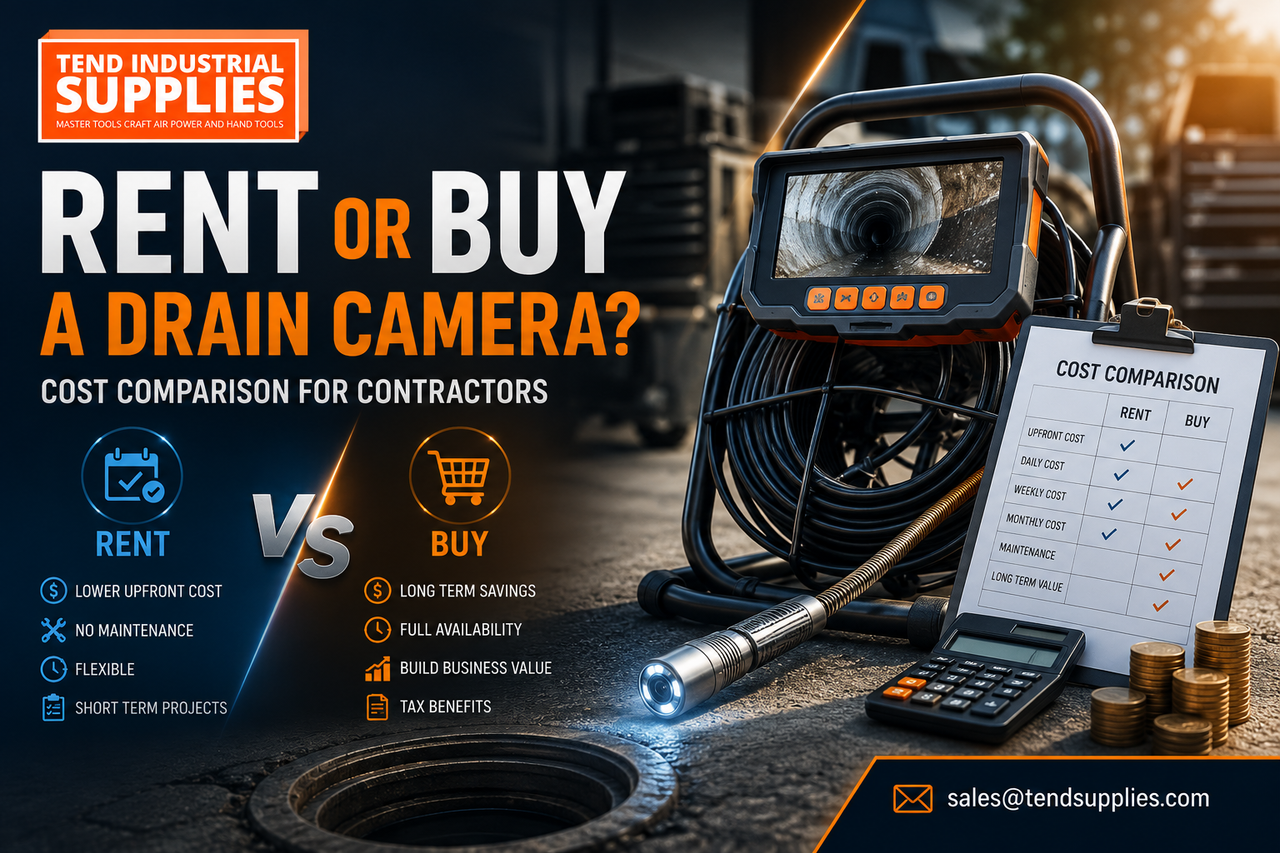
Rent or Buy a Drain Camera? Cost Comparison for Contractors

Last verified: July 30, 2026
Author: TendIndustrial Support Team
Quick answer: Rent a drain camera for occasional, unusual or one time inspections. Buy when the camera will be used repeatedly, must be available without delay or helps generate inspection revenue. The break even calculation should include accessories, repairs, technician time and rental pickup or shipping, not only the advertised daily rate.
Need a rental or purchasing recommendation? Tell Tend Industrial Supplies the pipe diameter, run length, access point, recording requirement and job dates.
Rent Versus Buy at a Glance
| Situation | Better choice | Reason |
|---|---|---|
| One confirmed job | Rent | Avoids capital tied up in idle equipment |
| Several inspections each month | Buy | Availability and repeated fees favor ownership |
| Unusual pipe size or very long run | Rent | Use specialized equipment for that job |
| Emergency service business | Buy | Immediate access protects response time |
| Testing a new service line | Rent first | Validates demand before purchase |
The True Cost of Renting
Rental cost includes the base period, additional days, deposit or authorization, tax, damage exposure, consumables, pickup time, delivery and return shipping. A low daily price can become expensive if the job is delayed or the equipment must remain on site over a weekend.
When Rental Creates Value
Rental is efficient when utilization is low, the required system is specialized or a contractor needs a backup while owned equipment is being repaired. It also allows a business to test whether customers will pay for video inspection and reporting.
Rental Risks
The correct camera may not be available on the job date. A rented unit also requires inspection, familiarization and careful return documentation. Damage charges can be significant when cables are kinked, camera heads are forced or equipment is returned dirty.
The True Cost of Ownership
Purchase cost is only the beginning. Include batteries or power supplies, skids, centering guides, storage, cleaning, cable repair, camera head replacement and eventual screen or recording problems. Ownership also requires procedures for inspection and maintenance after every job.
When Buying Creates Value
Buying is attractive when inspections are frequent, emergency availability matters or recorded findings help close higher value cleaning and repair work. A camera can become a revenue tool rather than only an expense when reports are priced and delivered consistently.
Ownership Risks
Underused equipment locks up cash. Buying the wrong cable length or camera head can also leave the contractor owning a tool that does not fit the actual work. Technology and customer reporting expectations may change before a lightly used unit pays for itself.
A Practical Break Even Formula
Use this calculation:
Break even jobs = Total first year ownership cost ÷ Avoided rental cost per job
Total first year ownership cost should include the camera, required accessories, expected maintenance and financing cost. Avoided rental cost should subtract any ownership specific labor or transport cost. Use conservative job volume, not the sales target.
Example
If a complete owned system costs $2,400 in the first year and renting the equivalent setup would cost $240 per job after all fees, the simple break even point is ten jobs. If ownership adds $40 of cleaning, maintenance and handling per job, the avoided rental cost is $200 and break even becomes twelve jobs. Replace these example numbers with actual quotations.
Specification Questions Before Either Decision
- What pipe diameters will be inspected?
- What is the longest realistic run?
- Is the line straight, branched or heavily curved?
- Must the camera be self leveling?
- Are distance counting and location required?
- Does the customer need photographs, video or a narrated report?
- Is the system waterproof to the required use condition?
- Which skids and guides are included?
- Who pays for return shipping or damage?
Choose by Business Model
General Contractor
Rent when inspections are occasional and subcontracted plumbing remains the norm. Buy only if camera work will be performed repeatedly and staff will be trained.
Drain Cleaning Contractor
Ownership usually becomes more valuable because inspection is closely tied to daily work, proof of condition and upselling repair or maintenance services.
Property Maintenance Company
Calculate volume across all managed properties. Rental can work for rare events, while ownership supports faster response if backups and blockages are frequent.
New Service Business
Rent for the first several paid jobs, record demand and job conditions, then buy the specification proven by real work. This reduces the risk of buying on assumptions.
How to Protect the Investment
Train operators not to use the push cable as a drain clearing tool. Clean and dry the system after use, inspect the cable for kinks, use the correct skid, protect connectors and document condition. For rentals, photograph the equipment at pickup and return and follow the supplier’s cleaning rules.
Final Recommendation
Rent when utilization is uncertain or the project needs a special configuration. Buy when repeated demand, emergency availability and inspection revenue justify ownership. Use a twelve month cost model and confirm the pipe, distance and reporting requirements before choosing a specific system.
Review the TendSupplies buying guides or request a drain camera quote or rental recommendation.
Frequently Asked Questions
How many jobs justify buying a drain camera?
Divide first year ownership cost by the net rental cost avoided per job. Use realistic utilization and include maintenance.
Should a new contractor rent first?
Usually yes. Several paid rentals reveal the cable length, head size and reporting features customers actually require.
What rental costs are often missed?
Delivery, return shipping, extra days, tax, cleaning, accessories, travel time and damage exposure.
Can a drain camera cable clear a blockage?
No. The push cable is an inspection component, not a drain cleaning cable. Forcing it can kink the cable or damage the camera head.
What is the most important specification?
There is no single specification. Pipe diameter, run length, bends, access and reporting needs must be considered together.
When is ownership clearly better?
When frequent use, immediate availability and inspection revenue outweigh purchase, maintenance and downtime costs.

Newest Guide & products Updates
Shinano 5-Inch Air Grinder Review: M14 vs 5/8-11 Spindle
Tend Industrial Knowledge Center / Product comparisons Looking for the best 5-inch air angle grinde...
Premium Air Impact Wrenches: Shinano vs CP, Dynabrade & Ingersoll Rand
Hero: original AI-generated editorial illustration; pictured tools are not exact product models. A s...
WAALPC AC2000 vs AC3000 vs AC4000: Which FRL System Does Your Workshop Need?
WAALPC AC2000 compact FRL and AC4000 higher-flow FRL. Match body size, port and flow to the comp...
VEVOR Drain Camera Replacement Parts: Cables, Camera Heads, Screens, Skids and Chargers
A complete VEVOR drain-camera system includes model-specific electronic, cable and camera-head com...

Why Industrial Suppliers Are Finally Ditching Spreadsheets for Real Systems
Why Industrial Suppliers Are Finally Ditching Spreadsheets for Real Systems Walk into most tool dist...
The Technical Evolution of Automotive Electronics: Why Professional Dashcam Hardwiring is No Longer Optional
Why Professional Dashcam Hardwiring is No Longer Optional The automotive industry is undergoing a m...