
Oil Drain Plug Sizes and Removal Tool Buying Guide

Last verified: July 30, 2026
Author: TendIndustrial Support Team
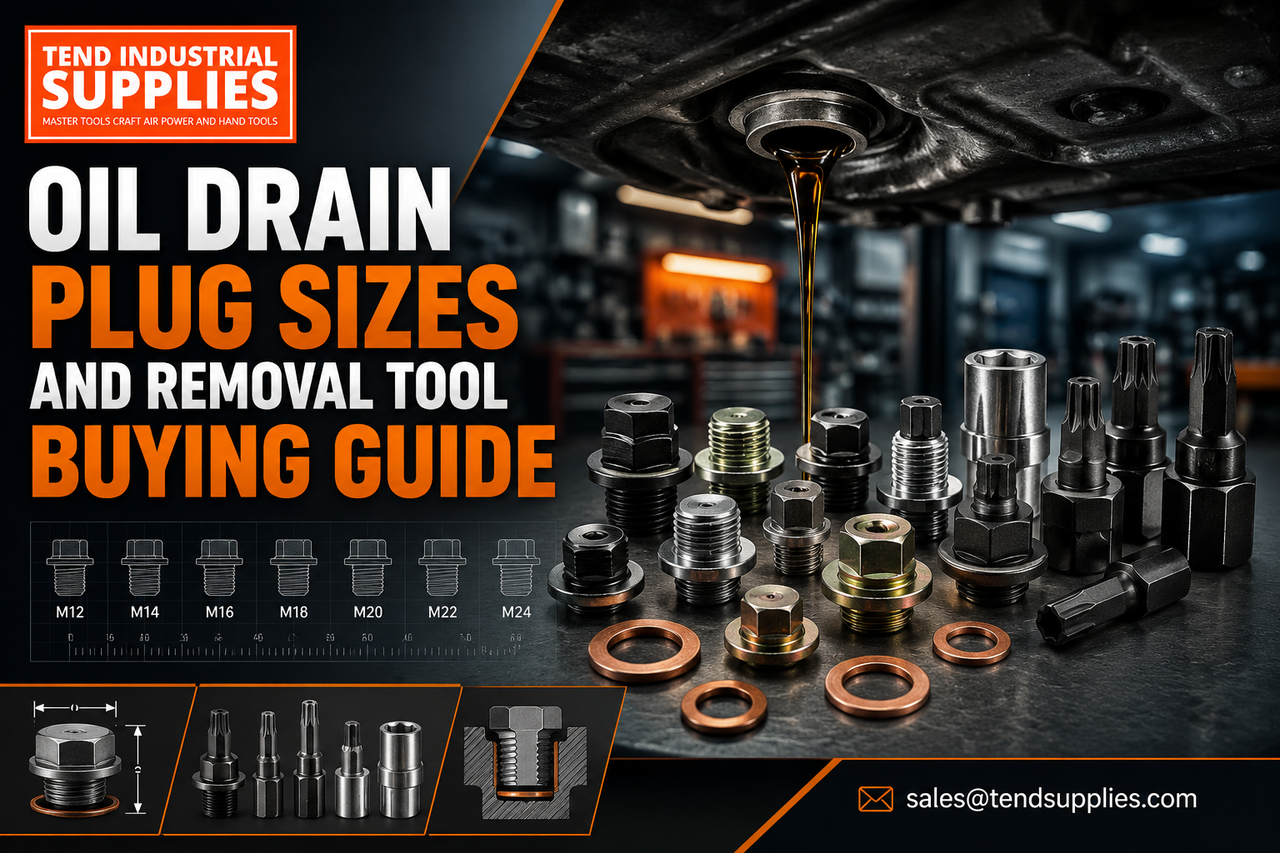
Quick answer: Oil drain plugs are not universal. Match four details before buying: thread diameter, thread pitch, threaded length and sealing method. The wrench or socket size describes the head, not the thread. Confirm the vehicle specification or measure a known correct plug before ordering.
For tool or plug selection help, send the year, make, model, engine and plug measurements to Tend Industrial Supplies.
The Four Measurements That Must Match
Thread Diameter
Metric threads are commonly described with an M designation, while inch threads use fractional diameters. A head that accepts the same socket can still have a completely different thread diameter.
Thread Pitch
Metric pitch is the distance between thread peaks in millimeters. Inch threads are commonly described by threads per inch. A plug can begin threading into the wrong pitch and then damage the pan, so never judge by the first turn alone.
Threaded Length
A plug that is too short may not engage enough sound thread. One that is too long can interfere with internal components or bottom out before sealing. Match the original specification.
Sealing Method
Some plugs use a crush washer, bonded seal or reusable gasket. Others seal with a tapered or machined seat. The correct plug with the wrong sealing method can leak.
Head Size Is Not Thread Size
The hex head determines the socket or wrench. The threaded shank determines fit in the oil pan. Two plugs with identical heads may use different threads, and two plugs with the same thread may have different heads. Record both sets of information.
| What you are identifying | Tool | Why it matters |
|---|---|---|
| External hex head | Caliper or test fit six point socket | Selects removal tool |
| Thread diameter | Caliper | Matches pan opening |
| Thread pitch | Thread pitch gauge | Prevents cross threading |
| Threaded length | Caliper or ruler | Ensures correct engagement |
| Seat or washer | Visual comparison | Controls sealing |
How to Identify an Unknown Plug
- Check the service information or reliable parts catalog using the VIN and engine.
- Compare the removed plug with a verified replacement.
- Measure the major thread diameter across the outside peaks.
- Use a pitch gauge instead of guessing.
- Measure threaded length from the sealing surface to the tip.
- Identify whether the plug uses a washer, gasket, flange or tapered seat.
- Confirm the required torque in vehicle service information.
Choosing the Correct Removal Tool
External Hex Plug
Use an exact size six point socket. A shallow socket often keeps force close to the plug, while the available access may require a longer socket or extension. Keep the tool square.
Internal Hex or Torx Plug
Clean debris from the recess and seat the bit fully. A partially inserted bit concentrates force at the opening and can round the recess quickly.
Rounded External Head
Use a spiral extraction socket sized to bite securely. Avoid repeated attempts with an oversized socket, adjustable wrench or pliers. Read our guide to removing stripped or stuck drain plugs.
Damaged Internal Drive
An internal extractor or carefully selected driven bit may work. The repair must account for pan material and access. Replace the damaged plug after removal.
Metric and SAE Identification
Do not convert a metric dimension to the nearest inch size and assume it is equivalent. Small differences matter on a tight fastener and thread pitch differences are critical. Use measured values and a verified catalog specification.
Washer and Gasket Selection
Crush washers deform to create a seal and are often replaced during service. Bonded seals combine metal and elastomer. Reusable gaskets should be inspected for damage or hardening. Never stack washers to compensate for the wrong plug length or damaged threads.
Torque and Installation
Clean the plug and pan seating surface. Start the plug by hand for several turns; resistance at the beginning suggests misalignment or wrong threads. Install the specified seal and tighten with a calibrated torque wrench to the vehicle specification. Check for leaks after filling and running the engine.
Buying Checklist
- Vehicle year, make, model and engine
- Thread diameter and pitch
- Threaded length
- Head or drive type and size
- Seat shape and washer type
- Oil pan material
- Manufacturer torque specification
Final Recommendation
Identify the thread and sealing system before selecting the removal tool or replacement plug. Use a six point socket for an undamaged external hex and an extractor only after the head is compromised. If the pan threads are damaged, treat it as a thread repair decision, not merely a plug purchase.
Browse automotive tools or ask TendSupplies to help match the tool.
Frequently Asked Questions
Are oil drain plugs universal?
No. Thread diameter, pitch, length, head and sealing design vary by vehicle and engine.
Is the socket size the same as the thread size?
No. Socket size describes the head. Thread size describes the shank that fits the oil pan.
Can I reuse the drain plug washer?
Follow the vehicle specification. Crush washers are commonly replaced, while some gasket designs may be reusable after inspection.
How do I measure thread pitch?
Use a thread pitch gauge and confirm the result against a reliable vehicle or parts specification.
What happens if the plug is too long?
It may bottom out, fail to seal or interfere internally. Match the specified threaded length.
How tight should the plug be?
Use the torque specified for the exact vehicle, engine, plug and pan. Do not rely on a universal value.

Newest Guide & products Updates
Shinano 5-Inch Air Grinder Review: M14 vs 5/8-11 Spindle
Tend Industrial Knowledge Center / Product comparisons Looking for the best 5-inch air angle grinde...

Premium Air Impact Wrenches: Shinano vs CP, Dynabrade & Ingersoll Rand
Hero: original AI-generated editorial illustration; pictured tools are not exact product models. A s...
WAALPC AC2000 vs AC3000 vs AC4000: Which FRL System Does Your Workshop Need?
WAALPC AC2000 compact FRL and AC4000 higher-flow FRL. Match body size, port and flow to the comp...
VEVOR Drain Camera Replacement Parts: Cables, Camera Heads, Screens, Skids and Chargers
A complete VEVOR drain-camera system includes model-specific electronic, cable and camera-head com...

Why Industrial Suppliers Are Finally Ditching Spreadsheets for Real Systems
Why Industrial Suppliers Are Finally Ditching Spreadsheets for Real Systems Walk into most tool dist...

The Technical Evolution of Automotive Electronics: Why Professional Dashcam Hardwiring is No Longer Optional
Why Professional Dashcam Hardwiring is No Longer Optional The automotive industry is undergoing a m...