
WAALPC AC2000 vs AC3000 vs AC4000: Which FRL System Does Your Workshop Need?

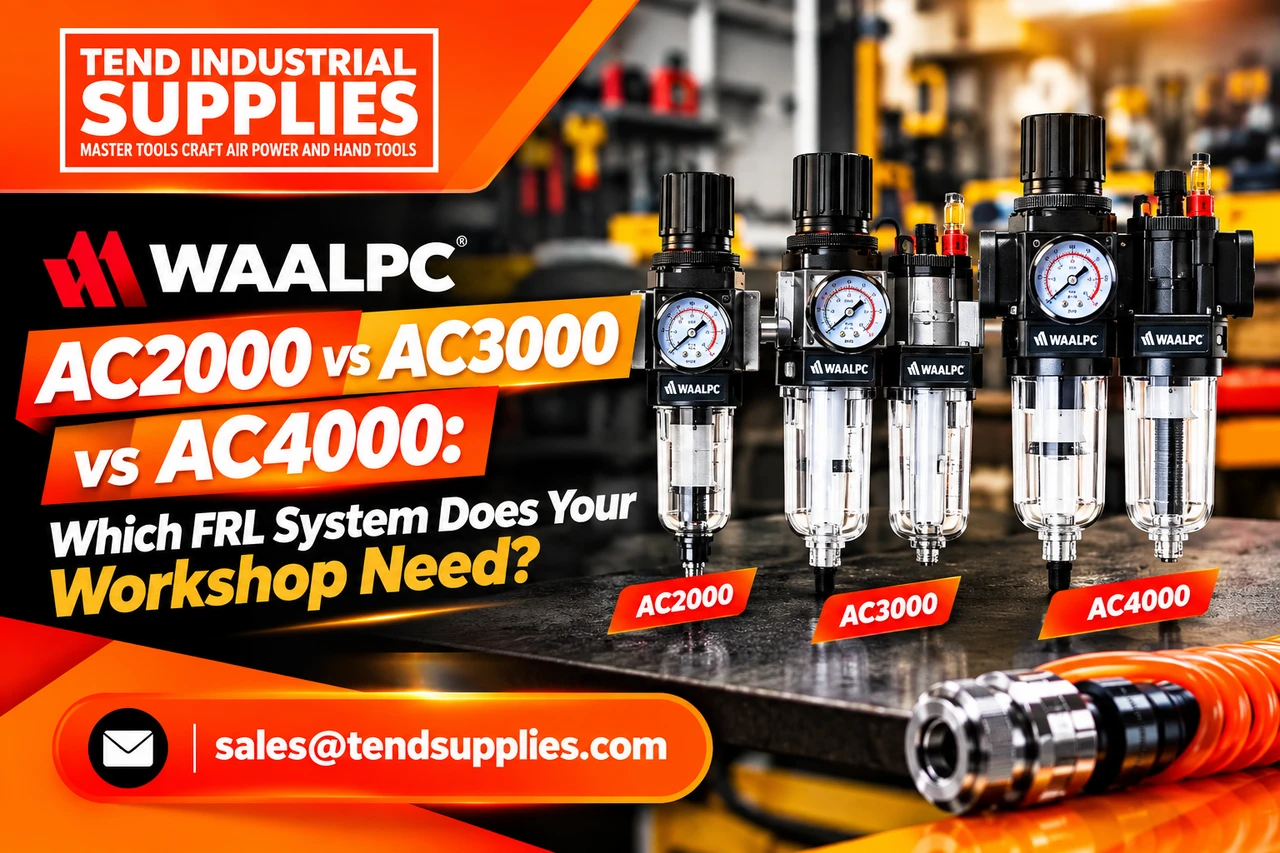
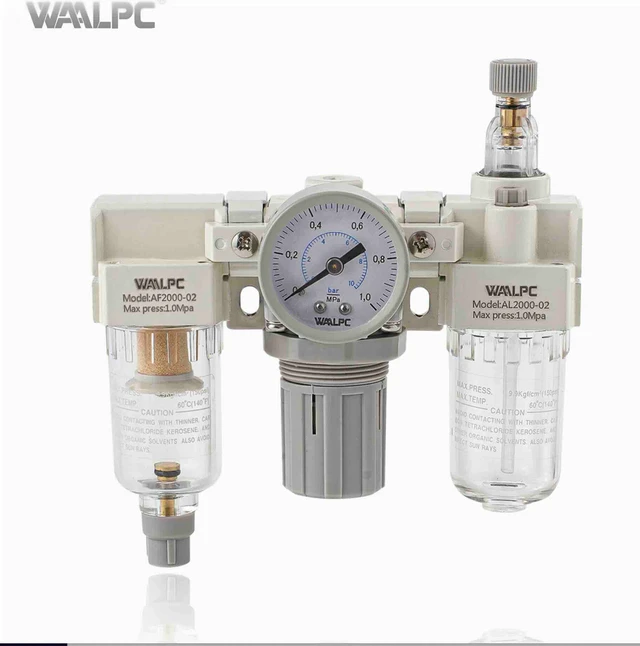
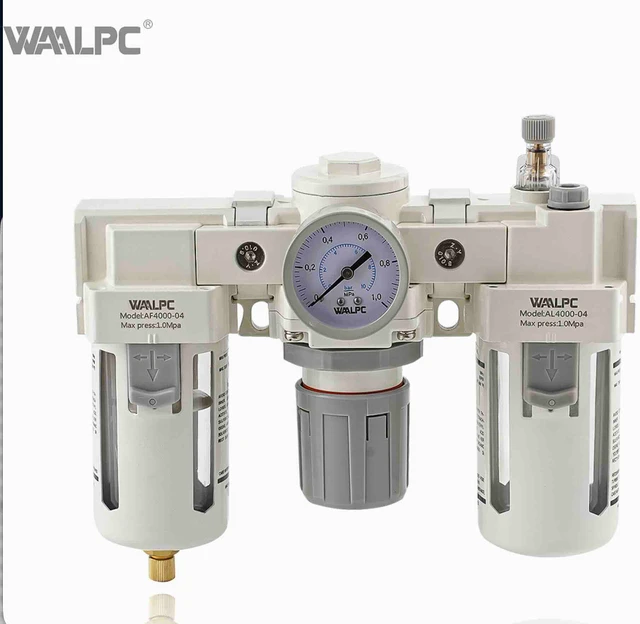
WAALPC AC2000 compact FRL and AC4000 higher-flow FRL. Match body size, port and flow to the complete workshop air system.
For a compact single-tool station or light service bay with a 1/4-inch connection, start with the WAALPC AC2000. Choose the manual-drain AC2000 when staff will inspect and empty the bowl routinely; choose the AC2000 auto-drain where condensate management needs less operator intervention. Move toward the AC3000 for a mid-size line only after confirming the required port, flow and pressure. Choose the AC4000-04 1/2-inch FRL for a higher-flow trunk, larger equipment or a multi-bay system where a compact 1/4-inch unit would create an avoidable restriction.
Fast selection: AC2000 manual for an attended compact station; AC2000 auto-drain where condensate may be neglected; AC4000 for higher-flow and multi-bay systems.
That is the short answer. The final choice must still be checked against compressor delivery, peak simultaneous air demand, allowable pressure drop, port thread, ambient conditions and downstream tool requirements.
Current TendSupplies offer, verified September 1, 2026:
- WAALPC AC2000-02 manual-drain 1/4-inch NPT, 5μm — $34.99.
- WAALPC AC2000-02D auto-drain 1/4-inch NPT, 5μm — $42.99.
- WAALPC AC4000-04 manual-drain 1/2-inch NPT, 5μm — $61.55.
Prices and availability must be rechecked on the product page before publication or promotion.
WAALPC AC2000, AC3000 and AC4000 at a glance
| Series | Position in the range | Typical connection class | Best starting use | Main buying risk |
|---|---|---|---|---|
| AC2000 | Compact | 1/4-inch on the current AC2000-02 offer | One work station, light-duty bay or point-of-use tool protection | Undersizing a busy line or high-demand tool |
| AC3000 | Mid-size | Verify the exact listed model and port | Intermediate flow where AC2000 is restrictive but AC4000 is unnecessary | Buying by series number without confirming port and rated flow |
| AC4000 | Higher-flow body | 1/2-inch on the current AC4000-04 offer | Larger equipment, trunk lines and multi-bay distribution | Assuming a larger port fixes undersized upstream piping or compressor capacity |
This table is a selection framework, not a substitute for the manufacturer’s model-specific flow curve. Port diameter alone does not establish usable flow at the pressure-drop limit your tools can tolerate.
What an FRL system does
An FRL combines three air-preparation functions:
- Filter: removes particulate contamination and separates bulk condensate.
- Regulator: reduces and stabilizes downstream pressure.
- Lubricator: introduces a controlled oil mist when the downstream equipment requires line lubrication.
A larger compressor does not remove the need for an FRL. Compressor output can still contain water, rust and pipe debris, while unregulated pressure can shorten tool life or produce inconsistent operation. Conversely, installing an FRL that is too small can create pressure drop and starve the tool of airflow.
When the WAALPC AC2000 is the right choice
The AC2000 is the compact option in this comparison. TendSupplies currently lists AC2000-02 combinations with a 1/4-inch NPT connection and 5-micron filtration.
Choose AC2000 for these applications
- A single pneumatic hand-tool connection.
- Tire inflation and intermittent service tasks.
- A compact workbench or maintenance station.
- A small compressor line already built around 1/4-inch connections.
- Point-of-use treatment close to a tool, provided the unit’s flow is adequate.
Do not select AC2000 by price alone
Impact wrenches, grinders, sanders and other continuous or high-demand tools can expose an undersized regulator or filter. Compare the tool’s required airflow and duty cycle with the complete air path. The hose, couplers, fittings and upstream pipe can cause as much restriction as the FRL.
AC2000 manual drain vs auto drain
| Decision factor | AC2000 manual drain | AC2000 auto drain |
|---|---|---|
| Current TendSupplies model | AC2000-02 | AC2000-02D |
| Current listed price | $34.99 | $42.99 |
| Drain approach | Operator empties collected condensate | Drain mechanism reduces routine manual emptying |
| Best fit | Attended station with a documented maintenance check | Busy or less-attended station where condensate may otherwise be ignored |
| Maintenance need | Simple, but depends on staff discipline | Still requires inspection; “auto” does not mean maintenance-free |
Choose manual drain when the bowl is easy to see and a daily or shift-based check will actually happen. Choose auto drain where the small price premium reduces the risk of neglected condensate. The auto-drain unit must still be installed, operated and inspected according to its instructions.
When to consider the WAALPC AC3000
The AC3000 occupies the middle of the body-size range. It can be a logical choice when calculated demand and allowable pressure drop exceed the practical capability of the compact series but do not justify the larger AC4000 installation.
Do not publish a fixed AC3000 port, pressure or flow claim until the exact TendSupplies product model is active and its specifications are verified. The series name can cover multiple configurations. Use the actual suffix, thread type, bowl, drain and gauge specification in the purchasing decision.
TendSupplies currently carries a 5-micron replacement filter element for WAALPC AC3000, AW3000 and AF3000 units, which supports maintenance of installed 3000-series equipment. The replacement element is not itself evidence that every AC3000 FRL configuration is stocked.
When the WAALPC AC4000 is the better choice
The current WAALPC AC4000-04 offer uses a 1/2-inch NPT connection and is positioned for higher-flow industrial applications. It is the stronger starting point for a larger main line, equipment with sustained air demand or multiple downstream stations.
Choose AC4000 when
- The distribution line is designed around a 1/2-inch connection.
- Several tools may operate at the same time.
- The system supplies a multi-bay workshop.
- Downstream equipment has sustained rather than intermittent air demand.
- Calculated pressure drop makes the compact unit unsuitable.
A larger FRL cannot fix every air problem
An AC4000 cannot compensate for an undersized compressor, long narrow hose, restrictive quick couplers, leaking pipework or a pressure setting that is too low. Diagnose the system as a complete flow path.
Which FRL fits each workshop setup?
| Workshop setup | Recommended starting point | Verification required |
|---|---|---|
| One light-duty service station | AC2000 manual drain | Tool SCFM, 1/4-inch port and maintenance routine |
| One station where condensate is frequently neglected | AC2000 auto drain | Drain operating conditions and tool SCFM |
| Mid-size equipment line | AC3000 candidate | Exact model, port, rated flow and pressure-drop curve |
| Busy multi-bay automotive shop | AC4000 candidate at the main treatment point | Simultaneous demand, 1/2-inch piping and downstream branch sizing |
| Paint preparation or critical clean-air process | Filter/regulator configuration selected for the process | Air-quality requirement; lubricated air may be unsuitable downstream |
| High-demand grinder or sander station | Size from actual continuous demand | Tool SCFM, duty cycle, hose ID, couplers and pressure loss |
For a detailed calculation process, use the five-step FRL sizing guide.
Seven checks before ordering
1. Calculate peak simultaneous airflow
Add the demand of tools that can operate at the same time and apply a realistic duty factor. Do not size a multi-bay line from the average consumption of one tool.
2. Confirm port thread and pipe size
“1/4 inch” and “1/2 inch” describe nominal connections, but the thread standard must also match. The current TendSupplies offers referenced here are listed as NPT.
3. Set an acceptable pressure-drop limit
Pneumatic tools may underperform even while the compressor tank gauge looks normal. Check pressure dynamically at the tool while it is operating.
4. Decide whether lubrication belongs in this line
Many pneumatic tools benefit from lubrication, but paint and other contamination-sensitive processes generally require clean, oil-free downstream air. Use separate branches or treatment stages when requirements conflict.
5. Choose the drain type
Match manual or automatic drainage to condensate load, staffing and maintenance discipline. Inspect either type routinely.
6. Plan replacement-element maintenance
A dirty filter element increases restriction. TendSupplies lists replacement 5-micron elements for WAALPC 3000- and 4000-series equipment, plus other supported models in the air-preparation collection.
7. Verify environmental limits
Confirm working pressure, temperature, bowl material compatibility and installation orientation from the exact product documentation before commissioning.
Common sizing mistakes
- Choosing the FRL solely by compressor horsepower.
- Matching only the thread size and ignoring rated flow.
- Sizing for one tool when several operate simultaneously.
- Installing small couplers or hose after a correctly sized FRL.
- Lubricating a branch that supplies paint or sensitive instrumentation.
- Treating an auto drain as maintenance-free.
- Assuming AC2000, AC3000 and AC4000 parts are interchangeable.
Frequently asked questions
Is AC4000 always better than AC2000?
No. AC4000 is a larger starting point for higher-flow systems, but it may be unnecessary for a compact point-of-use station. Correct sizing balances flow, pressure drop, port, space and maintenance.
Can AC2000 run an impact wrench?
It depends on the wrench’s airflow, duty cycle and the rest of the air path. Confirm dynamic pressure and flow rather than relying only on the 1/4-inch connection.
What is the difference between AC2000-02 and AC2000-02D?
The current TendSupplies listings distinguish the AC2000-02 manual-drain model from the AC2000-02D auto-drain model. Both are listed with 1/4-inch NPT connections and 5-micron filtration.
Where does AC3000 fit?
AC3000 is the mid-size series in this comparison. Select the exact model only after confirming its port, flow, pressure and drain specification. Do not infer all specifications from the series name.
Which unit should a multi-bay workshop start with?
AC4000 is the stronger starting candidate for a higher-flow main treatment point, but the final design must be based on simultaneous tool demand, piping and allowable pressure drop. Some shops may need treatment at both the main line and individual points of use.
Does a 5-micron filter remove all water and oil vapor?
No. A standard particulate/water-separating filter does not automatically deliver the air quality required for paint, breathing air or sensitive instrumentation. Those applications may require additional treatment designed for the process.
Can I replace an SMC AC2000 with a WAALPC AC2000?
Do not assume drop-in compatibility from the series number alone. Compare thread, port position, mounting, dimensions, pressure range, flow, drain, bowl and downstream requirements. The TendSupplies FRL sizing guide discusses series mapping, but model-level verification remains necessary.
How often should the filter element be replaced?
Use the manufacturer’s inspection criteria and monitor pressure drop, contamination and operating conditions. A visibly dirty element or increasing restriction requires attention even if a calendar interval has not elapsed.
Buy the right WAALPC FRL system
Use these three commercial routes:
- Compact attended station: Shop WAALPC AC2000 manual-drain FRL.
- Compact station needing automated drainage: Shop WAALPC AC2000 auto-drain FRL.
- Higher-flow or multi-bay line: Shop WAALPC AC4000 and air-preparation systems.
For a workshop bundle, volume order or sizing review, use the Tend Industrial Supplies contact page and provide compressor information, main-line size, tool list, operating pressure and number of simultaneous users.
Choose the FRL that protects airflow and tool performance
Shop compact AC2000 options or move to the AC4000 platform for higher-flow workshop systems.
Shop FRL Systems Request a Workshop Quote
Newest Guide & products Updates
Shinano 5-Inch Air Grinder Review: M14 vs 5/8-11 Spindle
Tend Industrial Knowledge Center / Product comparisons Looking for the best 5-inch air angle grinde...
Premium Air Impact Wrenches: Shinano vs CP, Dynabrade & Ingersoll Rand
Hero: original AI-generated editorial illustration; pictured tools are not exact product models. A s...
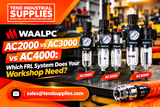
WAALPC AC2000 vs AC3000 vs AC4000: Which FRL System Does Your Workshop Need?
WAALPC AC2000 compact FRL and AC4000 higher-flow FRL. Match body size, port and flow to the comp...
VEVOR Drain Camera Replacement Parts: Cables, Camera Heads, Screens, Skids and Chargers
A complete VEVOR drain-camera system includes model-specific electronic, cable and camera-head com...

Why Industrial Suppliers Are Finally Ditching Spreadsheets for Real Systems
Why Industrial Suppliers Are Finally Ditching Spreadsheets for Real Systems Walk into most tool dist...

The Technical Evolution of Automotive Electronics: Why Professional Dashcam Hardwiring is No Longer Optional
Why Professional Dashcam Hardwiring is No Longer Optional The automotive industry is undergoing a m...